Students would transition from this closing North Philly school to worse-performing ones in the district’s plan
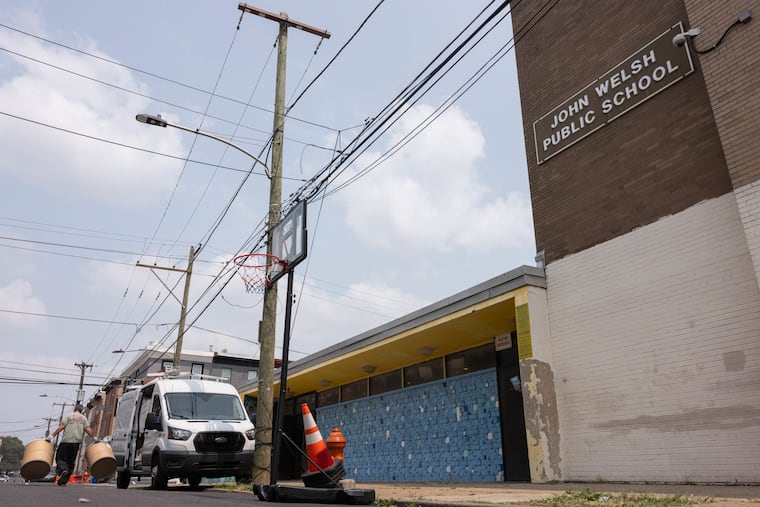
The district’s plan calls for the John Welsh Elementary School building to be upgraded and reopened as a new year-round high school in the 2029-30 school year.
Philadelphia School District officials said they considered poverty rates and prior school closings in a neighborhood when weighing which schools to close.
Each school had a score based on its surrounding neighborhood, and only one of 20 proposed closures is in a “very high risk” neighborhood: John Welsh Elementary.
Welsh, on the northern edge of the Norris Square neighborhood, has 185 K-8 students and operates at under a quarter of the building’s capacity. Enrollment has declined over the past several years and the school now holds an average of 20 students per grade, including only 9 second graders. About two-thirds of the students are Latino, and the other third are Black.
While it’s small and its building is not in good shape, it was not necessarily obvious that the district would target Welsh for closure — because so-called neighborhood vulnerability was a factor in officials’ decision-making.

Wholesale changes are coming to the Philadelphia School District, with the school board passing a $3 billion facilties plan that aims to close 17 schools permanently, and renovate 169.
Superintendent Tony B. Watlington Sr. presented the plan to the school board Feb. 26 and it immediately faced strong opposition. After some amendments, the board passed the plan April 30. Here's what we do and don't know about it.
And to see the proposed list school closures and check how your school could be impacted, use our interactive charts.
Each of the schools proposed for closure has its own story. Find them all here.
But Welsh parents and students argue the school shouldn’t be closed because its students were performing well, despite the lack of investment from the district, as well as the condition of the building and its surrounding neighborhood.
Kareemia Boyd, the parent of a Welsh eighth grader, credited the school with helping her son turn around his grades after he came from a charter school. She transitioned her son to Welsh in fifth grade, when his grades were suffering and he experienced bullying. Now poised to graduate this year, she said he gets A’s and B’s.
“I didn’t expect he would actually grow in so many ways,” she said at a recent community meeting about the closure plan.
The district’s draft plan calls for the Welsh building to be upgraded and converted into a new year-round high school which would open for the 2029-30 school year.
Current Welsh students would transition to John F. Hartranft School or William McKinley School. Hartranft and McKinley would receive new ADA investments and other renovations, Algebra I instruction, and pre-K programming, officials said.
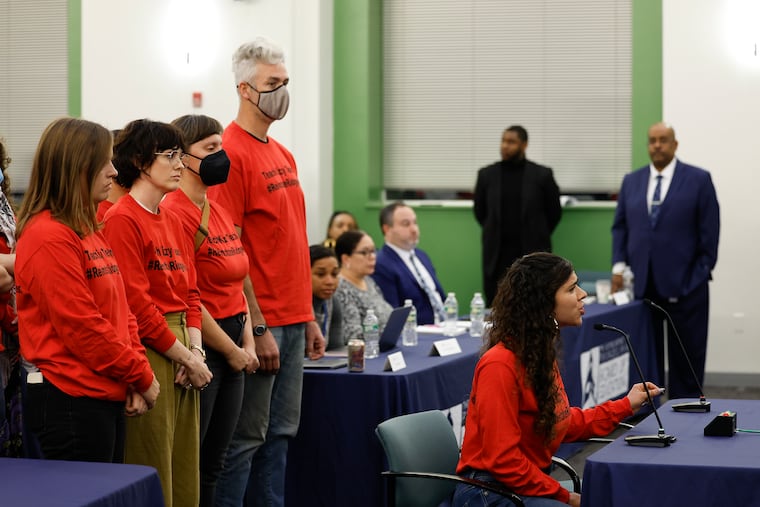
Several students asked district officials at the community meeting why they would be transitioned to Hartranft and McKinley, when those schools have performed worse academically than Welsh. About 14% of students at Hartranft and 10% of students at McKinley scored at least a proficient level on state English language arts exams last year, compared to 20% of Welsh students.
District representatives said they did not consider academic performance when deciding whether to close schools. Instead they focused on getting proper resources to students and schools, they said, which will be more feasible once schools are consolidated.
Boyd said her son’s teachers at Welsh pushed him to improve, and wouldn’t let him settle for less than what he was capable of. She appreciated how much they cared about him, and said they had “a big impact.”
“I want somebody to care about my kid as much as I do,” she said.
She said she believes the declining enrollment has to do with the school’s neighborhood. Boyd said people are concerned about crime and drugs, and don’t feel safe sending their kids to the school, particularly when school security is limited.
But for those who have stayed, Sary Rodriguez, a parent of current Welsh fifth and eighth graders, said it’s a community where everyone looks out for others.
“We all know each other. We all support each other. So it’s hurting a lot of people,” she said about the district’s plan.
Rodriguez also has a 19-year-old daughter who graduated from Welsh and works at the school. But Rodriguez said she’s considering moving her children to charter schools if the school closes, in part because of her concerns for the academics at McKinley and Hartranft. No matter where they go, transitions are difficult for all involved, she said, including parents.
“It’s not only the students that have to meet new people and new friends and new teachers, their parents have to start all over [with] a new relationship with teachers and students, the neighborhood … I don’t know nothing about those schools,” she said.
Rodriguez implored the district officials at the community meeting to genuinely consider pleas to keep the school open.
“I really have the feeling it doesn’t matter what we say or what we do. It’s just going to be a decision that they’re gonna make,” she said.
Rodriguez said she’s upset that the district hasn’t invested in Welsh, but plans to put resources into a new school at the same location.
“It bothers me that they’re going to spend the money to fix it for a high school and they can’t fix it for our kids,” she said.
Ava Huertas, a sixth grader at Welsh, planned to graduate from the school just like her grandmother, mother, and sister did. She’s been enrolled there since she was in kindergarten, and now would have to move to a new school for eighth grade before transitioning again for high school.
She asked several questions to district officials about why they were planning to close her school, reading off notecards and avoiding eye contact. As she wrapped up her final question, she thanked the officials for listening, but had to be honest about her feelings.
“I hope that the plan doesn’t go through, I’m not gonna lie,” she said.