Despite winning awards for improving test scores, this North Philly school is planned to close
The Philadelphia School District has proposed closing Robert Morris Elementary School. Residents say that would leave Brewerytown and the surrounding area without an elementary school.
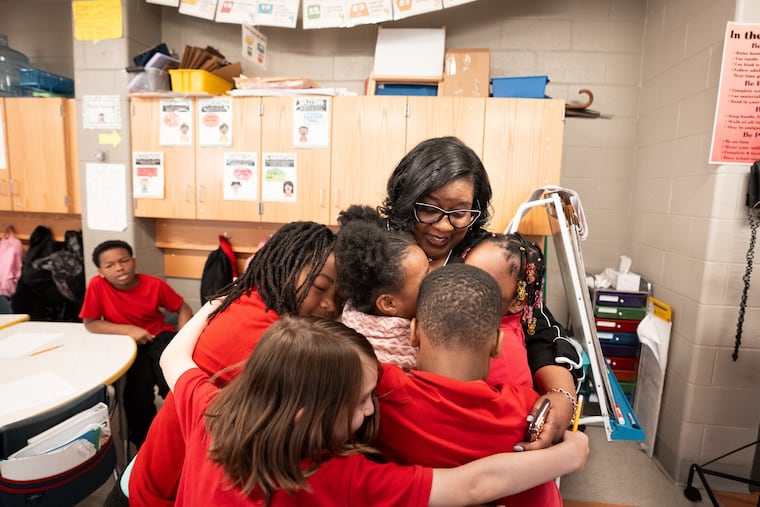
Robert Morris School in North Philadelphia has been lauded for improving test scores, and it is the last elementary school in its immediate neighborhood.
But the school district says not enough neighborhood children want to attend.
The Brewerytown K-8 school’s enrollment is just under 23% full, with 216 students, and Morris is one of 18 schools slated for closure under the district’s facilities plan.
At a community meeting last week, district officials said the school’s “severely underutilized” capacity was the driving factor behind their recommendation to close Morris after the next school year.
But community members have questioned why low enrollment alone was enough reason to cut the school — and have voiced concern that the district is closing a school with a majority-Black student population while keeping open a nearby elementary school that has more white students.
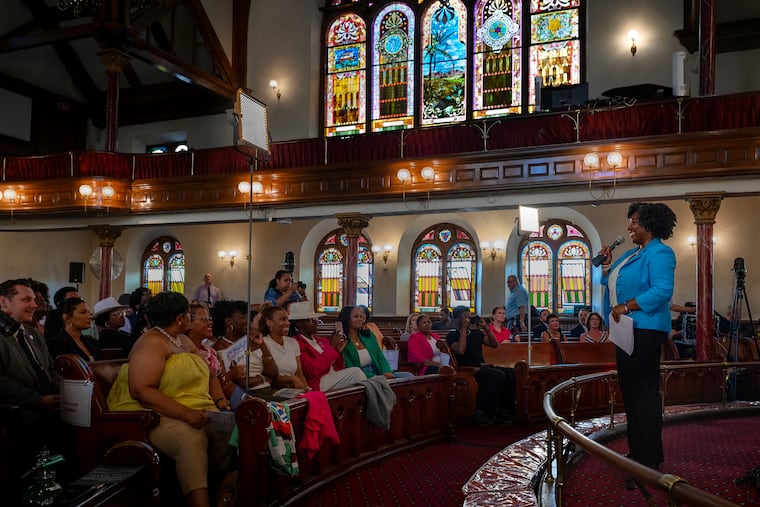
“We want the option for our children to be able to walk a block or two or three and get to their school. And it’s not clear to us the reason why that isn’t a possibility,” said Cierra Freeman, co-lead of culture and strategy for the Brewerytown-Sharswood Neighborhood Coalition.

Wholesale changes are coming to the Philadelphia School District, with the school board passing a $3 billion facilties plan that aims to close 17 schools permanently, and renovate 169.
Superintendent Tony B. Watlington Sr. presented the plan to the school board Feb. 26 and it immediately faced strong opposition. After some amendments, the board passed the plan April 30. Here's what we do and don't know about it.
And to see the proposed list school closures and check how your school could be impacted, use our interactive charts.
Each of the schools proposed for closure has its own story. Find them all here.
Morris students would be reassigned to Bache-Martin School or William D. Kelley School for fall 2027 under the plan.
The district plans to repurpose the building at 2600 W. Thompson St., which it has categorized as being in “fair” condition, into a hub for its Office of Diverse Learners. Currently, the office operates within district headquarters and has an evaluation center near Central High School.
District officials also said they want to keep the building so it could be reopened as a school in the future should enrollment interest rise.
‘Punished for being so small’
Morris was honored by the district last year at its Accelerate Philly awards for major improvements in test scores across reading and math. Its third-grade class jumped from 7% proficiency in reading and 14% in math to 48% and 59%, respectively. The district has said it did not consider schools’ academic performance in its facilities plan.
“It seems like Robert Morris is being punished for being so small,” Paul Brown, a school psychologist at Roxborough High School a Youth and Education co-lead for the Brewerytown Sharswood Neighborhood Coalition and a member of Stand Up for Philly Schools, said at the community meeting.
Neighbors said the district has not done nearly enough to retain and attract families to Morris, a “neighborhood gem,” according to Siobahn Neitzel, a local resident and youth and education action team co-lead for Brewerytown-Sharswood Neighborhood Coalition.
“The challenges that the district talks about with regards to Morris … really come from a continued lack of investment on the district’s part,” she said.
If there must be change at Robert Morris, some speakers urged the district to consider colocating the Office of Diverse Learners with the school instead of closing it. District officials said that option would be considered — but it was not reflected in a revised plan Superintendent Tony B. Watlington Sr. presented Thursday that spared two schools originally slated for closure. Morris is still on the closure list, but the school board could make changes before voting on the plan in the coming weeks.
A changing area
Brewerytown and adjacent Sharswood are neighborhoods in flux. The area is experiencing rapid gentrification, with new developments and property values shooting up in recent years, including the $750 million Philadelphia Housing Authority project to clear and redevelop the Norman Blumberg Apartments towers.
In the last round of mass closures in 2013, the district shuttered Meade Elementary School, less than a mile from Morris. Residents within the Morris catchment area have opted for other choices in recent years, including charters and other public schools. District officials said about 16% of students in Morris’ catchment already attend Bache-Martin.
Freeman said that is, in part, the district’s fault.
“This school has not been marketed to parents and families in the neighborhood. It has not been made attractive. It has not been pushed up,” Freeman said.
Some residents are frustrated with the plan to instead invest more than $50 million in Bache-Martin to handle an infusion of hundreds more students, including from Laura W. Waring School, and $4.7 million into Kelley. They believe Bache-Martin students deserve that kind of investment, but so do Kelley and Morris students. District officials said Kelley has received more funding in recent years, making a similarly large investment unnecessary.
Residents are concerned the consolidation could result in violence, by putting kids from different neighborhoods and rival gangs suddenly under the same roof at Bache-Martin or Kelley. And some at the community meeting worried that even if the district reopens the Morris building as a new school, it would be as a magnet that excludes local students.
Undergirding many of their concerns is the reality of race. Morris’ student body is 82% Black, and its community members said its potential closure was another indicator of the major impact the district’s plan would have on Black families. Bache-Martin in Fairmount, poised for significant financial support, has only about 34% Black students.
» READ MORE: https://www.inquirer.com/education/philadelphia-school-district-building-closures-black-students-impact-20260129.html
“When closures disproportionately affect minority communities, we cannot pretend race is not a part of this story. … What message are we sending to our students, my fifth- and sixth-grade students, when [the] place that nurtured them is going to disappear?” Adrienne Ramsey, a math teacher at Morris, said at the community meeting.
Freeman insisted that there must be a public education option for elementary school students in the neighborhood. She said she is concerned that charter schools, which are privately run and publicly funded, do not have enough public oversight, and public schools are critical to communities.
“Schools are one of the places that the real community building and community weaving starts,” she said.
She said she believed interest in a public elementary school in the Brewerytown-Sharswood area would return, particularly as incoming residents occupying the new developments look for places to send their childrenand current neighbors reconsider their education options.
“People want to be part of their communities. They want to be part of their neighborhoods. They want their children to have friends whose home they can walk to,” she said.