Some South Jersey districts plan to eliminate positions, cut programs, and close schools to plug budget gaps
Cherry Hill is considering a tax hike and eliminating 72 jobs, while Collingswood is seeking to close an elementary school to fill a budget deficit.
The Cherry Hill school district is considering slashing 72 positions. Collingswood is planning to close an elementary school. Washington Township has proposed cutting 52 teachers and support staff.
These tough decisions are playing out across South Jersey as districts are struggling to balance budgets for the 2026-27 school year during one of the most difficult budget seasons in recent years.
Although Gov. Mikie Sherrill has proposed increasing education spending in her first budget proposal unveiled last month, her plan includes reductions in state aid for some districts, including Cherry Hill. Others have structural budget deficits as expenses outpace revenues.
After submitting preliminary budgets last week, districts are awaiting approval from county superintendents. School boards then have about a month to make changes, hold public hearings, and adopt final budgets.
Cherry Hill is weighing job cuts and a tax hike
The Cherry Hill school board last week approved a tentative budget that would increase property taxes by $420 for a home assessed at the township average of $227,000.
The 7.4% tax increase, which the district said it needs in addition to slashing to millions in spending, would impact operations across the board.
While school officials have said they’re considering eliminating 72 positions to save $6.5 million, they have disclosed few details about which jobs would be cut and whether there could be layoffs. The district also plans an additional $8 million in non-personnel cuts.
Superintendent Kwame Morton said he plans to begin rolling out details next week. Some of the positions may be eliminated through attrition, he said.
Morton declined further comment, citing contractual obligations. Cherry Hill has about 1,700 employees and enrolls about 11,000 students.
“We tried to present the most efficient, lean budget possible. We’ve gone through every line,” Morton said in an interview. “It’s difficult. It’s challenging.”
Cherry Hill’s rising costs
District officials have said cost-cutting moves are necessary because of a 3% reduction in state aid, as well as rising costs for healthcare, transportation, and special education.
This is the third straight year that Cherry Hill has seen a cut in state aid. The district is getting $850,000 less for the upcoming year.
Although the budget gap is greater than the state aid reduction the district is facing, the state budget figures worsened the financial outlook. The state uses a formula to determine school funding for each district based on categories including enrollment, property values, and wealth.
Cherry Hill’s healthcare costs have increased by $10 million, according to district officials.
The state allows districts to exceed the 2% property tax cap to cover some additional healthcare costs. Because districts have negotiated contracts with employees, those benefits cannot be changed. Some residents have called for teachers to pick up more of their healthcare costs.
Still, Cherry Hill officials are worried about increasing the tax rate. In 2022, voters in the community of 70,000 approved a 20-year bond referendum that raised annual property taxes $400 for the owner of an average home.
“It’s tough to ask taxpayers to continue to foot the bill,” Morton said. “We don’t want to overburden any taxpayers.”
Class sizes will likely increase in Collingswood
In nearby Collingswood, the cost of operating the district has outpaced available revenues, leaving no choice but to reduce positions and programs, said Superintendent Fred McDowell.
“We’re talking about a pretty signification reduction in force,” McDowell said. “There are few choices.
Collingswood’s state aid was reduced by $305,000, while expenses have increased by $4.8 million. The district is trying to plug a $3.3 million deficit.
» READ MORE: Collingswood voters overwhelmingly rejected $44.5 million school bond referendum. What’s next?
In addition to a 6.4% property tax increase, the district plans to consolidate its high school and middle school operations, shut down its high school wellness center, impose fees for some extracurricular activities, and reduce staff to make up the shortfall.
Under a $43.4 million preliminary budget approved last week, James A. Garfield Elementary would also close in June, affecting about 112 students.
McDowell said the displaced students — including his own children — would be assigned to one of the district’s remaining four elementary schools. It was not clear how many staff members would be affected by that closure.
“Every single one of us in our community are affected in different ways,” McDowell said. “As a community we must confront this financial challenge.”
Some school board members have suggested the district could consider offering a bond referendum next year to raise funds and restore the cut funding. Collingswood voters have not approved a referendum in more than 25 years.
Budget cuts rejected in Washington Township
A preliminary budget narrowly rejected last week by the Washington Township school board proposed cutting 29 teaching positions across the Gloucester County system and 23 support staff.
The district’s state aid increased $1.5 million, but it still has a $4.8 million budget gap and it’s unclear how it will make up the difference.
Business administrator Janine Wechter said the district could impose a 6.1% tax increase under a waiver for increased healthcare costs.
Wechter shared general budget categories, but said the district must first build class schedules to determine how many positions would be impacted. She said class sizes were being considered.
She said the district was waiting to see if the state would again offer a Tax Levy Incentive Aid program that last year allowed districts that met certain conditions to apply for additional aid and additional taxing authority.
» READ MORE: Here are the 25 South Jersey school districts that raised taxes under a state program to help balance their budgets
Washington Township was among 85 districts statewide that received approval to exceed the 2% property tax cap last year. The state said at the time that it was a one-time offer.
» READ MORE: Some superintendents in South Jersey get tens of thousands of dollars in bonuses
Even with a 7.13% tax increase that added $345 annually to a home assessed at the township average of $232,000 last year, the district laid off staff and eliminated programs.
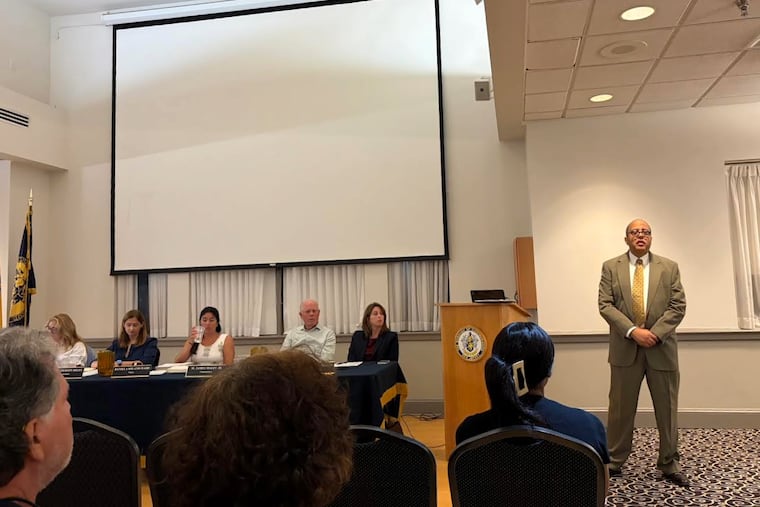
“It’s a completely flawed system,” Superintendent Eric Hibbs said at last week’s school board meeting. “They have to revamp the entire formula.”
The board was scheduled to again discus the $186.1 million proposed budget at meeting Tuesday night.