Temple announces ‘historic’ gift to start an honors college
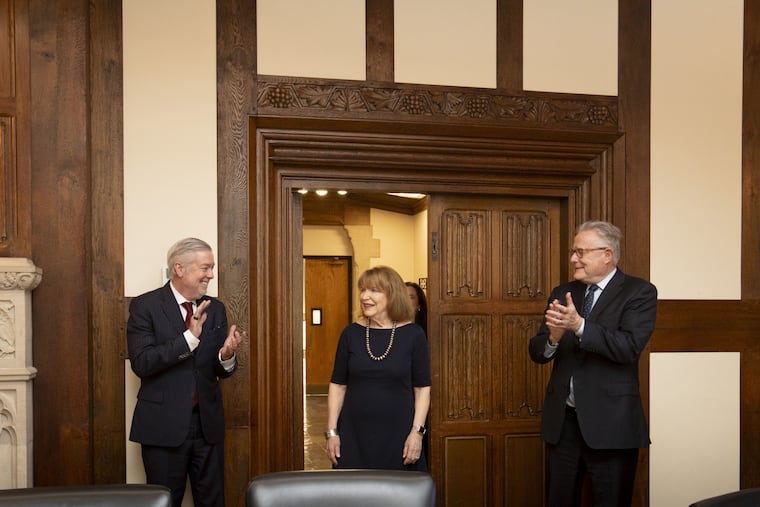
Jane Creamer Sullivan, a 1970 Temple graduate, and her late husband Thomas J. Sullivan, also a Temple graduate, have given Temple one of its largest gifts to create the honors college.
When Temple University announced plans in January to elevate its honors program to an honors college, university officials made clear the goal was aspirational because it would require quite a bit of fundraising.
Three months later, that goal is becoming a reality thanks to a hefty gift from 1970 Temple graduate Jane Creamer Sullivan and her late husband, Thomas J. Sullivan, also a Temple graduate.
Temple did not release the gift amount at the request of the donor, but president John Fry called it “historic” and said it is one of the largest in the university’s history. Since Fry became Temple’s president nearly 18 months ago, the university has announced record-setting gifts of $27.5 million from philanthropists Sidney and Caroline Kimmel last April and $55 million from Christopher Barnett in October.
» READ MORE: Temple has released its plan for the next decade. See what the North Philadelphia university has in mind.
The new college comes as the university attempts to grow overall enrollment, which has declined from a high of more than 40,000 less than a decade ago to under 30,000. The board of trustees approved the gift and the creation of an honors college at its meeting Wednesday.
“Having this honors college really ups our competitive game,” Fry said. “When we … are competing for the best, highest-quality students, we go to market with the Sullivan Honors College, which is a significant sort of competitive asset that we can use.”
Having a college brings more prestige and requires more programming, study-abroad and research stipends, experiential learning opportunities, and eventually an option for those enrolled to live together in a residential community.
Fry noted that many of Temple’s competitors, including Pennsylvania State University, the University of Pittsburgh, and Drexel University, all have honors colleges. Penn State’s Schreyer Honors College started in 1997 with a $30 million gift from William and Joan Schreyer, who followed with a $26 million gift in 2006.
Shortly after he became Temple’s president, Fry said, he visited with Temple honors students and staff and asked if they had thought of ever becoming a college. Honors program director Amanda Neuber was enthusiastic about the idea, Fry said, and staff developed a proposal. Fry included it in the strategic plan the school released earlier this year.
The college will accept its first group of students in fall 2027, Fry said.
Temple’s honors program currently exists within the College of Liberal Arts and enrolls 2,100 students — just under 10% of Temple’s undergraduate enrollment, excluding its Japan campus. In recent years, students have won Fulbright, Goldwater, and Truman scholarships, and in 2018 Hazim Hardeman became Temple’s first Rhodes scholar.
University officials do not expect the program to grow much in size of enrollment, but rather in programming and experiences. The Sullivan gift will be used for hiring more staff and faculty and for stipends and scholarships for students.
A gift to ‘raise Temple’s standing’
Sullivan, the donor, said in a statement that she hopes other donors will invest in the honors college, too.
“I believe the Honors College will raise Temple’s standing nationally, and will offer high-potential students a new reason to come here,” she said.
» READ MORE: Temple University receives record $55 million gift from an alum who almost didn’t get accepted
She and her husband, who died in 2024, already had been planning to include Temple in their wills, she said. But that changed when interim provost David Boardman presented her with the idea of helping create an honors college and seeing the impact of that during her life.
“It was a natural fit,” she said. “I am absolutely delighted to do this for the university I love.”
Sullivan has a journalism degree from Temple and is cochair of the Klein College of Media and Communication’s Board of Visitors. Boardman is dean of Klein, and Sullivan has been one of the leading donors to the annual Lew Klein Alumni in the Media Awards event, the college said. She also has made donations for student research, travel, and other initiatives. And she serves on Fry’s Leadership Council and Real Estate Advisory Council.
But her ties to Temple go back further than her own undergraduate days. Her father, Robert H. Creamer, was a founder of Temple’s College of Engineering, first teaching there and later becoming associate dean and acting dean until he retired in the early 1980s. And her late husband got his degree from the engineering college at Temple. Both Sullivan and her husband started construction companies. Her company, the Sullivan Co., provides construction management and consulting and is based in Essington.
Global studies and ‘discovery grants’
Boardman said Temple’s honors college will differ from others in how it recruits students. It will not just admit students based on high SAT scores, but also will seek to find students with various talents, leadership skills, and high potential. And students will be able to transfer in from another college or at various times during their enrollment, in addition to entering freshman year.
The college will invite students to study global issues in seminar courses in Philadelphia, but also on its campuses in Rome, Tokyo, and Kyoto, Japan, Boardman said. Students will engage in research and receive mentoring from alumni and other experts and complete a “self-directed” senior project, the university said.
They all will receive a “discovery grant,” allowing them to engage in research, an internship, study abroad, or civic engagement, the school said.
Students also will be allowed to design their own major, minor, or concentration. And the college will foster “collaboration over competition,” Boardman said.
“It’s so important that people are prepared for the workplace in a way that really trains them to be effective collaborators across disciplines, and we’re going to really underscore that,” Boardman said.
Eventually, honors students may live in the same residential housing, but Temple needs to raise more money for that, as well as for additional student scholarships, he said.
A group of faculty, administrators, students, and alumni will be discussing and planning the college in more detail over the next year, Boardman said.