Amy Gutmann, once Penn president, is teaching again. Here’s what it’s like to be her student.
Penn president emerita Amy Gutmann is coteaching the class with Sarah Banet-Weiser, dean of the Annenberg School for Communication. "It's kind of a power duo," one student said.
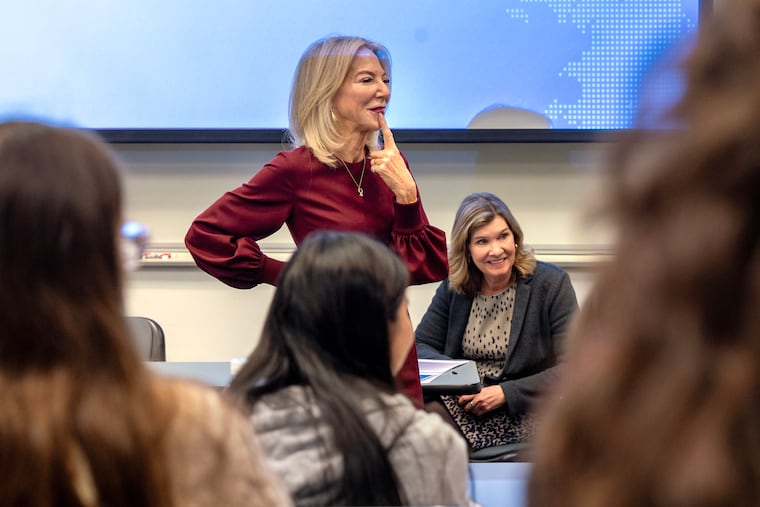
The undergraduate class at the University of Pennsylvania vigorously discussed the use of affirmative action in college admissions, half the room charged with arguing one side and half the other.
Their task, informed by the 2023 U.S. Supreme Court decision that ended the use of race-conscious college admissions, was to brief and advise a popular governor of a swing state who had not yet taken a position on the issue.
“Guess who is the governor?” said their professor, Amy Gutmann. “I am the governor.”
And for 90 minutes, the entirety of the class period, Gutmann guided a lively discussion in which students talked as much as she did.
While never a governor, Gutmann has quite the leadership portfolio. She was president of Penn for a record 18 years, leaving in 2022 to become U.S. ambassador to Germany under former President Joe Biden, a post she held until 2024. She is also a Harvard-educated political scientist who cowrote the book The Spirit of Compromise and in 2018 was called one of the world’s 50 greatest leaders by Fortune magazine.
» READ MORE: What Philly-area schools are saying about the SCOTUS ruling to end race-based admissions in colleges
Now, for the first time in about 25 years — since she was a politics professor at Princeton — Gutmann is back in the classroom teaching a full course this semester in the Annenberg School for Communication. Sarah Banet-Weiser, dean of Annenberg, who initially came up with the idea for the course, is her co-teacher.
» READ MORE: Confirmed as the next U.S. ambassador to Germany, Amy Gutmann reflects on nearly 18 years as Penn’s president
For students, the professorial star power was hard to pass up. There was a waiting list for the class.
“It’s kind of a power duo,” said Evan Humphrey, 21, a senior communications major from Seattle. “Got to take that class.”
Focusing on teaching — the heart of a university — has been especially meaningful to Gutmann, and to Banet-Weiser, too, at a time when higher education has had its federal funding threatened and its approaches attacked.
“It literally gives me life every week,” Banet-Weiser said.
Gutmann, 75, who said she aspired to be a teacher since she was 5, said it has made her feel productive “in a way that goes to the heart of what a university is about.”
» READ MORE: Amy Gutmann: Penn’s long-serving president seeks to bridge the divide | Industry Icons
“We should never lose sight of that heart of the university and how valuable it is,” she said.
The goal of the class, called “The Art and Ethics of Communication in Times of Crisis,” is “to learn how and why to communicate with greater insight and understanding across differences,” while creating space “for free and open dialogue about controversial issues.”
It could be a primer for the politically divided nation.
“My pitch is that you can’t really know what you believe if you don’t know what people who disagree with you believe and what their reasons are,” Gutmann said in an interview. “I always say I don’t care what your position is. I care that you can give reasons for it and understand the strongest arguments on the other side.
“That’s the method to search for truth, and it’s the way we serve a democracy.”
Bringing experience to the classroom
During class, Gutmann frequently drew on her experiences as a first-generation college student, a young professor at Princeton, a college president, and an ambassador.
When she got her first teaching job, a male colleague congratulated her, but later she learned he told someone she got the job because she was a woman.
“Did I take that as a compliment? Mm-mm,” Gutmann told the class.
Humphrey said she especially likes hearing about Gutmann’s vast experiences.
“She’s like, ‘Well, when I was the president here, this is something I dealt with,’” Humphrey said. “It’s really interesting knowing the experience she has and her background and the perspective she brings.”
Gutmann’s life outside class continues to be full, too. After class Wednesday, Gutmann, whose father fled Nazi Germany, flew to Berlin to receive the Prize for Understanding and Tolerance from the Jewish Museum Berlin.
Having returned to Philadelphia to live after leaving Germany, Gutmann said it wasn’t hard to find her stride again in the classroom. She had given one-off lectures as Penn’s president.
“I have a lot of muscle memory on teaching,” she said.
Her style has changed from her early days at Princeton, where she worked from 1976 to 2004. She said reading a student’s notebook left behind and open after one of her ethics and public policy lectures was a major turning point.
“‘That’s not what I said,’” Gutmann thought. “And I realized it’s not what you teach them, it’s what they learn. At that point, I realized I needed feedback.
“So I changed from doing the 45-minute [lecture] thing to doing five or 10 minutes, max, and then asking them questions. Then I got them to argue with one another, and once I found that, I found what I really discovered worked for learning.”
Gutmann said she spends Fridays and weekends preparing for the class, which meets twice a week.
“It’s a ton of work,” she said. “I’m really delighted to be doing it.”
The class comes against the backdrop of fraught times for colleges. Penn earlier this year scrubbed its website of diversity initiatives after President Donald Trump’s administration threatened funding to schools employing diversity, equity, and inclusion efforts. In the summer, the school struck an agreement with the administration over the past participation of former transgender swimmer Lia Thomas, and Penn was one of nine schools originally asked to sign a compact that would have given the school preferential consideration for federal funding in exchange for complying with certain mandates affecting admissions, hiring, and other university operations. Penn declined.
‘One-of-a-kind’ discussions
Gutmann and Banet-Weiser do not allow laptops, phones, or any electronic devices in class so that students completely focus on the conversation. To prepare for the affirmative action discussion, students were assigned related readings and review of the court cases.
The two professors interacted with each other and prompted discussion among students with deep questions: Is treating people equal the same as treating them equally? Is it right to use affirmative action for only one racial group? What about other forms of affirmative action or preference, including for athletes, low-income students, and legacies whose parents attended the university?
The approach resonated with students.
“I wanted to take a class where I would really be encouraged to step out of my comfort zone and be able to learn not only how to understand my own beliefs and values but understand the beliefs and values of others,” said Sarah Usandivaras, 21, a senior communications and political science major who was born in New York and grew up in Paraguay.
She found it in Gutmann and Banet-Weiser’s classroom.
“It’s a one-of-a-kind,” she said.
Ariana Zetlin, a doctoral student in Penn’s Graduate School of Education, is auditing the class to observe its approach.
“The discussion and the debates are so much deeper and stronger than what I’m seeing in classrooms that don’t necessarily have these structures,” said Zetlin, 30, who is from New York.
During class, those on both sides found common ground.
“So I’m hearing agreement that diversity is a good thing but disagreement on how you get it,” Gutmann said.
She asked students how many believed that having low-income and racially diverse students in class contributed to their learning. Every hand went up.
“That to me is really striking,” Gutmann said. “There aren’t that many things that we can get unanimity on.”
She asked students how they would advise colleges to teach the issue.
“It would be good to teach with activities like this,” said Angele Diamacoune, 21, a senior communications major from Allentown.
“Are you learning?” Gutmann asked her.
“I am,” Diamacoune answered.
“I am, too,” Gutmann said.