Villanova students process trauma as school seeks ‘return to normalcy’ after active shooter hoax
The university, which enrolls nearly 10,000 undergraduate and graduate students, declined to make leaders available for comment, saying their focus was on students, parents, faculty, and staff.
The day after a false report of an active shooter roiled the Villanova University campus during freshman orientation, campus officials were aiming to restore normalcy and support students, faculty and staff.
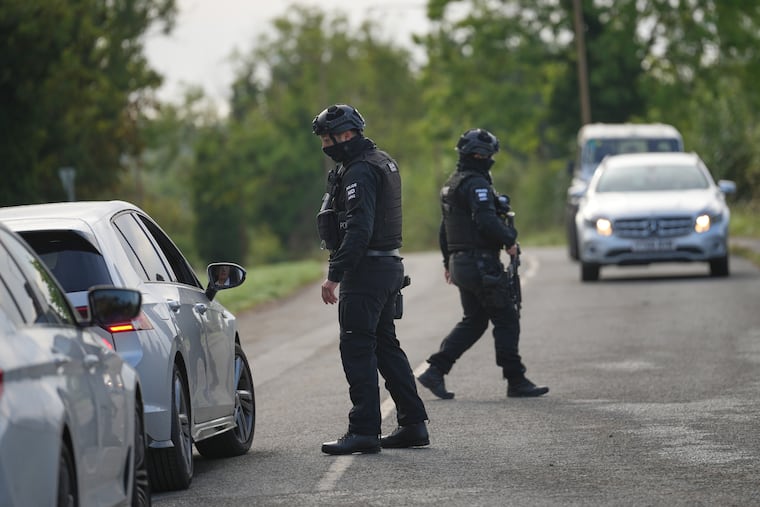
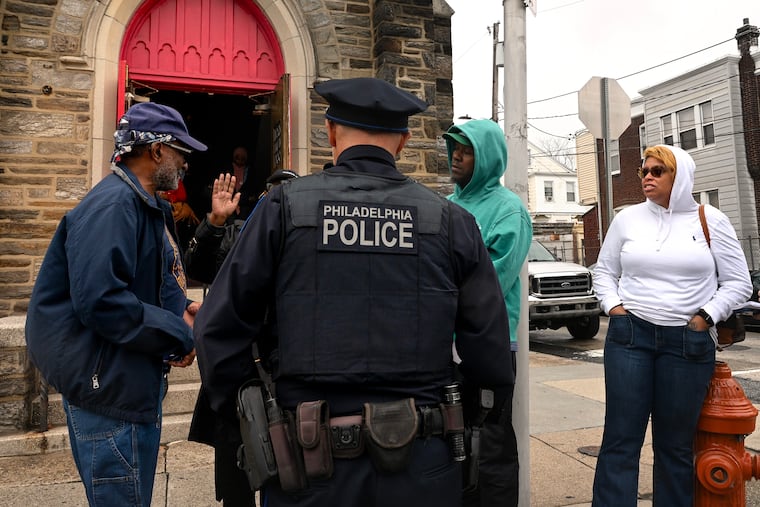
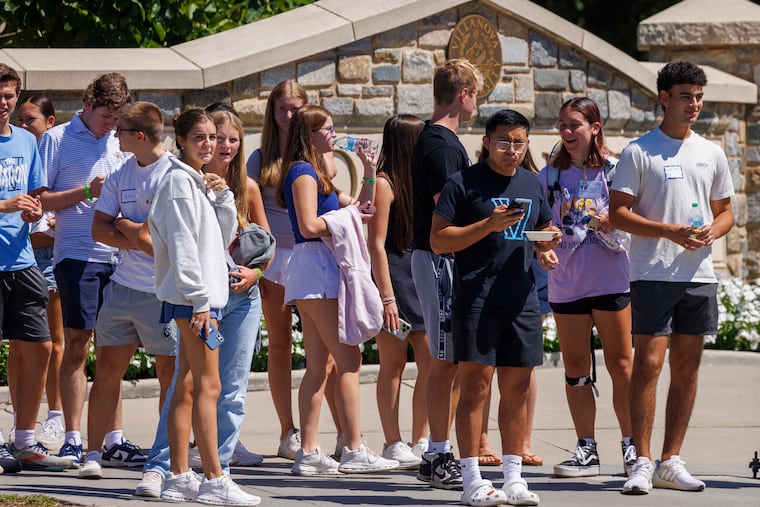
Cohorts of students trekked across Lancaster Avenue on Friday led by guides in purple T-shirts as move-in and first-year orientation continued. Uniformed police officers stood watch at busy intersections, and marked police cars were positioned around and throughout the grounds.
“It’s clear that people feel for our students, especially,” said Michael Moreland, a professor of law and religion, who has taught at the Catholic university on the Main Line since 2006. “We want to try to make it so when classes start Monday it’s as much a return to normalcy as we can accomplish.”
» READ MORE: Active shooter report at Villanova was a ‘cruel hoax,’ university president says; no injuries reported
Just after 4:30 p.m. Thursday, reports of an active shooter began coming in, sending students, faculty, parents, and staff — some of whom were attending an orientation Mass — scrambling to hide in secure locations. Fear and panic set in for about 90 minutes as heavily armed police patrolled the campus, looking for a potential shooter.
Officials later said it was a swatting incident in which someone reported a fake emergency, inciting panic. Villanova’s president, the Rev. Peter M. Donohue, called it a “cruel hoax” in a message to the campus community. Police are continuing to investigate.
Though the report was fake, the fear it instilled was all too real, and those on campus were trying to process their emotions Friday.
“You’re relieved on the one hand,” Moreland said. “But it’s hard to undo all the anxiety and fright and worry you have in the moment. It’s a weird combination... Obviously, I’m still trying to process that.”
Moreland and his wife, Anna Moreland, a humanities professor and chair of the honors program at Villanova, were at the Mass when the active shooter alert went out. Their son, Sebastian, a senior chemistry and humanities major, also was there, serving as a freshman orientation leader.
» READ MORE: Police scanner shows panicked response to Villanova shooting ‘hoax’
Moreland said he and his wife ran to a classroom about 50 yards away. Their son fled to the same building, but to a different classroom, and they communicated by text. They spent their next moments scared, worrying, and praying, he said.
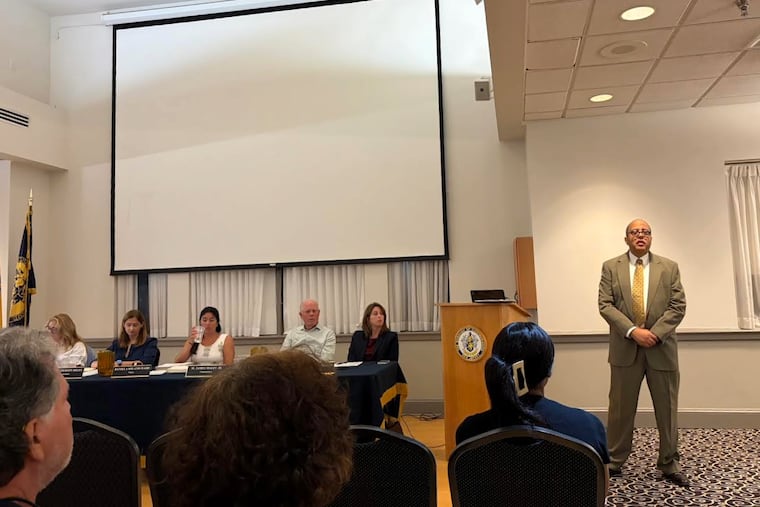
On Friday, his son was back at orientation, helping freshmen. Moreland participated in a meeting with law school faculty and administrators to talk about what happened and to prepare for Monday.
The university, which enrolls nearly 10,000 undergraduate and graduate students, declined to make Donohue or other administrators available for comment, saying their focus was on students, parents, faculty, and staff. A Mass was held on campus shortly after noon, as it is every day. It was moved from the chapel to St. Thomas of Villanova Church, the school’s historic church along Lancaster Avenue, to accommodate more people.
‘Violation of trust and faith’
Bridget Sullivan was headed to the performing arts center Friday morning — her fourth day as production manager of the school’s theater department — for rescheduled auditions.
Before auditions were set to begin Thursday, the NOVA Alert burst through Sullivan’s inbox. Only days into her tenure, she’d gotten the new employee pamphlet but hadn’t digested what to do, whom to call, or where to go in an emergency.
And although the theater is far from where the threat was called in, the consensus was, “If I were a student, I don’t know if I would want to audition,” Sullivan said, “and is it that important?”
After the initial adrenaline, followed by relief at learning it was a hoax, Sullivan’s thoughts and emotions came in waves: frustration, resignation, disappointment.
“No one was hurt, there were no weapons, and at the end of the day, that’s what matters,” she said Friday. “The violation of trust and faith in the goodness of humanity, that’s harder.”
Students and employees could continue to experience emotions from Thursday’s incidents for days, weeks, or even longer, said Philip Izzo, medical director of outpatient psychiatric services for Main Line Health.
“These are visceral emotions that are going to come about after a traumatic event,” he said, citing shock, fear, anxiety, and anger.
He said Villanova seemed to be handling the incident well, inviting people to come back to the campus green for the traditional Augustinian blessing and allowing them to gather in a safe, secure place and talk.
Also important, he said, is to make students and employees aware of resources available and urge them to reach out for help if they need it, he said. Anxiety following such an event can manifest in many ways, including trouble sleeping, shortness of breath, jittery feelings, and depression, he said.
Swatting incidents elsewhere
St. Joseph’s University in 2023 also experienced a false report of a shooter on campus, but it was resolved in less than half an hour. The school subsequently vowed to improve its communications in such emergency cases.
St. Joe’s also extended support to its community.
“In the days that followed, the university shared timely information about available resources, including counseling services, spiritual care, academic support, and employee assistance programs,” spokesperson Kevin Gfeller said Friday. “These resources were utilized by our community members.”
At Villanova on Friday, sophomore Campbell McKinnon, a volleyball team member who had been on campus for a few weeks, was walking on Lancaster Avenue in front of the large Villanova sign. She recalled how earlier on Thursday she was focused on another shooter alert — at the Chattanooga campus of the University of Tennessee. There, an alert of an active shooter had gone out just before 12:30 p.m.
McKinnon, who is from Tennessee, was checking in on her friends there. They were on lockdown and eventually evacuated. That report, too, turned out to be fake.
Later, from her dorm room window, McKinnon saw chaos unfolding on her own campus. She saw parents and students fleeing, then helicopters and SWAT crews. McKinnon and her roommate Lola Taylor sat silently, they said, occasionally muttering, “Oh my gosh, what’s going on?”
Senior business major Jose Miselem was headed to the campus’ health center when he saw a barrage of people running. He initially dismissed it, thinking it was an orientation activity, like a scavenger hunt. Then he was told to barricade.
Miselem, 23, ended up in a health center room with 15 others, he said. Miselem started frantically Googling: Who is the shooter? Are they a student? What’s their motive?
Then the group, led by the son of an ex-Marine, brainstormed a plan for if they encountered the shooter: The men would stack up against the door and tackle the gunman.
Taylor and McKinnon relied on X, TikTok, Yik Yak — an anonymous platform geared toward college kids — and eventually TV news livestreams for information. There were reports of gunfire and rumors that someone was shot and that police were taking battering rams to doors, they said. Those reports all proved to be false.
McKinnon rattled off a text to her friends in Tennessee. “You won’t believe what’s happening,” she told them.
When Donohue announced it was a fake, McKinnon and Taylor were stunned. Taylor was taken aback by Donohue’s description of it as a “hoax.”
“For three hours, we were all grieving, basically, our whole school year and how everything was possibly going to change,” she said. “You go to the worst-case scenario.”
Until classes start, Miselem said he intends to stay off campus, fearing a copycat threat.
“Being at that peak of being scared of dying and just later finding out it was a hoax, is such a roller coaster of emotions,” the senior said. “I can’t imagine dealing with that on your first day on campus.”