Bruce Springsteen’s last Philly show was elegiac. This time, it’ll be a ‘teeth-kicking’ protest.
The Boss has been anything but subtle in his scathing critique of the Trump presidency. “Land Of Hope and Dreams” tour is about defending "our American ideals, democracy, our Constitution," he said.
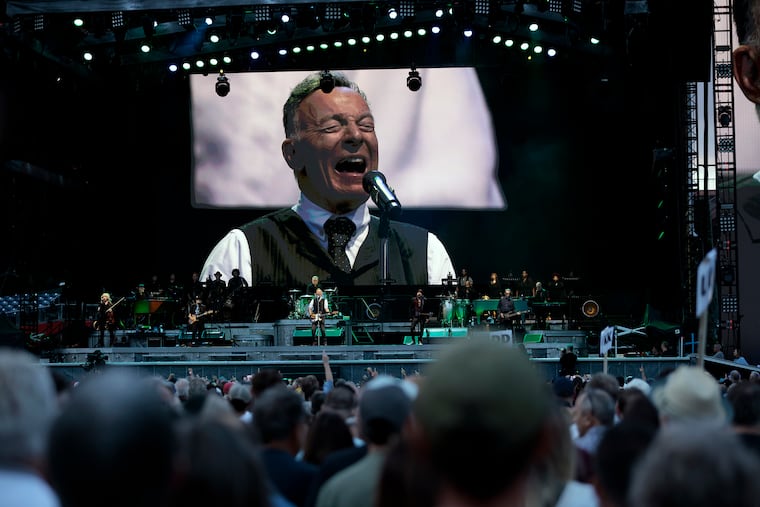
The last time Bruce Springsteen played Philadelphia with the E Street Band, mortality was on his mind.
At two Citizens Bank Park shows in 2024 — both delayed a year due to illness — the centerpiece was “Last Man Standing,” inspired by the death of George Theiss, leader of Springsteen’s teenage band the Castiles.
In a solo acoustic interlude, Springsteen, then 74, talked about how with age, “death brings a certain clarity” and “a clearer vision of what living itself can mean” while philosophically observing that grief “is just the price we pay for having loved well.”
Two years later, Springsteen is set to return to South Philly.
As he gets ready to play Xfinity Mobile Arena on May 30 on a “Land Of Hope and Dreams” tour date that was also delayed — by the Sixers’ unexpected playoff victory over the Boston Celtics, which pushed it back three weeks — Springsteen’s outlook is not so sanguine.
With the E Street Band again in tow — expanded now to 18 members with the inclusion of Rage Against the Machine guitarist Tom Morello — the Jersey rocker will arrive in the city that’s been a stronghold for him since the early ‘70s.
He comes back to town with renewed clarity of vision and a clear sense of purpose.
Only this time, he’s not in such an elegiac frame of mind. And the urgent message he’s keen to communicate has less to do with the passage of time and dimming of his days than a deep concern for the state of American democracy.
Not to mention the sense of civic duty that has given meaning to his life’s work and helped him retain a relevant place in pop culture decades after his popularity peaked.
Springsteen was a dominant commercial force in the Born in the U.S.A. 1980s, but he hasn’t had a Top 10 hit since “Streets of Philadelphia” in 1994.
We still talk about him like he matters, though.
That’s because he does.
Not only on account of marathon shows that fill arenas and stadiums but also because — whether viewed as self-important, or profound — he sees it as his responsibility to make music that reflects and comments on the times, in the American vernacular music tradition that goes back to Woody Guthrie.
Springsteen in 2026 has a man-on-a-mission quality akin to the era of The Rising, the album he wrote in response to the terrorist attacks on the World Trade Center in 2001.
In his 2016 Born to Run memoir, Springsteen tells the story of how he was driving in a state of shock after the towers fell. A guy who recognized him yelled, “Bruce, we need you!” That shout instigated The Rising, and focused a recording career that had been in midlife malaise.
A quarter of a century later, Springsteen is again responding to what he sees as a call of duty and a need felt by his fan base — or at least those whose left-leaning politics mirror his own.
The job, as he sees it, is to put forth a communal, compassionate vision of what America is and can be; an idea that that runs counter to a MAGA world view espoused by President Donald Trump.
(That work will continue after this tour is over when the Bruce Springsteen Center for American Music in Long Branch, N.J., opens with “Music America: The Songs That Shaped Us” concerts on June 4 and 5. Springsteen will be joined by artists like Public Enemy, Jackson Browne, Mavis Staples, Jon Bon Jovi, and Valerie June in shows billed as “Celebrating 250 Years of American Music.”)
In 2024, Springsteen campaigned for Kamala Harris, including an appearance at the Liacouras Center in North Philly with John Legend and Barack Obama. But the shows he played in the run-up to the presidential election didn’t put particular emphasis on his political views. The only overtly political song he performed was “Long Walk Home,” a mournful tune from his (underrated) 2007 album Magic whose protagonist no longer recognizes the America he grew up in.
It’s subtly moving, and has remained in Springsteen’s protest-focused setlist on this arena tour, which began in Minneapolis in March and was supposed to end with its one outdoor stadium show on May 27 at Nationals Park in Washington.
(Instead, the Philly date is now the final show, which Springsteenophiles hope increases the chances of old school treats added to the setlist for day one fans. Can we reach back to 1973 for “For You” or “Rosalita?” Or at least a “Streets of Philadelphia?” C’mon Boss!)
But back to “Long Walk Home,” and the notion of subtlety. Springsteen has been anything but subtle in his response to the second Trump presidency.
A year ago, on the first night of the “Land of Hope and Dreams” tour in Manchester, England, he walked onstage and called the administration “corrupt, incompetent, and treasonous.” The president hit back, calling Springsteen “Highly Overrated” as well as “not a talented guy — just a pushy obnoxious JERK” and “dumb as a rock,” among other insults.
Since the American tour began, Springsteen’s critique has gotten more detailed. He’s added “reckless” and “racist” to his opening remarks, spoken out against a Justice Department that “has thrown its independence away” and decried the dismantling of foreign assistance agency USAID.
None of that is particularly subtle, and neither is “Streets of Minneapolis,” the anti-ICE song Springsteen wrote the day protester Alex Pretti was killed by federal agents, outraged at the government’s initial claims that placed the blame on Pretti and Renee Good for their own deaths.
When he first performed the song in Minneapolis in January, Springsteen said he asked Morello if the song — written in the broadside tradition of Guthrie, Bob Dylan, and the civil rights protests of the 1960s — was “too soapboxy.”
Morello, who plays a guitar emblazoned with the words “Arm the Homeless,” told him not to worry. “Nuance is wonderful,” he said, “But sometimes you have to kick them in the teeth.”
The show that Springsteen and the E Street Band will put on next weekend then will aim to be a teeth-kicking affair. It won’t be a radical departure. The setlist will include many longtime Springsteen crowd-pleasers like “Badlands,” “Hungry Heart,” and the Patti Smith cowrite “Because The Night.”
But it will also make room for both Springsteen-penned protest songs “The Ghost of Tom Joad” and “American Skin” and choice covers such as Edwin Starr’s emphatically anti-war “War.”
It will also include the tour’s title song, a gospel-fired anthem that, in the year of the nation’s Semiquincentennial, invites all aboard a train where “dreams will not be thwarted” and “faith will be rewarded.”
In the opening remarks Springsteen has made on earlier tour dates, he has said that he and the E Street Band are performing “in celebration and in defense of our American ideals, democracy, our Constitution, and our sacred American promise, the America that I love, the America that I’ve written about for 50 years.”
There’s fear at the heart of that statement. The belief that those ideals are under serious threat, and also — on a personal level for Springsteen — that a lifetime of work in support of those ideals will have been in vain.
So it stands to reason that an impassioned three-hour Springsteen and the E Street Band call to join him in his fight — in the city that helped launch his career, and where those American ideals were born — will be a night to remember.
Bruce Springsteen and the E Street Band: “Land of Hope and Dreams American Tour,” Xfinity Mobile Arena, 3601 S. Broad St., 7:30 p.m. May 30. xfinitymobilearena.com.
