Philly Pigeon Tours offer a bird’s-eye glimpse of South Philly
The 90-minute strolls tour some of the Italian Market’s most established pigeon flocks, examining the rocky relationship between humans and birds often known as “rats with wings.”
Early on a recent sky-blue Saturday, 12 people stood rapt at Sixth and Washington, gazing up at a flock of pigeons perched along a telephone wire.
“What do you see?” a guide posed, as the pigeons cooed, contently.
The docent’s cheerful query loosened a chorus of replies and conversation, including enthusiastic observations on the birds’ shimmering iridescent hues and micro-feather structure, to discussions on the airfoil-like curvature of their wings, obsessive preening, and seasonal molting.
Just then, a white-speckled feather drifted down from the high wire.
“Here’s a feather floating down right here to make a point,” another guide interjected to laughter.
Welcome to South Philly’s hottest new excursion: Philly Pigeon Tours. A weekly, 90-minute morning stroll to several of the Italian Market’s most established flocks, offering an engaging and enlightening glimpse into the long-revered — and more recently rocky — relationship between humans and rock doves, the fancy term for urban pigeons. It’s a look at South Philly through a pigeon’s eyes.
5,000 years of pigeon history
Founded by partners and pigeon owners (more on that in a moment) Hannah Michelle Brower, 34, and Aspen Simone, 36, Philly Pigeon Tours have quickly transformed into a hot ticket. In June, the pair’s first tour, organized as a one-off, sold out all 25 slots. The crowds keep flocking.
Casually covering 5,000 years of pigeon history — from the rock doves’ esteemed status in ancient times as symbols of love, sexuality, and war to their more thorny present-day urban existence, dodging hungry hawks and alley cats, and navigating anti-pigeon netting and spikes — the pair ask tour takers to challenge skewed cultural narratives.
“We teach people everything we know about pigeons,” said Brower, originally from New Orleans, who first moved to Philly to attend Haverford College, and then returned after earning a master’s degree in epidemiology from the Harvard School of Public Health. Earlier this year, federal cuts eliminated her job as a public health consultant.
In August, Simone closed Birdhouse Gelato, after DOGE cuts cost them their day job at an agency that helped improve federal digital efficiency — a gig that helped fund the popular Bella Vista shop.
“We debunk a lot of pigeon misinformation and replace it with facts,” Brower said of the tours.
Having seemingly cornered the Philly pigeon-tour market — the pair will soon start tours in West Philly, with Old City walks coming in the spring, and a podcast just dropping — the outings no doubt appeal to secret pigeon-lovers everywhere. But much of the charm of the pleasant pigeon rambles is found in Brower and Simone’s sincere and catchy love for birds derided by many as “rats with wings.”
“We often talk about how hating pigeons is a choice,” said Simone.
Primrose the Pet Pigeon
The couple weren’t always pigeon boosters themselves.
Brower had never cared much for pigeons until three years ago, when a neighborhood woman caring for an ailing pigeon called out to her.
“I was really like, ‘I don’t understand why we have to care about this,’” she recalls. “I figured that the pigeon could be a tasty snack for some city hawk or cat.”
Convinced by the woman to seek help for the malnourished bird, Brower fell in love with the pigeon before she made it home.
“I remember thinking, ‘Don’t name the pigeon. You’re gonna become attached.’ But then I said, ‘Primrose is her name.’ She just wanted to be close to me. She was very cuddly, and I just completely fell in love with her.”
Simone recoils when recalling their thoughts upon finding a pigeon stowed in a cardboard box that first night in the couple’s South Philly apartment.
“That’s kind of gross,” they said. But Primrose quickly won Simone over, too.
“It turns out she was a baby and might have been left a little too soon by her parents,” Brower said. “The rehabilitator said, ‘This is the sweetest, most cuddliest pigeon I ever met. I don’t think she’s going to survive on the streets. Do you want a pet pigeon?’”
Pigeon behavior and croissant crumbs
“She’s very much like a cat or a dog,” Brower said with a smile of Primrose, who favors a sunny spot on a guest-bedroom blanket. “She’s a free-roaming indoor pigeon. People always ask about the poop. She has her favorite spots in the house, so we just put down cage paper and it catches the poop. It doesn’t smell.”
(They are searching the internet for Philadelphia Eagles-themed pigeon poop pants that Primrose can don for guests.)
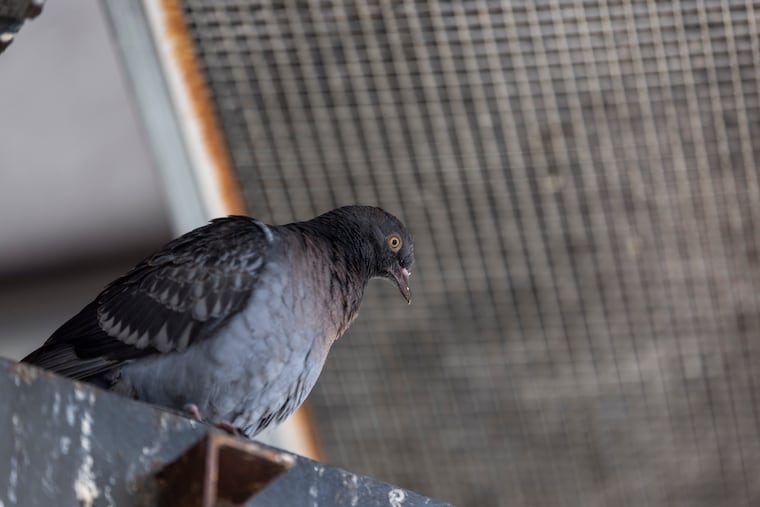
Regal and stout, with a scarf of green and purple neck feathers and striking orange eyes, the affectionate pigeon quickly made herself at home, perching on the couple’s shoulders and heads during work-from-home Zoom meetings — and whenever the couple prepare to head out the door, wanting to stay with the family flock.
“She likes to sit on our laps and we just pet her,” Brower said, adding that Primrose does the same with company.
Conscientious pigeon owners, Brower and Simone became keen observers of pigeon behavior. Like when Primrose perches near the sink to signal bath time, before luxuriating in a warm bowl of water. Or when she interrupts a TV show or work call to perform a pigeon’s elaborate mating dance, cooing, walking in circles, and running close to the ground, before bowing and elegantly fanning her tail feathers. How she sits atop the unfertilized pigeon eggs she lays, for weeks, until she is confident they will not hatch. Her sweet tooth for croissant crumbs.
Soon, they couldn’t help but spot the same sorts of behaviors among the pigeons they encountered around the neighborhood. They pored over pigeon books.
“We began to look a bit more into the science behind it and learned more about pigeon group dynamics,” said Simone.
Misconceptions based on fear
Holding aloft guide sticks with small cardboard cutouts of Primrose (a decided homebody, Primrose does not join the strolls), Brower and Simone share their newfound pigeon truths one tour at a time.
In ancient Mesopotamia rock doves were associated with gods — and viewed as signs of safety in Abrahamic religions, and symbols of status before the French Revolution, Brower said.
By the 1960s, the urban pigeon’s reputation was roundly sullied after a media-fueled panic blamed their droppings for causing meningitis in New York City, she said.
“Woody Allen repeated the phrase ‘rats with wings’ in Stardust Memories, and that’s when it spread and took hold,” Simone said of the 1980 film.
A recent tour included two young biologists, a pair of pigeon enthusiast sisters, and a group of young friends. They had all seen advertisements for the tours tacked up in the neighborhood or on Instagram.
“We were talking about how pigeons make us feel emotional,” said Tess Cronin, on why she and her friends signed up for the tour. “How pigeons were bred by human beings, and now we think of them as rats and pests.”
Near Ninth Street, where businesses are outfitted with spikes to keep birds from roosting, Brower and Simone preached pigeon empathy. Starting with the lessons they learned from Primrose.
Like with all things, Brower said, it’s never just about pigeons.
“Our misconceptions originated with fear,” she said. “And I think we’ve really been able to catch ourselves better when we notice ourselves maybe stereotyping.”
With that, the tour set out to find more pigeons.