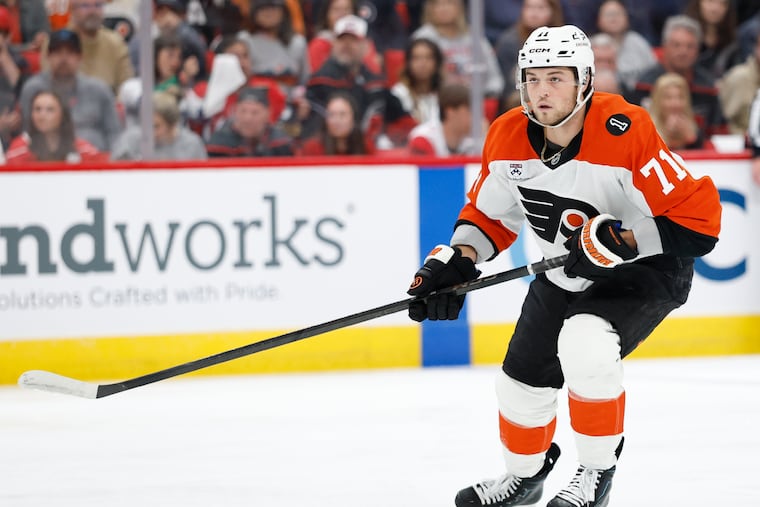
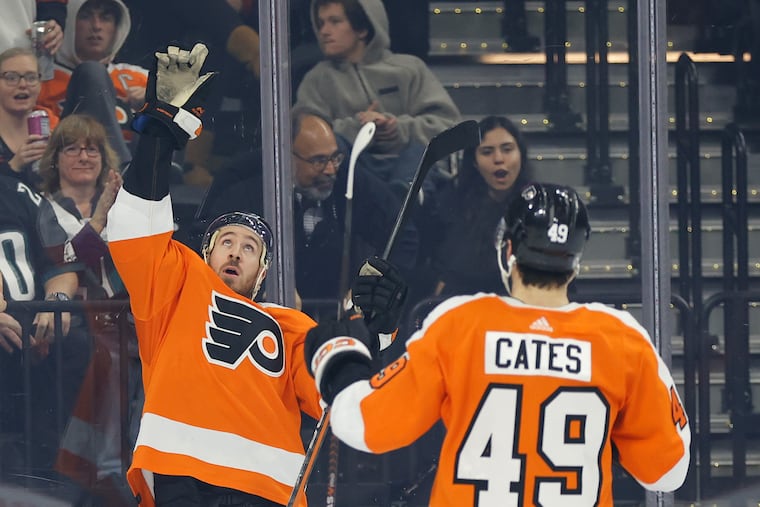
The Flyers’ gifted Matvei Michkov overcame pressure as a rookie. Now he’s out to avoid the sophomore slump.
The Russian winger cleared plenty of obstacles last season at age 19. In his second season, Michkov will have new coach Rick Tocchet and his teammates in his corner.

Long before Danny Brière sat down for a one-on-one interview with The Inquirer on Sept. 27, the topic of this story was set.
But then the former NHL All-Star-turned-Flyers general manager said the quiet part out loud when asked about the expectations for Matvei Michkov’s second season.
“There’s also always the scare of the sophomore slump that you see from different guys,” Brière said, confirming the topic. “I’m hopeful that he won’t fall into that because he’s so competitive, but that’s the next worry.”
The dreaded sophomore slump. It is nightmare fuel for brass, coaches, and fans alike.
What is a sophomore slump, or what some call a sophomore jinx? The basic definition is a rookie putting up big numbers and then seeing a significant drop in production in Year 2.

- Flyers Q&A: Danny Brière on the NHL draft
- 15 options for Flyers at No. 21
- Brent Flahr on the Flyers’ draft strategy with the 21st pick and more
- Jaxon Cover and Ryder Cali: From the Cayman Islands to the NHL
- Is 17-year-old Ilia Morozov the next center to join the organization?
- Alexander Command feels in sync with Philly. Will he be there at 21?
- Mock draft 3.0: Could another Hextall be in Philly soon?
The root cause is unknown, but the consensus is that it is because of pressure to perform, higher expectations by onlookers, a shift in a player’s role, or that teams have a book on the player. Or maybe it’s all four of those factors.
It has happened to guys like former Flyers forward Jeff Carter, who put up 23 goals in his rookie year and then scored just 14 times, albeit in 19 fewer games.
Colorado Avalanche forward Nathan MacKinnon played in 18 fewer games in Year 2 but also saw his production drop from 24 goals and 63 points — while winning the Calder Trophy as top rookie — to 14 and 38. Edmonton Oilers forward Ryan Nugent-Hopkins saw one of the biggest drops, going from 18 goals and 52 points in 62 games as the runner-up for the Calder to 4 and 24 across 40 games during a lockout-shortened 2012-13.
Considering that Carter went on to win two Stanley Cups, that MacKinnon has one and won the Hart Trophy two years ago, and that Nugent-Hopkins has his name etched all over the Oilers record book alongside guys like Mark Messier and Wayne Gretzky, it’s easy to say all three are doing just fine today.
“It’s kind of a cat-and-mouse game,” said Flyers forward Travis Konecny, who doubled his goals and points in his second year and has led the Flyers in scoring for five of the last six seasons.
“Your first year is usually, it’s a good, fun season to have, but then your career and your role and things start to filter out as the years go on and you start to find what makes you effective every year, over and over again.”
‘A pretty special player’
When Brière and his crew walked up to the stage in Nashville to select Michkov in the 2023 NHL draft, they had no idea how the next two years would play out.
The phenom fell into the Flyers’ lap at seventh overall, likely because he had a three-year contract in Russia, and, coupled with geopolitics being what they are, he wasn’t expected to come to the United States until that was completed. But because the Orange and Black were willing to do the hard part and wait, it worked out.
A few weeks before Michkov was officially introduced to Philly in July 2024, Flyers director of player development Riley Armstrong was prophetic about the young star.
“I think the blue line out, and when he gets the puck, I think he’s going to pull all of you guys [the media] right out of your seats and along with the other fans at the Wells Fargo Center,” he said at development camp.
“So I don’t know how long it will take for him to adjust to the league, but once he figures it out and understands his linemates and stuff like that, I think he’s going to be a pretty special player.”
» READ MORE: Q&A: GM Danny Brière preaches patience but says Flyers ‘have to be better’ this time around
Although he had some defensive zone miscues, which led to a pair of full-game scratches and a few in-game benchings by then-coach John Tortorella, Michkov did not disappoint. He led the Flyers and all NHL rookies with 26 goals and finished second on the team with 63 points, the most by a Flyers rookie since Mikael Renberg in 1993-94. Michkov won Rookie of the Month twice, becoming the first Flyer in 30 years to do so.
But the uber-competitive and driven winger was not satisfied.
“Everything, every aspect of the game needs to be improved,” Michkov said through a translator in April at his exit interview with the media. “There’s no skill, nothing in my game that I’m 100% on yet.”
And then came the kicker that makes Michkov special: “I could have scored more, not happy with my result.”
Unending pressure
Few have laced up their skates in the game, let alone for the Flyers organization, who know the pressures Michkov faces on a nightly basis.
When Eric Lindros was drafted first overall by the Quebec Nordiques in 1991 — and subsequently traded a year later to Philly — expectations were high for the hulking power forward, a five-tool star who had size, speed, skill, finesse, and grit. Even before he was a twinkle in fans’ eyes, former Flyers general manager Bob Clarke famously said a 16-year-old Lindros “could play in the NHL right now.”
Following in the footsteps of Gretzky and Mario Lemieux, Lindros was anointed The Next One, and in his rookie year, he potted 41 goals and 75 points in 61 games during the run-and-gun days of the early 1990s. And there was no sophomore slump for Lindros, who was full steam ahead across his entire career and had 44 goals and 97 points in 65 games in his second year.
“Try not to deal with any of the exterior stuff,” Lindros said in an interview last week when asked about dealing with high expectations. “I think there’s enough internal pressure that each player puts on themselves, or should put on themselves.
» READ MORE: Spend a day in the life of a Flyers beat reporter
“There’s enough inside, and if you just keep it in house and within your own mind, with how you want to be, how you want to perform, I think that’s enough fire to fuel [you] to get that fire truly lit.”
During Michkov’s exit interview with Brière at the end of the season, the Russian shocked the GM.
“He has a detailed plan of all the things he wants to do. I was actually shocked by how prepared he was for his meeting,” a grinning Brière revealed. “He knew exactly what he needed to do and how he wants to conduct himself. … He was telling me all the things that he learned this year. And I was amazed [because] usually you don’t expect that from a 20-year-old.”
The lessons were almost daily for Michkov, who not only battled the pressure of being anointed a savior for the organization and playing in the NHL like Lindros, but also was adjusting to a new country and a new lifestyle — and faced a language barrier.
But with the experience of dealing with the constant travel and rigors of a full NHL season behind him, that should help Michkov.
“He recognizes that the league is even a little more difficult than he thought before he arrived. … And he also recognizes how much work he’s going to have to do this summer to fill in some of the gaps, to get better in some areas,” Flyers president Keith Jones said in March during an interview on 94.1 WIP-FM radio. “What we’re going to see is [that] he’ll be an even better-conditioned athlete when he returns next year.”
The mental part of the game
Michkov went home to Russia to train. Although he said through the team translator at the start of training camp that he would not disclose specifics, he did reveal that he worked with a personal trainer and focused on his mental approach.
“The most important [thing is] being mentally ready — everything else you can basically put it together,” he said. “I was getting ready for the season, and I’m ready for it 100%.”
Michkov’s motivation is surely internal. Lindros’ motivation was, too, but he also had the fitness legend himself, Rod Brind’Amour, next to him. After all, one does not get the nickname “Rod the Bod” without earning it.
“You go to camp, and my goal was to beat Rod Brind’Amour,” Lindros said with a chuckle. “Some years I was fitter than Rod, and other years I wasn’t. We were always 1-2. That was the goal. … Roddy was the peak. He was the target on our team and set the bar extremely high, and you wanted to be right there.”
But being in shape is one thing. Producing on the ice is another. There is a comfort level in Year 2, knowing the rinks, the pace, and the grind; however, as Konecny, who is heading into Year 10, said, “You shouldn’t [get comfortable]. You should be kind of treating it like Year 1 again, like, I’m still trying to figure this out.”
According to Lindros, he has not chatted or met with Michkov. However, in conversations with the two, the similarity in their passion to be the best is clear. And both are driven by the desire to win.
“First and main is for the team to make the playoffs, and then we’ll see,” Michkov said last month when asked what he expects out of himself in his second season. It follows the pattern he set in his introductory news conference, when “Here to win,” “playoffs,” and even Stanley Cups were mentioned during the chat he had with the media.
When posed with a similar question on what his mindset was heading into his second season, Lindros’ response was also about the team.
“Well, we didn’t make the playoffs my first year,” the 1995 Hart Trophy and Hockey Hall of Famer quipped. “We were getting better, we could feel a shift in our momentum, in our abilities. We were getting better, but still [had] a long way to go.”
Tocchet in his corner
Heading into the 2025-26 season, the current iteration of the Flyers is shouldering a five-year playoff drought. But while Michkov is focused on a playoff spot, he has the support to avoid a down year across the 23-man roster and beyond.
Last season, he connected with the captain Sean Couturier and Konecny. This season, he is slotted alongside fellow rising star Trevor Zegras at center and, in the penultimate preseason game, with Owen Tippett on the wing. He also had veteran and defensive-minded forward Christian Dvorak on the wing in the preseason.
And he now has Rick Tocchet behind the bench.
A Flyers draft pick in 1983, Tocchet played 621 of his 1,144 NHL games with the team, accumulating 508 points and a franchise-record 1,815 penalty minutes across two stints. He bleeds orange and black, telling The Inquirer in 2023 when he was the coach of the Vancouver Canucks that “a big part of my blood is the Flyers.”
And Tocchet is just as motivated to win in Philly. He has some unfinished business here. “For sure, 100%,” he said recently. “You see the other teams in this town, and if you can win in this town, [it would] be a pretty special place to win.”
» READ MORE: Will big defenseman Adam Ginning make the Flyers out of training camp? This could be the year.
Hired in May, Tocchet brings a different approach to coaching than Tortorella did during Michkov’s first season. Tortorella was a hard-nosed, demanding coach who punished players, like Michkov, for defensive miscues. Tocchet, who played all over the lineup during his NHL career, still wants consistency and his players to play hard, but he sees his style more “like a partnership with the player.”
“I think just knowing that I’ve played the game, and I know what sometimes players expect from a coach, I think that helps,” he said in 2023. “Gives me a little bit of an advantage.”
And he has dealt with young stars. Tocchet was elevated to the head coaching job with the Tampa Bay Lightning after Barry Melrose was axed 16 games into Steven Stamkos’ rookie year. The future two-time Stanley Cup champion jumped from 23 goals in his first year to a league-best 51 in Tocchet’s only full season running things in the Sunshine State.
Now the coach known as Tocc is preparing to help Michkov avoid the sophomore slump.
“I think the best answer for me is to create an environment around [Michkov] that can protect that — your peers, your leadership group, the coaches, management, the expectations,” he told The Inquirer last week.
“I think if you can somehow keep him in a good frame of mind, temper the high expectations, I think that would really help him.
“Obviously, it’s also on him, too. He can’t walk around saying, ‘Oh, this is an easy game,’ and he knows it’s going to get harder and harder, and I think he understands that.”
Fighting off slumps
Michkov can lean on his teammates to help him get through the in-season slumps that always happen, even to the best of the best. Last season, he started red-hot, putting up nine points (four goals, five assists) in his first 11 games and winning Rookie of the Month for October. In November, it was 10 points in 12 games, then 10 points in 13 games in December, and as the season slogged on, it dropped to five points in 15 games in January.
“I feel like the slumps are harder in the second year,” Konecny said. “ … It’s more or less you kind of compare yourself to the year before, and you’re thinking, ‘Oh man, this month last season I had this many,’ so you start doing comparisons a little bit.
“It’s just difficult. You’ve just got to lean on your teammates. And, you know, he’s a good enough player, I’ll be shocked if he goes through anything too big, but we’ll see.”
But as Konecny said, Michkov can draw on the good from last year, too. A rested Michkov came back from the 4 Nations Face-Off break and finished the season with 10 goals and 27 points in the final 25 games, winning Rookie of the Month honors for February.
The key now for Michkov is how he’ll adjust once the puck is dropped in Thursday’s opener at Florida. Yes, he knows more about the league, but the league also knows about him now, too.
“He’s going to get game-planned now. People know who he is,” Tocchet said. “They know his tendencies — Hey, he likes to go to this spot; he does this on a breakaway; he’ll sneak behind a defenseman. They’ll know that now; there are smart coaches in the league, they pre-scout this stuff.
“So now we’ve got to give him some other options, but also that he’s got to understand that he might have to change a few things in his game to counteract that pre-scout on him.”
Michkov is focused. Although he is still working on his English — he recently spoke in the locker room with reporters in friendly chatter — Tocchet said, “You can communicate sometimes just about hockey.” And the winger stays on the ice long after practice is over with Zegras, who is 24. They play the crossbar or breakaway game but are still working on their technique, something Konecny, at 28, does as well.
» READ MORE: Christian Dvorak, Nikita Grebenkin look ready as the Flyers preseason schedule winds down
“I still stay out after practice working on things,” Konecny said. “I still am listening to the coaches and what they have, and they’re in focus. I mean, I’ll finish my career not knowing probably half the [stuff] I should have. You’ve got to listen to everybody, everyone tells you something new and how to play, and you just try to soak it up every day.”
Being a sponge is a familiar concept now for the Flyers. Time will tell how Michkov’s sophomore season will go.
“I expect more from him,” Brière said. “I expect him to be a little bit more of a leader. … I expect him to be one of the guys that Tocc is going to lean on and put in the spotlight, to say this is how we do things. And I expect Matvei to kind of lead the way offensively, and then, hopefully get the young guys to follow suit and to get them, the Bumps, the Luchankos, the Grebenkins. Now he becomes an example for them.”
No pressure.