Flyers takeaways: Power-play struggles continue, Rick Tocchet frustrated about missed reads
The Flyers have been controlling the puck better and sustaining pressure, but their power-play success rate continues to lag.
Still not the worst, but pretty darn close.
The Flyers’ power play has slipped to 31st in the NHL, with a paltry 15% success rate.
(You may want to look away at this moment.)
It ties last year’s percentage through 82 games, but is worse than 2022-23, the first year former coach John Tortorella and Rocky Thompson were in charge. On the plus side, it is better than the 2023-24 season (12.2%).
While some of the puck movement has looked good, the man advantage is having trouble converting — and it’s costing the Flyers games. They couldn’t score when they faced the league’s worst penalty kill, the Seattle Kraken, in a losing effort despite three-man advantages right after the holiday break.
And on Thursday, the Flyers lost 2-1 in overtime to the Toronto Maple Leafs despite having more than three minutes of power-play time in the third period. They were up 1-0 in the third period when Toronto’s Matthew Knies was called for slashing Denver Barkey, and 68 seconds later, Troy Stecher tripped Owen Tippett.
Two minutes of the man advantage were a five-on-three, and they even had a six-on-three when Dan Vladař went to the bench during the delayed call on the second penalty. But they still couldn’t score — kinda.
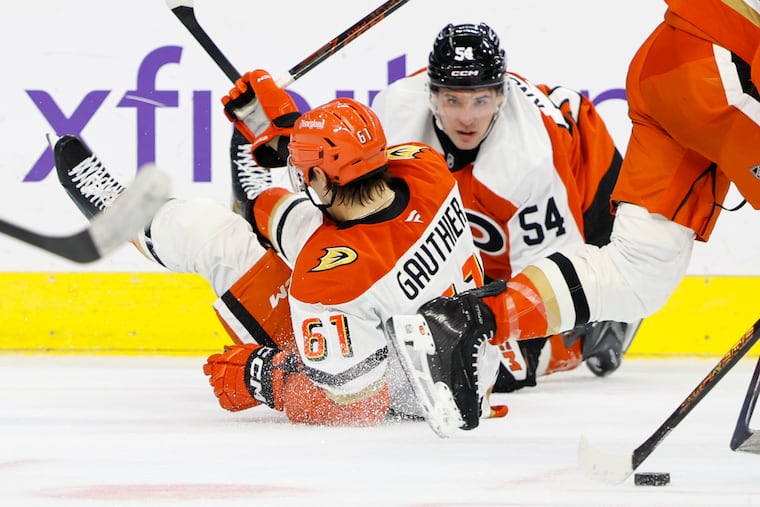
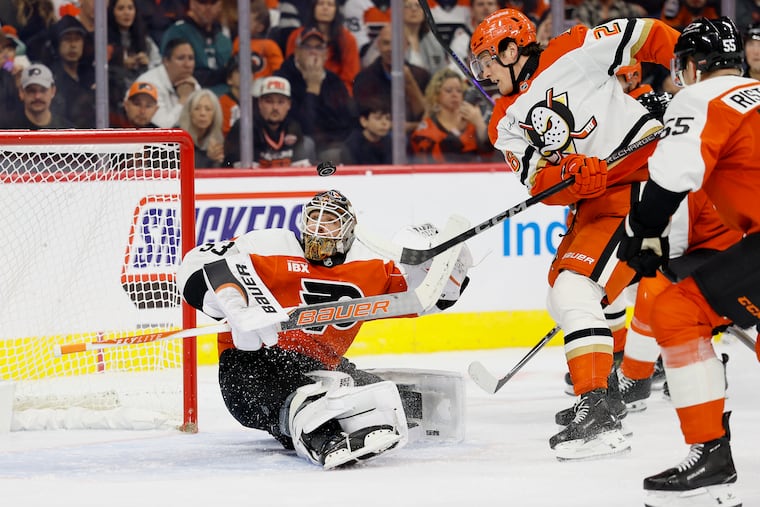
“I mean, on the other hand, against Anaheim ... we had quite a few looks, quite a few shots,” said Travis Sanheim about Tuesday’s game, when the Flyers went 1-for-8. “Just got to keep working away at it, and keep trying to get better each day, and hope that we can start putting some in. Obviously, it’s a big part of good teams, and something that we obviously got to be better at.”
With Knies in the box, out came Trevor Zegras, Cam York, Christian Dvorak, Matvei Michkov, and Tippett. Zegras and York have finally been united, and Dvorak has one objective: to stand in front of the goalie. Usually, Travis Konecny is with this unit, but he did not return for the third period due to an upper-body injury.
» READ MORE: Rick Tocchet wants the Flyers to get to the net more, specifically on the power play. Is Christian Dvorak the answer?
The opening faceoff saw Dvorak lose to none other than former Flyer Scott Laughton, who was a top penalty killer during his days in Philly. The Flyers were able to regroup quickly in the neutral zone and reenter with 1:53 left in the power play.
They were able to set up, and Michkov, now on the left side with Konecny out and Zegras a threat in the right circle — the normal spot for the Russian winger on the other unit — got the puck down low to Tippett. One of the best Flyers on the night, and the past few weeks, spun and got a shot on goal from atop the crease.
With 1:39 left on the penalty to Knies, that unit stayed on the ice and again Laughton beat Dvorak in the faceoff circle — Laughton was 19-for-20 on the night. The puck was sent down the ice, and the Flyers started their breakout.
York scooped up the puck and dropped it back to Tippett, who sent it over to Zegras. Tippett got it back as he skated through the neutral zone and took off. Using his greatest asset, his speed, he flew past Maple Leafs defenseman Troy Stecher, and his wraparound hit the post.
Dvorak got a great rebound attempt, and Zegras thought he then jammed the puck in — and maybe it was with Hildeby’s arm half into the goal and half out, and the goalie deftly moving to hide where the puck was — but it was reviewed and ruled the puck did not cross the line.
With 1:14 left, the unit stayed out, and Laughton won another faceoff, but this time, Tippett hustled to get to the puck first along the end boards and was pulled down by Stecher. Vladař went right to the bench for an extra attacker, and Sean Couturier came on and went right to the net. York sent a shot on goal that was deflected wide, and the Leafs touched up.
It gave the Flyers a 52-second two-man advantage. The only change was Rasmus Ristolainen swapping with York. Laughton once again beat Dvorak in the circle, and the Flyers had to regroup, knocking off 11 seconds before they got back in the offensive zone.
Herein lies the problem. They started moving the puck around the perimeter — on a five-on-three — and eventually Zegras got a one-timer deflected out by Toronto defenseman Simon Benoit.
The Flyers have been controlling the puck better and sustaining pressure, and NHL Edge has them up to 59.4% of offensive-zone time with the man advantage; they have risen from 24th on Nov. 15 to 17th in the NHL in offensive-zone time on the power play.
But they still need to get to the net. According to Natural Stat Trick, they are tied for the sixth-fewest high-danger chances on the power play (82).
» READ MORE: Flyers defenseman Jamie Drysdale lands on injured reserve after hit by Anaheim’s Ross Johnston
With 25 seconds left on the two-man advantage, Laughton won another draw, and they didn’t get back in until 10 seconds were left. Benoit lost his stick with six seconds left, leaving him vulnerable. Ristolainen put a shot on goal from that side of the ice, but it hit a teammate in front, and with 64 seconds left in power-play time, Cowan got back into the play from the penalty box.
But then Michkov scooped up the puck and made a really nice move when he was able to bounce Laughton off him as he cut through the slot. He avoided the rest of the Leafs and got a shot on goal after his first shot was blocked by Benoit — who still didn’t have a stick — as he drove to the net.
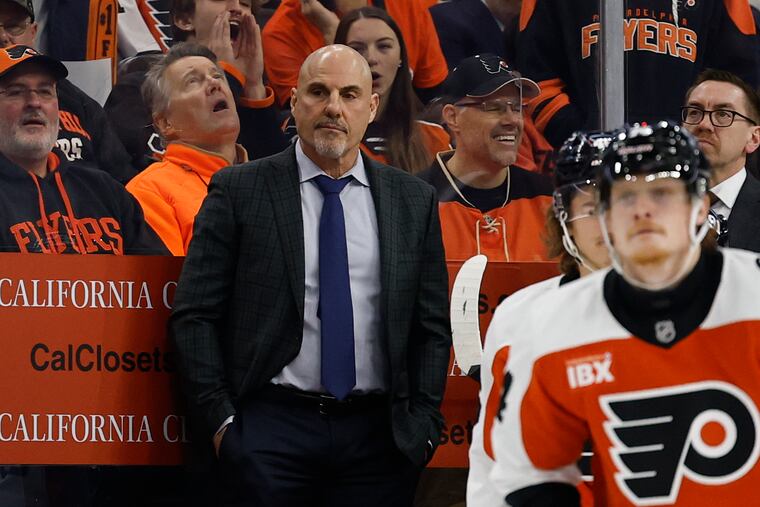
Flyers coach Rick Tocchet expressed frustration after the game about the power play, noting his team is missing reads.
“They had two guys on one side, and if we made one pass, somebody would have been wide-open. But we’re looking for plays instead of organically playing,” he said of the five-on-three.
“Yeah, you want to roll [around the zone] and all that stuff, but sometimes a team will just be all in. They had a guy with no stick, and we had the puck on the other side. That’s a hard one for me to swallow, because you want the puck on the side of the guy with no stick, right? You want to pick on him, but we have the puck on the other side.”
“I don’t know if it’s the pressure with the power play; sometimes I think guys are squeezing it so much,” he added. “But we need some guys to kind of understand the pressure and convert.”
After a shift that lasted 2:08, the next unit came out with Couturier, Sanheim, York, Denver Barkey, and Noah Cates. Couturier didn’t have to face Laughton and won the draw against Nicolas Roy, allowing the Flyers to set up.
It was now a five-on-four, and after some perimeter work, York put a shot on goal that Couturier — who went to the net right after the faceoff and never left — tipped in front. Hildeby was able to pounce on the puck. Couturier got tossed, and Cates took the faceoff, lost it, but the Flyers recovered it in the offensive zone.
Couturier, who was, like Tippett, heavily engaged on the power play, got the puck on the half-wall and put another good shot on goal with Cates screening. The Leafs were able to clear, and with time ticking down, after getting back into the zone, Sanheim sent a shot wide that led to Laughton’s short-handed goal to tie the game.
“Sanny can’t miss the net on that one,” Tocchet said. “You have to hit the net, or at least take it a little bit off. We had people going to the net, and they score that goal. ... I still think the guys played hard. I mean, that’s a hard game to play, second [game] coming off the road, emotional [against Anaheim] and stuff, so I give them a lot of credit, yeah. The special [teams] stuff, yeah. Do you wish some guys converted? Yeah.”