It can take two years for a restaurant to get approved for outdoor dining. One Philly councilmember is trying to make it easier
Councilmember Rue Landau introduced legislation to expand areas where sidewalk cafes can exist without a special zoning ordinance.
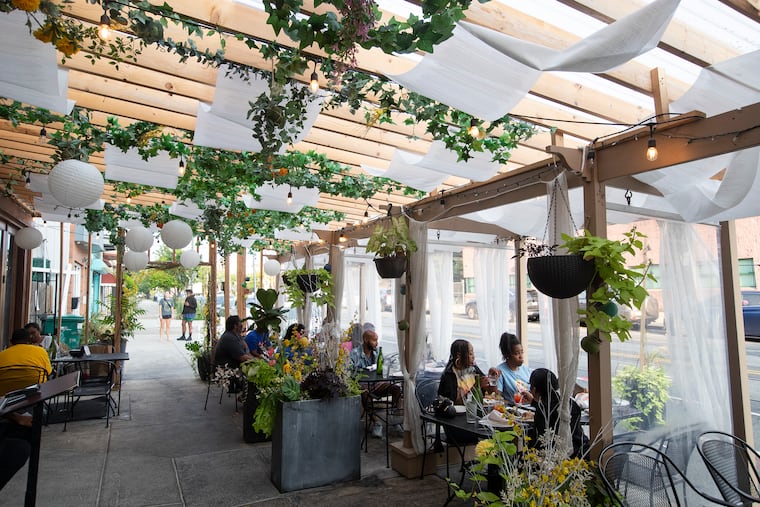
Philadelphia City Council is taking yet another crack at streamlining the city’s complex and drawn-out permitting process for outdoor dining.
At-large Councilmember Rue Landau introduced legislation Thursday to expand the “by-right” areas where sidewalk cafes can exist without a special zoning ordinance. The proposed bill, if approved, could hasten the daunting permitting process and dramatically increase the space available for outdoor dining.
Currently the law allows sidewalk cafes to be licensed in certain areas that are largely centered on Center City and smaller commercial corridors in East Passyunk, the Italian Market, Manayunk, and other neighborhoods throughout the city. Restaurants outside those corridors must ask their district Council member to get legislation approved to authorize a sidewalk cafe license. The step can add months to a process restaurateurs say is already lengthy, confusing, and costly.
All restaurants seeking sidewalk cafes must submit copies of plans to Philadelphia’s Streets Department and Department of Licenses and Inspections separately for approval before securing a $1 million insurance policy and paying an annual $227 licensing fee, according to the application’s website. Approvals and disapprovals should be ready within 30 days of applying.
In reality, restaurant owners said, the process often involves thousands of dollars to keep an architect on retainer, as both departments can take months to review plans. And in the interim, at least one restaurant owner alleged, businesses can be fined for having tables and chairs outside while they wait for a decision.
Landau believes the new legislation stands to remove one hurdle from a system that is overall in need of reform.
“The ordinance process alone takes many months, and is just one part of a lengthy and convoluted process,” Landau said in an interview Wednesday. “Currently, it takes approximately between 18 and 27 months just to put a couple of tables and chairs outside of your business.”
Sidewalk cafes are different from streeteries, which occupy parking spaces and require a $1,750 licensing fee alongside myriad approvals from different city departments, depending on the structure. Both face similar challenges.
Sidewalk cafes and streeteries proliferated during the pandemic, allowing many restaurants to keep serving patrons as COVID-19 limited indoor dining. At their peak, there were roughly 800 sidewalk cafes or streeteries operating in Philly. That number fell drastically after 2022, when the city made streeteries permanent and announced a web of since-revised regulations that many restaurants could not keep up with, often requiring businesses to consult engineers and architects to build structures that the city might request to be torn down only months later.
» READ MORE: Philly needs to fix its controversial ‘streetery’ outdoor dining program, city controller says
There are just 28 active streetery and 287 active sidewalk cafe licenses in Philly as of November 2025, according to L&I’s business license dashboard.
“The current outdoor dining licensing process in Philadelphia is characterized by complexity and high cost, which pose significant barriers for businesses seeking to utilize outdoor dining opportunities,” City Controller Christy Brady wrote in an August 2024 report on the licensing systems.
What would the proposed law change?
Landau’s proposed legislation would increase the number of streets in Philly where sidewalk cafes are considered “by-right,” which means business owners would not have to call on City Council to preapprove their tables and chairs.
Landau held more than a dozen listening sessions with community members in eight Council districts, she said, and worked with the Pennsylvania Restaurant and Lodging Association to consult over 100 Philadelphia restaurant owners before drafting the legislation.
» READ MORE: From Sept. 2024 | Bob & Barbara’s must take down its new streetery for South Street repaving after spending $50,000
The proposed bill still follows the tradition of councilmanic prerogative, allowing each district Council member to select which streets receive the “by-right” designation for sidewalk cafes. Councilmember Jamie Gauthier included the entirety of the 3rd District — encompassing the majority of West Philly — while others carved out several streets. Councilmembers Cindy Bass and Brian O’Neill have yet to designate streets, Landau said.
The bill will then go to the streets subcommittee for a hearing, Landau said, where blocks can still be added.
“There’s plenty of time for councilpeople to get some skin in the game,” Landau said. “We don’t want to be exclusive here.”
Bass, who represents the 8th District — which includes parts of Mount Airy, Germantown, and West Oak Lane — and O’Neill, who represents Northeast Philly in the 10th District, could not be reached for comment.
How do restaurant owners feel?
The proposed legislation is cold comfort for Jeremy Page, general manager of the West Philly brunch institution Booker’s. The restaurant’s application for a revamped sidewalk cafe has languished with L&I since he filed in April, Page said.
While Booker’s sits squarely within Gauthier’s district, the restaurant won’t be spared any red tape. It already secured the necessary ordinance and spent $2,000 on an architect to draw up plans for six outdoor tables.
“I was very surprised I had to do that. Nobody tells you,” Page said. He said he was heartened by Landau’s legislation. “It feels like someone finally sees what’s going on and is locking in to make a change.”
Setting up the new outdoor space was bittersweet: Between 2020 and September 2025, Booker’s had a 33-seat sidewalk cafe enclosed with wooden slats that staff would decorate with string lights, flowers, and garlands. It was lauded by some as among the city’s most beautiful outdoor dining arrangements.
» READ MORE: From 2021: Booker's is one the most beautiful streeteries in Philadelphia
When the city announced its new outdoor dining regulations in 2022, the structure was no longer compliant, Page said. But Booker’s kept the structure up for three years as it searched for a workaround, incurring roughly $10,000 in fines until Page said he finally tore down the covering in September. It has been replaced by simple tables and chairs.
The change resulted in a loss in business that forced Booker’s to let go of five staff members, Page said.
“I miss it so much,” Page said. “It’s extremely impactful when you are getting fined for something that was legal at one point and then, all of a sudden, is not legal anymore.”
Carlos Aparicio recalled a similar experience. The owner of South Philly’s El Chingón, now a Michelin-recognized restaurant, spent two years going back and forth with different city departments until his 12-seat sidewalk cafe was approved in fall 2023.
During that time, Aparicio told The Inquirer, he was hit by fines and told by an L&I officer that the agency would remove his tables and chairs. After that, he started hiding the furniture at his house during off hours.
“It was very confusing and upsetting,” Aparicio said. “We’re not doing anything bad. We’re not selling drugs. We’re not trying to do anything but build community.”
El Chingón is just one block outside East Passyunk Avenue’s by-right area. Aparicio estimated he spent $10,000 after securing his zoning ordinance to retain an architect, an engineer, and a lawyer to help him navigate the permitting process.
It’s experiences like these that incense Landau, she said.
“All the restaurants that we spoke to, they all said that the city does not waste any time to fine them or tell them what it’s doing wrong, but it’s not there to help them in a positive way,” Landau said. ”We must cut red tape to make it easier for restaurants to do a very simple thing: put some tables and chairs outside.”
Staff writer Anna Orso contributed to this article.