The owners of Surfside, Philly’s homegrown canned cocktail heavyweight, are suing Anheuser-Busch
Stateside Brands is asking Anheuser-Busch to change the packaging of its Skimmers hard teas, citing “strikingly similar” packaging.
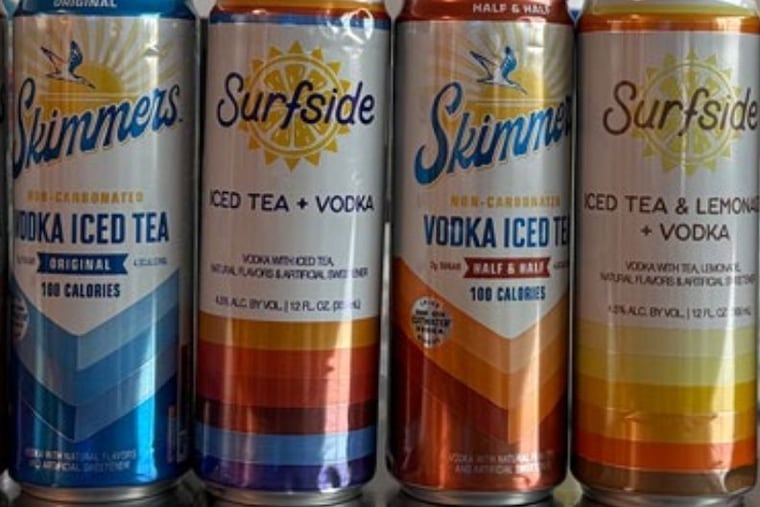
It’s a bad day to be a vaguely beach-y can of vodka iced tea with a sun on it.
Local vodka distiller Stateside Brands, best known for its top-selling Surfside hard iced teas and lemonades, is suing Anheuser-Busch InBev, alleging that the beverage conglomerate ripped off Surfside’s can design when creating Skimmers — a recently launched line of competing vodka-based hard teas and lemonades — according to a federal lawsuit filed in Philadelphia on Tuesday.
The suit centers on “strikingly similar” packaging used by Surfside and Skimmers, which debuted in April. Both cans use the same central design elements to give off a vibe of causal debauchery, the lawsuit alleges, which could dupe consumers into believing that Skimmers is associated with Stateside.
Stateside is seeking a permanent injunction that would force Anheuser-Busch to change Skimmers’ packaging. They are also suing for an unspecified amount of damages, including “any and all profits” that Anheuser-Busch has earned from selling cans of Skimmers. (For context, the spirit-based ready-to-drink cocktail market is valued at more than $2.7 billion, more than double its valuation in 2021.)
“Anheuser-Busch could have selected from a vast universe of design elements to create a can that stood on its own,” the lawsuit states. “Instead, it opted to mimic Stateside and freeride off its popular and successful Surfside design, product, reputation and goodwill to gain an unfair marketplace boost.”
Stateside is represented in the suit by Center City law firm Reilly, McDevitt & Henrich.
“Every element — from our design and packaging to the way we show up in the world — has been intentionally crafted to reflect who we are, our values and what we stand for," a Stateside representative said in an emailed statement. “We are dedicated to … ensuring our brand and the trust our customers place in it remain clear, recognizable, and uniquely ours.”
Anheuser-Busch “will vigorously defend” against the accusations, a spokesperson said over email. “We believe this lawsuit is without merit.”
» READ MORE: Pennsylvania Uncorked: What does your neighborhood drink?
Copying Philly’s favorite canned cocktail
Surfside is the canned cocktail-de-résistance for Stateside, a distillery cofounded in Kensington in 2013 by area natives Clement Pappas and Matthew Quigley and their brothers. The company initially specialized in “craft vodka” and later hard seltzers, but struck gold in 2021 when it launched Surfside, a 4.5% ABV, 100-calorie cocktail of vodka mixed with various teas (and later lemonades).
In 2022, Stateside sold 200,000 cans of Surfside. In 2024, the company sold over 4.9 million cans, according to the lawsuit. This summer, Forbes hailed Surfside “the fastest growing alcohol brand in America" after Stateside said it was on track to sell 12 million cans this year alone.
The sunshine-y cans are as prevalent nationwide as they are in Philly. Surfsides have been the best-selling spirit in Citizens Bank Park three years running, and the distiller entered a 15-year licensing deal to turn Xfinity Live! into Stateside Live! this fall.
» READ MORE: How Surfside crushed the canned cocktail market
Stateside’s lawsuit contends that Skimmers’ packaging borrows three elements to create an indistinguishable identity:
a gradient of different colors of bands covering the lower third of the can,
A white background overlaid by a sun and each brand’s name,
A rim color that pulls from the lower third’s color scheme.
“Anheuser-Busch obtained a substantial unfair competitive advantage by forgoing the effort required to develop its own brand identity and is instead freeriding on Stateside’s significant investments of time and money,” the suit reads.
Anheuser-Busch is one of the biggest brewers in the world, responsible for Budweiser and Bud Light and foreign brews, such as Stella Artois and Modelo. The company entered the canned cocktail market with Cutwater, a line of drinks with ABVs as high as 13%. At only 4.5% ABV, Skimmers is meant to be a chiller alternative.
Does Stateside have a case?
Yes, according to some legal experts.
Anheuser-Busch “flew too close to the sun,” said Josh Gerben, a D.C-based (and Main Line-bred) trademark lawyer.
“We live in a culture where dupes are everywhere, and normally it’s the smaller companies knocking off the big guys with a cheaper product. This is a big guy knocking off a smaller one.”
This isn’t the first time Anheuser-Busch has been called out for jacking some beverage swag: Outdoor apparel brand Patagonia sued the beverage producer for copyright infringement in 2019 after it launched a beer called Patagonia and began selling it at ski lodges. Both parties settled out of court in 2021.
Still, said Gerben, the lawsuit may not be a slam dunk for Stateside. The beverage upstart never filed a trademark to protect the Surfside product design, based on records from the United States Patent and Trademark Office.
It’s common for some beverage companies to trademark the designs of their bottles, said Gerben. Jack Daniels has one for the distinctive square shape of its whiskey handles, while Maker’s Mark has one to protect its iconic drippy red wax seals.
That level of granularity is typically reserved for more sophisticated companies, explained Gerben.
“Surfside really only took off in 2022,” he said. “They were probably only focused on how to meet demand.”