After bankruptcy and a kiln disaster, Felt and Fat is remaking itself
After filing for Chapter 11 bankruptcy in October and then the explosion of its kiln in January, Kensington ceramics company Felt and Fat forges a new path.
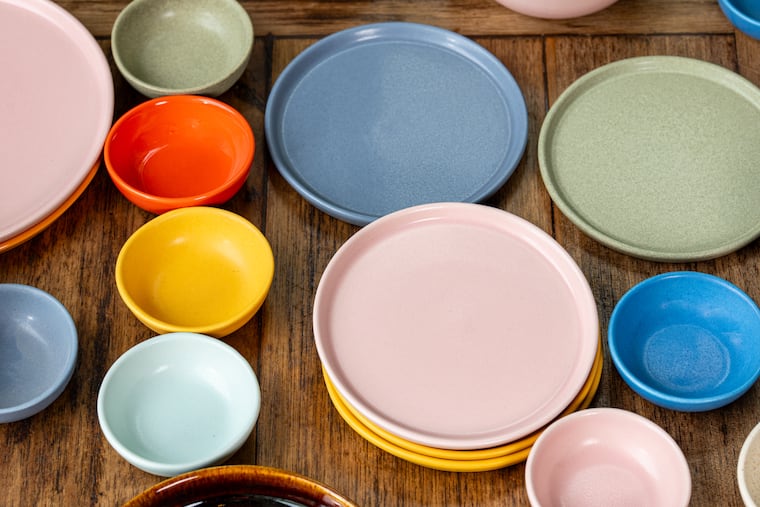
The vibrant, paint-flecked, confetti-esque glazed bowls are Philly icons. But at the end of January, these and hundreds of other ceramic dishes lay in ruins inside Felt and Fat’s kiln.
Philly’s back-to-back snowstorms and cold temperatures froze the ceramic producer’s warehouse’s sprinkler lines, causing sprinkler heads to crack.
Mist blanketed Felt and Fat’s kiln — and kilns are not supposed to ever get wet — for 12 hours. The kiln was just over a year old, custom-ordered from the Netherlands. It cost over $300,000 and was the keystone of founder Nate Mell’s plans for expansion.
The kiln took a year to arrive and was outfitted with a specialized rack system that made loading and unloading pieces — up to 250,000 per year — easy.
“The kiln company told us they couldn’t repair it and with high-pressure gas going into the kiln, even if they could, they couldn’t speak for it in terms of liability,” said Mell, 40. The electrical components were all soaked and frozen. The inside was completely destroyed. “We still haven’t quantified our revenue loss,” he said, despite getting his old kiln back in use about a month after the disaster.
The kiln explosion came on the heels of Felt and Fat filing for Chapter 11 bankruptcy. “We were really struggling in 2024 and 2025, which was a terrible time to raise money. The early 2020s for us were all about growth,” said Mell.
To get out of bankruptcy, Mell had to come up with a reorganization plan for his creditors. It required getting back to Felt and Fat’s roots.
It all started in 2013, when Ellen Yin and Eli Kulp commissioned custom ceramics from Mell for the original High Street restaurant, which opened in September of that year. He officially formed the business in 2014, and over the next decade, Felt and Fat grew from a two-person ceramics studio — encompassing Mell and former business partner Wynn Bauer, who left the company in 2017 — into one of the region’s most recognizable dinnerware manufacturers. Their plates were seemingly at every award-winning Philadelphia restaurant, from River Twice to Tesiny to the now-closed Laurel.
“We had been growing the same way everyone else grows: build a factory, add people, add machines,” said Mell, a Temple grad who admitted that this trajectory had little to do with what he had been trained in. “I went to the Tyler School of Art and Architecture and studied glass but took classes in ceramics. I worked as a server in Philadelphia restaurants for eight years and started delving deeper into ceramics by working part-time at the Clay Studio back when it was in Old City.”
He realized that what he and his team does well is “great design, really interesting glaze work with relatively low minimum-order quantities, and interesting collaborations.” His expansion plans were taking him away from that design and glaze work. “The bulk of what we were doing, and what every other factory does, is taking clay and turning it into a shape.”
He reached out to an old contact, the company Anfora, located outside of Mexico City, which has been making ceramics for over a century. “They do massive volume, making stuff the way we do. They treat their people well and make the same quality dinnerware with the same porcelain clay we use.”
His restructuring plan meant Anfora would produce the shapes for Felt and Fat, and they would be glazed by hand in Philadelphia. Mell has just received the first of his shapes from Anfora, with more to come.
“We’re going to have our standard shapes formed at Anfora. But we’re going to expand our high-touch, low-output forming — hand thrown and slip cast,” he said. “We’re going to be even more handmade than we were before. And we’ll be able to lean into that. But we’ll also have the consistency of our standard pieces.”
These days, Felt and Fat has just seven employees, including Mell. “Everybody gets their hands in everything. We’re a tight little team,” said Mell, though he hopes to add more employees at a more sustainable rate than before.
“The two years leading up to this were tortuous,” said Mell. But he hopes the future will be brighter, with slower, more purposeful growth.
Felt and Fat’s studio is open for browsing by appointment from Monday to Friday, 9 a.m. to 4 p.m. at 3750 M St., Philadelphia, Pa., 19124. To make an appointment, email support@feltandfat.com or call 215-259-8773. Orders can also be placed online at Felt and Fat’s website and picked up at the studio.