With McGlinchey’s impending closure, Center City marks the end of an era — or several, really
The clock is ticking for Center City’s last public smoking bar.
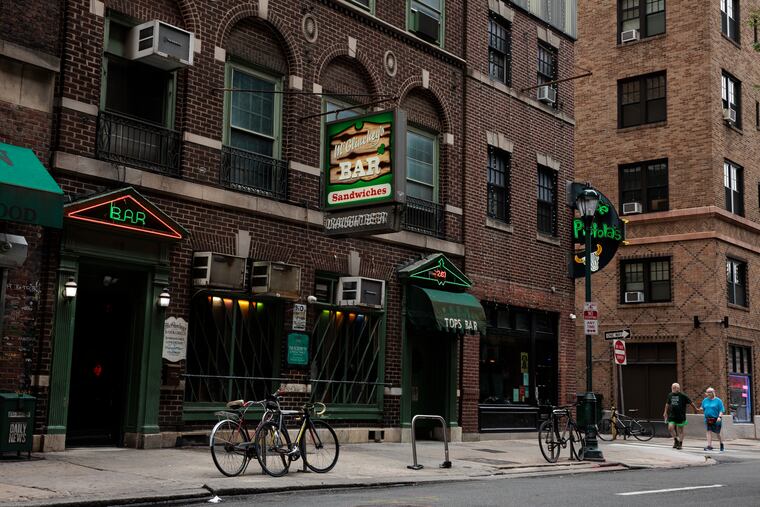
The midafternoon haze was thick inside McGlinchey’s on Monday, less than a day after word had spread that the decades-old dive bar was shuttering at the end of the week. Accordingly, there were far fewer emptier seats than usual around the weathered laminate bar, on which were scattered dozens of Miller High Lifes, empty shot glasses, and no fewer than five packs of cigarettes.
“Do those exhaust fans still work?” asked Fergus Carey, the serial Philadelphia bar owner who got his start in the industry at McGlinchey’s. The bartender told him that the fans embedded in the bar’s storefront did in fact work, but that he didn’t want to vent out the air-conditioning.
“I used to fight with them all the time,” Carey said of McGlinchey’s owners, brothers Ron and Sheldon Sokol, who didn’t want to incur a higher utility bill. “If Ronnie wasn’t there, I’d turn it on and give it a minute and suck the smoke out,” Carey said, sprinkling in a few other choice words.
Carey was one of a tight network of McGlinchey’s alums who took time this week to mull over what the bar had meant to them in life — even if they had moved on to clearer skies from Center City’s last public smoking bar.
In the front corner of the bar, in the glow of McGlinchey’s iconic stained-glass parallelograms, longtime Dirty Franks staffer Abigail Cassatt Willenborg canoodled with her husband of 19 years. The pair met in the early aughts, while she was bartending at McGlinchey’s and he was teaching at the Art Institute of Philadelphia. When they eloped in Las Vegas in 2006, so many McGlinchey’s regulars tuned into the livestream, the chapel shut it down.
Willenborg said she got the job at McGlinchey’s thanks to Jim McNamara, who now co-owns Fergie’s Pub and the Jim with Carey. When he was training her, “Jim told me never to clean without gloves because he got shakes from absorbing the nicotine through his skin.”
Willenborg quit smoking about 18 years ago, a timeline she knows by heart because “my son is 17½ and I quit when I was 5 months pregnant with him,” she said. “I couldn’t take the smoke.”
McGlinchey’s and smoke are inseparable. Jo-Ann Rogan, who worked at the bar on and off between 1989 and 2017, recounted her after-work decontamination process: “When I got home, I would take my clothes off and put them directly in the washer, put the soap on, and start ’em, because they had to be washed twice.” That was followed by a long, hot shower that Rogan compares to a famous scene in Silkwood, the 1983 Meryl Streep movie set in a nuclear plant.
Rogan said she was stricken when she heard that McGlinchey’s is on the way out, even if it’s not happening Friday. “When I thought they were really closing closing, I felt like someone had died," she said. “It hit me harder than I thought it ever would.”
McGlinchey’s history
Hundreds of thousands of Philadelphians (and well beyond) have passed through various permutations of McGlinchey’s over the establishment’s 88-year history. Joseph McGlinchey bought the building at 259 S. 15th Street in the late 1930s and opened a restaurant on the second floor. By the ’50s, a bar had supplanted the book and tchotchke shop on the first floor, according to Hidden City’s thorough examination of the building’s history.
In 1968, Henry Sokol bought McGlinchey’s from Joseph McGlinchey’s widow. Henry’s sons were reportedly there when he signed the papers, but Sheldon — Ron passed away in 2022 — admits he’s fuzzy on that date and pretty much any others, in general. (He marks time by major events. Example: “We had [dinner] until the cook got sick and died. His name was Morris.”)
What Sheldon Sokol is sure of is that McGlinchey’s was always a bargain, even before it became a dive.
“It was always a place that was inexpensive compared to the other places in the area,” he said. “I have menus going back to the time when a pork chop dinner was 50 cents.”
McGlinchey’s used to see a big lunch rush from nearby offices — the famous duck-hunting scene plastered on one of its walls is actually an old billboard that was gifted to it by regulars who walked over from their petroleum-company job — but as Center City changed, the crowd morphed, too.
So did McGlinchey’s. Henry Sokol and his sons installed the bar’s stained-glass panels and took the kitchen out of the second story, converting it to apartments for a time. “My father would rent to young women from [what would become] the University of the Arts,” Sheldon said. “One day, the young man who was with the women drove his motorcycle down the steps from the second floor out to the street. And my father went crackers and kicked them out.”
After 1976, the upstairs became Tops Bar, which led different lives as a disco, a space for live music and poetry readings, and a pool bar (its current state).
Henry Sokol died in 1985, but his sons kept the legacy alive well after — at least that’s how Fergus Carey remembers it from his time behind the bar at McGlinchey’s, from December ’89 until November 1994, when he left to open Fergie’s.
“The [Sokol brothers] always ran it by their father’s rules,” Carey said. “Men were not allowed to wear shorts when bartending. And I’m like, ‘Why is that?’
“My father said, ‘People aren’t going to respect a man in shorts,’” came the answer.
Other rules from Henry Sokol the brothers upheld: Customers were not allowed to sit at the bar with their back to it (“They could have a gun and turn around and then shoot you”) and no ketchup with the 25-cent hot dog (mustard only).
Carey worked at McGlinchey’s during its heyday, before Center City became spoiled for choice. “It was so cheap and so busy,” he said of McGlinchey’s in the early ’90s. “A lot of people come in and they’ll have a pint of Rolling Rock for 80 cents, and then they’ll give me $2 and tell me to keep the change.”
The money was good. In 1990, Lisa Follman was working at Le Champignon, a classy French-Japanese restaurant in Headhouse Square, when a friend called and asked her to pick up a shift waitressing at McGlinchey’s. “I was like, ‘No, I work in a French restaurant,’” Follman said. “She told me how much they made” — about $150 a night — “and I said, ‘I’ll be right there.’”
From that night on, Follman worked at McGlinchey’s. “I think after two nights, I bought a mountain bike,” she said.
Now a school principal, Follman remembers waitressing there as the best job she ever had outside of education. It wasn’t the money — “it was the fun,” she said. “I knew almost everybody that would come in and it was like you were at a party. You were the hosts.”
In the mid ’80s and early ’90s, pre-internet and before cell phones, McGlinchey’s was the starting and ending point for a night out. “When you went there, you found out about all the parties, where the bands were playing, you saw your friends,” Follman said. “It was a lot of Temple, Drexel, University of Arts, PAFA kids all coming together. It was a really big, creative place for a lot of people. And at that time, there were only two places to go: Franks or McGlinchey’s.”
Philadelphia’s most life-changing dive?
Follman’s stint at McGlinchey’s lasted less than three years, but it impacted her life forever. Early on, she said, she mixed with Joe Follman, a whip-smart bartender whom she describes as “not the easiest person to talk to. For whatever reason, I really didn’t like him.”
Within six months, the pair started dating. In 1994, they married. They had their first child a year later and were due with a second when Joe died in a car crash in 1997.
Lisa and Joe’s kids are grown now — one’s clerking for a Supreme Court justice and the other’s in grad school for creative writing — but they’ve known McGlinchey’s their whole lives. “They had to see where their parents met,” Follman said. “If it wasn’t for that place, they wouldn’t have existed.”
Talk to other staffers and you’ll hear over and over that McGlinchey’s was a seminal stop on their journey. “I spent five years behind the bar there, and then that led to Fergie’s and Monk’s and God knows,” Carey said. “It led to my life.”
Sarah Stolfa started working at McGlinchey’s in the late ’90s when she was 21. At the time, she had moved to Philly to play in a punk-rock band — the drummer’s sister got her the gig — and she needed a second job.
Stolfa wound up tending bar and waitressing there for 10 years, during which time she went back to college and earned a degree in photography. She started shooting introspective portraits of McGlinchey’s patrons — always solo — at the bar, channeling a Dutch Masters aesthetic in her compositions. The series of photographs won a New York Times contest for college photography, constituted a large part of Stolfa’s admission to Yale’s master of fine arts program, and went on to become a book called The Regulars (with a begrudging intro from Jonathan Franzen).
When her McGlinchey’s time was up, Stolfa was more than happy to move on. “The day I got my acceptance letter from Yale for my masters, I was supposed to work that night,” Stolfa said. “I called out — it was like, I am not going to work. I am done with this.”
Now the CEO of the East Kensington nonprofit/gallery TILT Institute, Stolfa hasn’t been back to McGlinchey’s in years. She’s hardly sentimental about the bar’s potential closing, but she recognizes how pivotal it was in her own story.
“It was the pictures that I made there that got me out of there and helped me into a totally different life,” she said.
On the opposite end of the spectrum from Stolfa’s clear-eyed acknowledgment is Jo-Ann Rogan’s gushing testimonial. “I’m the wishy one who has all the good memories,” she said.
Rogan has much to attribute to her 28-year stretch at McGlinchey’s: In 1991, she met the band Thorazine — a group that included her future husband — and became its front woman. For years, she would go on tour for months at a time, always coming back to her job at McGlinchey’s. The Sokol brothers would hold her place. (They threw her a big party for her wedding in 2000.)
Rogan was still working there when she finished college; Ron took her and one of her coworkers and fellow graduates out for a celebratory meal. She left when she landed a full-time job in IT consulting, but came back in 2006, when the childcare situation for her two sons — one with high-functioning autism, the other with severe food allergies — reached a crisis point.
“I called Ronnie, and I was like, ‘Ronnie, I have to come back. I got a kid getting kicked out of daycare. Daycare’s more than my mortgage,’” Rogan said. “He’s like, ‘Holy [smokes], Jo-Ann, come back. We’re here.’”
For the next 11 years, Rogan worked a couple of nights a week, handing her kids off to her husband on the drive downtown. It afforded her the flexibility to homeschool her sons and keep a roof over their heads.
Rogan left McGlinchey’s again around 2017 when she couldn’t swing working till 3 a.m. anymore, but she said the bar turns up in her life in unexpected ways. She landed the job she has now in part thanks to a former customer, a blacksmithing UArts grad-turned-coder who went on to become a web developer.
“He started writing HTML after he graduated college, because he had no money and he was going to get evicted,” Rogan remembers. “He would come into the bar and I would give him a sandwich and buy him sodas, and I’d let him plug in his computer because he had no electricity.”
Another time she was touring a college with one of her sons when the president of the school approached her and said, “I know you.” It turned out he had completed his master’s at UArts and had been a regular at McGlinchey’s.
“My kid was like, ‘Mom, can anyone not know you as the bartender from McGlinchey’s?’” Rogan said, laughing.
Over nearly three decades, Rogan saw the business change. “It was still fairly busy even when I left [in 2017], you know, Friday nights were humming,” she said. But that didn’t compare to her first tour, as she calls it. “Every single night of the week in the ’90s, there were people in the waitress station and you’re screaming, ‘Get the [hell] out of the way!’”
Rogan felt better when she learned that Sheldon Sokol plans to sell the bar rather than close it, but she knows this touchstone of Center City Philadelphia nightlife won’t last. She said she’s heard many hypothetical discussions over the years of what people would do if they owned McGlinchey’s.
“Everybody’s had a million ideas about that place,” she said. “Someone’s gonna get it, and they’re gonna do their version of McGlinchey’s.” (Indeed, rumors of potential buyers — be it Carey or the owners of Tony’s Baltimore Grill in Atlantic City — have been swirling since last Sunday.)
What comes next for McGlinchey’s is inevitable, Rogan said. “It’s going to change.”