Attorney General Sunday appeals Pennsylvania court ruling that recognized abortion access as a right
The appeals sets up another clash in the Pennsylvania Supreme Court over the right to reproductive autonomy, and the constitutionality of a ban on public funding for abortion through Medicaid.
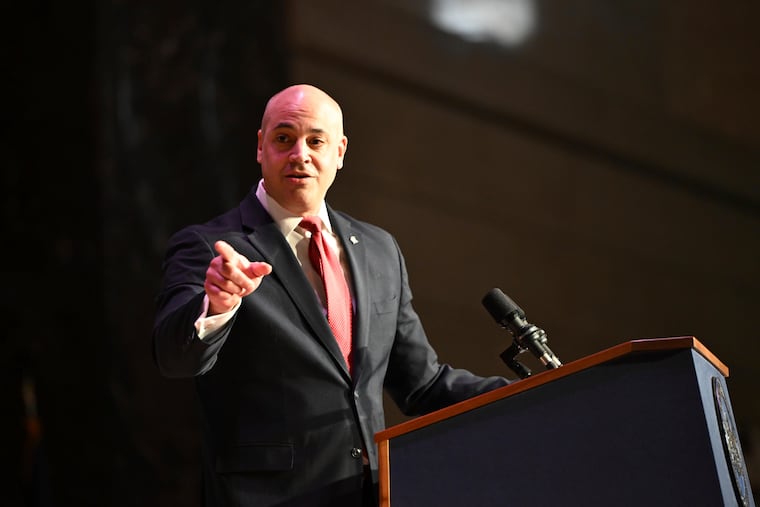
Attorney General Dave Sunday appealed a Commonwealth Court ruling that struck down Pennsylvania’s ban on public funding for abortion and recognized “a fundamental right to reproductive autonomy” in the state constitution.
The case now heads back to the Pennsylvania Supreme Court, where three justices previously signaled their willingness to rule that abortion access is a right.
The Republican attorney general stepped in Tuesday to defend the state law limiting Medicaid funding for abortions after Gov. Josh Shapiro told the court in July 2024 that his administration “cannot advance a meritorious defense” of the policy.
» READ MORE: Pa. court recognizes ‘reproductive autonomy’ as a right, strikes down ban on public funding for abortion
The appeal asks the Pennsylvania Supreme Court to review whether the Commonwealth Court judges were wrong to recognize abortion access as a constitutional right instead of leaving such “important policy considerations” to the “People’s representatives.”
Sunday also asked the justices to consider whether the Commonwealth Court should have avoided addressing a right to reproductive autonomy altogether, and whether the court was too dismissive of the state’s justifications for the ban.
“My responsibility as Attorney General is to defend the rule of law and defend statutes without interference of personal opinion or political posturing,” Sunday said in a statement.
David Cohen, a Drexel University law professor who alongside the Women’s Law Project represented the abortion providers in the case, said it is unfortunate Sunday chose to deny Pennsylvanians their constitutional rights by prolonging the case.
“We look forward to winning once again before the Pennsylvania Supreme Court,” Cohen said.
The state’s highest court ruled in 2024 that the abortion providers had standing to challenge the ban, but in doing so some justices used language strongly endorsing a constitutional protection for abortion access.
In a 219-page plurality opinion, Democrat Christine Donohue and independent David Wecht said Pennsylvania’s Equal Rights Amendment established a right to abortion access and called the funding restriction “presumptively unconstitutional.” (Wecht was elected as a Democrat but left the party this month over what he called its “acquiescence to Jew-hatred.”)
“The fundamental right of a woman to decide whether to give birth is not subordinate to policy considerations favored by transient legislatures,” Donohue wrote on their behalf.
» READ MORE: Pa. Supreme Court Justice David Wecht leaves the Democratic Party over ‘acquiescence to Jew-hatred’
Another Democrat, Justice Kevin M. Dougherty, called his colleagues’ reasoning “incredibly insightful” in a separate opinion that declined to fully endorse the finding at that time.
Democratic Chief Justice Debra Todd and Republican Sallie Mundy in dissents accused their colleagues of shoehorning a larger constitutional question into a narrower case — and said they would have rejected the challenge to the coverage exclusion.
(The court’s two other justices — Republican Kevin Brobson and Dan McCaffery, a Democrat who was sworn in months after the case was argued — did not participate in the 2024 decision.)
That ruling sent the case back to the Commonwealth Court, with instructions to review whether the state can justify an interest that would allow for a funding ban that amounts to a “sex-based distinction.”
A four-judge Commonwealth Court majority rejected arguments by Sunday’s office that the ban is justified to protect fetal life, the psychological well-being of women, and the conscience of citizens who do not want their tax dollars paying for abortions.
There are less-intrusive ways than the funding restriction to address these concerns, Judge Matthew Wolf, a Democrat, wrote for the majority.
The opinion further found a right to reproductive autonomy in the state constitution.
Recognizing the right is necessary to restrict government “attempts to coerce reproductive choice,” Wolf wrote.
“Those choices are the People’s, not the government’s,” Wolf wrote.
The three-judge dissent, authored by Republican Patricia McCullough, attacked the majority opinion, saying it declared that “corporate” abortion providers have “have a constitutionally mandated ability to bill Pennsylvania taxpayers to pay for abortion on-demand.” It also admonished the majority for issuing a ruling without hearing more evidence.
“I simply cannot recall another case in which this Court has decided issues of such profound public importance in this kind of summary, we-believe-you-if-you-say-so fashion,” McCullough wrote.
While Sunday remained mum throughout the 30-day window to appeal, and asked the Supreme Court to review the case with little fanfare, Shapiro celebrated the Commonwealth Court ruling.
“I’ve long opposed this unconstitutional ban, and as Governor, I did not defend it — because a woman’s ability to access reproductive care should never be determined by her income," the governor posted on X in April.