Pa. court recognizes ‘reproductive autonomy’ as a right, strikes down ban on public funding for abortion
In a 4-3 ruling, the Commonwealth Court found that abortion access is a fundamental right guaranteed by the Pennsylvania Constitution.
Pennsylvania’s ban on public funding for abortion is unconstitutional, a divided Commonwealth Court ruled Monday.
In reaching that conclusion, the statewide court that oversees government-related matters recognized “a fundamental right to reproductive autonomy” in the Pennsylvania Constitution.
The finding likely sets up another clash over abortion in the state Supreme Court, where three justices previously signaled their willingness to rule that abortion access is a right.
Recognizing the right is necessary to restrict government “attempts to coerce reproductive choice,” Judge Matthew Wolf, a Democrat, wrote for the 4-3 majority.
“Those choices are the People’s, not the government’s,” Wolf wrote.
The court further found that the Medicaid funding restriction was a “sex-based distinction” and rejected the argument from the Pennsylvania Attorney General’s Office that the distinction was justified because the state has an interest in protecting fetal life, the psychological wellbeing of women, and the conscience of citizens who don’t want their tax dollars paying for abortions.
There are less-intrusive ways than the funding restriction to address these concerns, Wolf wrote.
Fellow Democrats Michael Wojcik and Lori Dumas joined the majority opinion, as did the Republican President Judge Renee Cohn Jubelirer.
It is unclear how quickly people on Medicaid would be able to have abortions covered. The office of Attorney General Dave Sunday, who defended the Medicaid funding restriction in court, said it was reviewing the decision and did not immediately say whether the office would appeal.
The three-judge dissent, authored by Republican Patricia McCullough, attacked the majority opinion, saying it declared that “corporate” abortion providers have “have a constitutionally mandated ability to bill Pennsylvania taxpayers to pay for abortion on-demand.”
There are still unanswered question of facts in this case, McCullough wrote, and the majority “short circuited” the process by issuing its ruling without hearing more evidence.
“I simply cannot recall another case in which this Court has decided issues of such profound public importance in this kind of summary, we-believe-you-if-you-say-so fashion,” McCullough wrote.
The dissent also accused the four judges in the majority of minimizing the “present value” of “an unborn child’s life.”
Republicans Anne Covey and Stacy Wallace joined the dissent.
Elizabeth Lester-Abdalla, a Women’s Law Project attorney who argued the case in Commonwealth Court on behalf of abortion providers, called the ruling a “landmark victory.”
What makes the ruling so significant is the erosion of federal protections for reproductive rights following the 2022 U.S. Supreme Court decision that reversed Roe v. Wade. Advocates nationwide turned to their state constitutions for protections.
“It’s massive,” Lester-Abdalla said. “It’s historic.”
Abortion is legal in Pennsylvania through the 23rd week of pregnancy, but restrictive state policies make accessing care difficult. Patients must wait 24 hours after initial abortion counseling before having the procedure, and patients under age 18 must have a parent’s consent.
There are fewer than two dozen abortion providers in Pennsylvania — three are in Pittsburgh, and the rest are located east of Harrisburg.
And since the Supreme Court overturned Roe v. Wade, patients from states that have severely restricted or banned abortion have been increasingly turning to Pennsylvania and other states where it remains legal.
A seven-year battle
The ruling is the latest in a lawsuit filed in 2019 on behalf of seven abortion providers who argued that the coverage restriction violates the Equal Rights Amendment because it excludes women and there is no comparable exclusion for men’s reproductive health.
The limit on Medicaid funding amounts to an abortion restriction for poor women, attorneys for the providers told the court.
The Commonwealth Court dismissed the case in 2021, finding that the abortion providers didn’t have standing to challenge the funding restrictions.
But the Pennsylvania Supreme revived the case in 2024 and instructed the Commonwealth Court to determine whether the restriction was constitutional under the highest level of legal scrutiny.
In a 219-page plurality opinion, Democrats Christine Donohue and David Wecht said Pennsylvania’s Equal Rights Amendment established a right to abortion access and called the funding restriction “presumptively unconstitutional.”
“The fundamental right of a woman to decide whether to give birth is not subordinate to policy considerations favored by transient legislatures,” Donohue wrote on their behalf.
A third Democrat, Justice Kevin M. Dougherty, called his colleagues’ reasoning “incredibly insightful” in a separate opinion that declined to fully endorse the finding at that time.
Democratic Chief Justice Debra Todd and Republican Sallie Mundy in dissents accused their colleagues of shoehorning a larger constitutional question into a narrower case — and said they would have rejected the challenge to the coverage exclusion.
(The court’s two other justices — Republican Kevin Brobson and Dan McCaffery, a Democrat who was sworn in months after the case was argued — did not participate in the 2024 decision.)
Sunday steps in
The administration of former Gov. Tom Wolf defended the coverage ban in court, part of a tradition of executives defending challenges to legislation even if they disagree with the policy.
Gov. Josh Shapiro took a different path and declined to defend the case, telling the court in July 2024 that his administration “cannot advance a meritorious defense” against the providers’ arguments after the Supreme Court’s ruling.
Sunday, a Republican, stepped in to defend the ban instead of the administration.
“If the People of Pennsylvania desired a constitutional right to reproductive autonomy, they would have clearly said so in their Constitution,” Sunday said in a filing as part of the lead up to Monday’s ruling. “They have not.”
Silence and celebration
Republicans were largely quiet on Monday following the Commonwealth Court’s ruling.
A spokesperson for Senate Republican Caucus said in a statement that the legislators were “reviewing the impact of the decision and awaiting word if there will be an appeal.”
In the evening, Treasurer Stacy Garrity, a Republican who is challenging Shapiro for his seat as governor, posted on X that the court’s ruling “wasn’t only misguided, it is immoral.”
“We cannot allow four activist judges to have the final say on how our tax dollars are spent,” Garrity wrote.
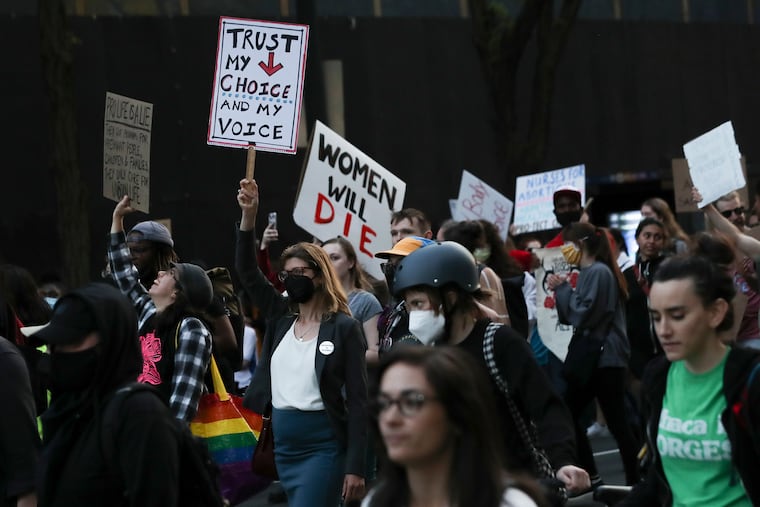
Meanwhile, Democratic officials and reproductive-rights advocates were taking victory lap.
Shapiro posted on X that he did not defend the Medicaid coverage restriction “because a woman’s ability to access reproductive care should never be determined by her income.”
The Women’s Center and Planned Parenthood Southeastern Pennsylvania, two of the providers who filed the lawsuit and provided services in the Philadelphia area, applauded the ruling.
Dayle Steinberg, CEO of Planned Parenthood Southeastern Pennsylvania, called the ruling a “major victory.”
“Reproductive autonomy is now a fundamental right in Pennsylvania. We have waited so long for this win,” she said.
Roxanne McNellis, a spokesperson for The Women’s Centers, said the ruling dismantled a system that stood in the way of access for many people since enacted decades ago.
“This decision is going to change lives, and once it is implemented, people on Medicaid won’t have to make a choice between paying rent, buying groceries, and affording healthcare,” McNellis said.