New Philadelphia-area cardiovascular surgery centers are pulling profitable procedures from hospitals and charging less
Four centers have opened or are in the final stages of approvals in Southeastern Pennsylvania after state lawmakers in 2022 broadly expanded the types of procedures allowed outside hospitals.
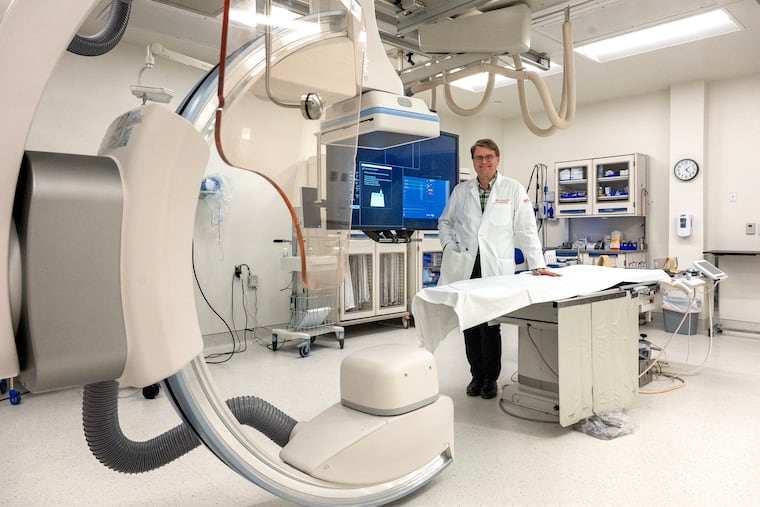
At AMS Surgery Center in suburban Montgomery County, patients can park right in front of the entrance, walk through just a few doors, and undergo cardiac procedures in a sterile operating room with equipment as high-tech as in any hospital procedure room.
In the year and a half since its first patient underwent a cardiac catheterization, the center has performed more than 1,000 cardiac procedures that previously required patients to go to full-service hospitals.
The Horsham center showcases a new front as sophisticated healthcare procedures move to freestanding outpatient medical facilities, promising to save patients money. The shift also adds to the financial pressures facing the region’s hospital-centered health systems.
Four centers have opened or are in the final stages of approvals in Southeastern Pennsylvania. Their arrival comes after state lawmakers in 2022 broadly expanded the types of procedures allowed outside hospitals to include cardiac catheterizations, pacemaker implants, and other treatments that until then had to be done in a hospital.
Pennsylvania is the first Northeastern state to allow the minimally invasive procedures in freestanding surgery centers, but Southern states like Florida, Louisiana, and Texas have permitted the practice for decades, experts said. Research has found surgery centers generally are as safe as outpatient departments in hospitals.
An independent physicians group, Bryn Mawr Medical Specialists Association, opened Heart & Vascular Center of the Main Line — the Philadelphia region’s first such center — in late 2022. in Bryn Mawr. AMS Surgery Center in Horsham performed its first procedure in the fall of 2024, initially treating only Medicare patients. It added patients with private insurance last summer.
The market has continued to rapidly expand: ReVaMP Heart & Vascular Surgery Center in Center City started treating Medicare patients last fall. The Ambulatory Cardiovascular Center of Pennsylvania, near King of Prussia, expects to perform its first procedures on patients next month.
Medicare pays the centers about a third less than hospital outpatient departments for the same procedures, but the centers have significantly lower costs, allowing them to be profitable. Medicare pays physicians the same wherever procedures are done.
Independent cardiology groups traditionally have performed interventional procedures, such as implanting stents and pacemakers, in hospitals. Some are jumping at the opportunity to expand through the surgery centers, where they can have a financial stake in the entire operation.
“We’ve always been very fiercely independent, fiercely entrepreneurial, and patient-centered,” said Richard Borge, an AMS interventional cardiologist who is medical director for the group’s surgery center.
How much cardiac care — among the most profitable business lines for hospitals — will move out of hospital outpatient departments remains unknown. But cardiac surgical clinics will not take over heart care to the extent seen when outpatient orthopedic centers began offering hip and joint replacements, predicted Lauren Clementi, a senior vice president at Kaufman Hall, a Chicago consulting firm.
“This one’s a little trickier because the acuity of patients,” she said.
Cardiologists will continue treating many patients with complex medical needs in hospitals, which remain the only option for riskier procedures such as open-heart surgeries.
Gregory Schmitt went to AMS Surgery Center to undergo procedures for a heart stent and stents in both legs. The retired machine-shop owner, who lives in Ivyland, called such centers great for patients.
“I highly recommend it. It’s much easier than trying to navigate a hospital,” Schmitt said.
How we got here
Healthcare has been shifting away from requiring overnight hospital stays, even for common procedures like cataract surgery. The trend started decades ago with same-day procedures in hospitals, followed by the rise of freestanding surgery centers.
In cardiology, people now commonly receive stents and pacemakers as outpatient care. But until recently, doctors had to implant the devices in a hospital.
“Once upon a time, every patient we cathed had to spend the night in the hospital,” said veteran cardiologist Mark Victor, referring to cardiac catheterization.
With the rise of outpatient procedures, Victor said, the question for many clinicians became: “If they’re hospital ambulatory, why do they have to be in the hospital at all?”
Victor has long advocated for the adoption of outpatient cardiology procedures as the CEO of Cardiology Consultants of Philadelphia. The large cardiology practice joined last year a national private-equity backed group, Cardiovascular Logistics, and will soon start performing surgical procedures at the center opening near King of Prussia.
In 2020, Medicare started paying for outpatient cardiac catheterizations — which entail running a catheter through a blood vessel in the thigh or wrist to examine the heart and install devices like stents.
Even then, Pennsylvania rules required cardiac catheterizations to occur in an acute-care hospital, according to Stephen Abresch, director of government affairs for the Ambulatory Surgery Center Association, a national trade group in Alexandria, Va.
Pennsylvania lawmakers cleared the way for expansion by eliminating that restriction in 2022 as part of a broad expansion of what the state’s surgery centers were allowed to do. “It had been a quarter century since the state had gone in and reviewed that,” he said.
Beginning this year, Medicare started paying surgery centers to perform treatments for irregular heartbeats, known as cardiac ablations.
The Heart & Vascular Center of the Main Line has scheduled its first cardiac ablations this week. Horsham’s AMS aims to start offering those procedures in June. Victor’s King of Prussia group expects to add ablations in the future as well.
Impact on hospitals
It is too soon to know how the new surgery centers will impact the region’s existing health systems. In some cases, independent cardiologists generate significant patient numbers for hospitals’ cath labs.
After Bryn Mawr Medical Specialists opened its cardiovascular surgery center near Main Line Health’s Bryn Mawr Hospital, the private group performed fewer procedures on low-risk patients at the hospital.
To sustain patient volumes, Main Line has increased collaboration with other physician practices, while continuing to treat an “older patient population, whose more complex health conditions require the advanced expertise and emergency support only a hospital setting can provide,” officials said in a statement.
In Horsham, most of the patients coming to AMS would have gone to Jefferson Abington Hospital before the surgery center opened in partnership with Atria Health, a private-equity backed group, Borge said.
Jefferson declined to comment.
King of Prussia’s Ambulatory Cardiovascular Center of Pennsylvania is opening through an unusual four-way partnership involving Cardiology Consultants of Philadelphia, Cardiovascular Logistics, SCA (a unit of UnitedHealth’s Optum), and the University of Pennsylvania Health System.
“Ours is not going to seriously impact any one hospital system, which they’re all relieved about,” said Victor, who is also president of the Mid-Atlantic region for Cardiovascular Logistics. He said other health systems were invited to invest in the surgery center, but only Penn did so.
Penn declined to comment for this article. On the Alvarez & Marsal What’s Your Moonshot podcast, the health system’s chief operating officer, Michele Volpe, recently said the system needs ”to move a bit faster in taking much of the work that we are doing in inpatient ORs and moving them into outpatient or ambulatory freestanding ORs.”
Center City’s ReVaMP Health & Vascular Surgery Center wants to bring in cardiologists from nonaffiliated practices, and even the city’s big health systems. The facility opened last year, spearheaded by Re-Vasc Med Professionals’ two interventional cardiologists in partnership with Surgery Partners, a publicly traded manager of surgery centers nationwide.
“I’m 100% sure this is going to be the trend of the future,” Re-Vasc CEO and founder Jon George said.
A health insurer’s perspective
Richard Snyder, a top executive at Independence Blue Cross, the largest health insurer in Southeastern Pennsylvania, has for years watched joint replacements and other procedures shift from hospitals to lower-cost surgery centers.
The financial impact goes beyond the lower prices at surgery centers, he said, expecting that hospitals will not simply cede these patients to new competitors.
Some hospitals might decide to take a lower payment for outpatient procedures. “Traditionally, that happens when we have capacity in lower-cost settings,” he said.
At the same time, Medicare is pushing to pay the same price for services, wherever they are performed. “Hospitals, by necessity, will need to move some things to lower-cost settings in order to not lose money on them,” Snyder said.