UPenn, where mRNA vaccine tech was pioneered, will not lose funding as feds cut $500M in mRNA grants
There have been no changes to the licensing and royalty agreements related to mRNA research that have netted the university more than $1 billion in the last several years.

Researchers in Philadelphia reacted with alarm this week when the Department of Health and Human Services announced that it is cutting $500 million in funding for mRNA vaccine development.
But the cuts will not affect mRNA research at the University of Pennsylvania, where two scientists first pioneered its use in COVID-19 vaccines, later winning a Nobel Prize for their work.
And there have been no changes to the licensing and royalty agreements related to mRNA research that have netted the university more than $1 billion in the last several years, said Holly Auer, a spokesperson for the university.
Still, Auer added: “The erosion of federal funding for lifesaving research poses significant challenges for our investigators and trainees and for the pipeline of new breakthroughs.”
The cuts, announced by Health and Human Services Secretary Robert F. Kennedy Jr., impact grants dispensed under the Biomedical Advanced Research and Development Authority. None of those grants went to Penn, officials there said.
Kennedy, a longtime anti-vaccine activist, said in a statement that the agency is beginning a “coordinated wind-down” of mRNA vaccine development at BARDA.
He said that mRNA vaccines are ineffective and that more traditional methods of developing vaccines, including using live and inactivated viruses, are safer. He said the agency supports “safe, effective vaccines for every American who wants them.”
Researchers around the state said that’s a dangerous misconception of mRNA vaccines — and that Kennedy risks stifling research on a promising new technology in the United States while other countries continue to innovate.
“mRNA is one of the biggest steps forward in vaccine technology in human history, and we’re going to step away from it and leave it to the rest of the world?” said Andrew Read, the senior vice president for research at Pennsylvania State University, which was not impacted by the BARDA cuts.
How mRNA vaccines work
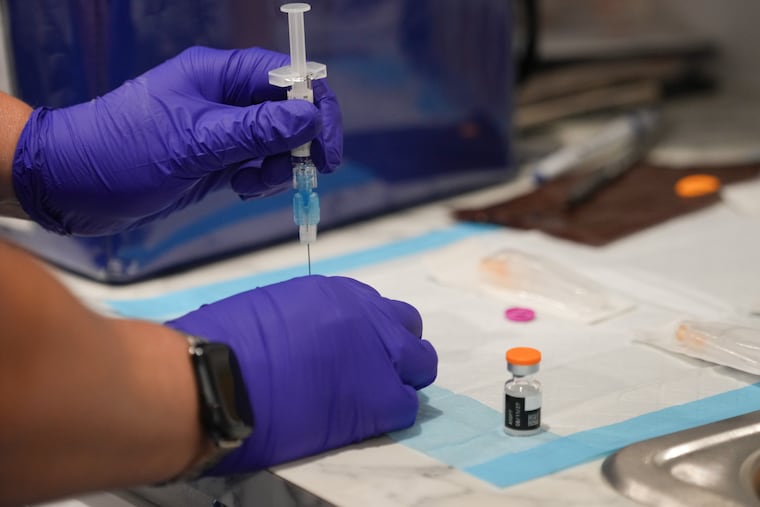
Vaccines that use mRNA work by instructing a person’s cells to build a harmless fragment of a pathogen like the coronavirus. In response, the immune system develops antibodies that can recognize that fragment and fight the pathogen if it infects the body.
These vaccines can be produced much more quickly than traditional vaccines and are particularly useful in a pandemic, experts say.
“The advantage of mRNA technology is its rapidity. In an emergency, such as what happened with COVID, you can more quickly develop an mRNA vaccine than any other technology,” said Stanley Plotkin, an emeritus professor of pediatrics at Penn and an emeritus professor of virology at the Wistar Institute.
That’s also true for research on new vaccines, said Ronald Collman, the director of the Penn Center for AIDS Research. Some researchers in his center are studying mRNA technology — a particularly promising avenue for development of an HIV vaccine, he said.
“The development of vaccines is incredibly more efficient and more likely to be successful because you can study, test, and develop more things with mRNA,” he said. “And the efficiency makes a difference. A group may not pursue developing a vaccine against something serious if they can’t do it with mRNA, because it will just never be efficient enough to do it through another technology.”
Vaccines that use live or inactivated viruses, like Kennedy mentioned in his statement, are effective against some viruses but not all, said Harvey Friedman, a Penn professor of infectious disease working on an mRNA vaccine for genital herpes.
“It’s not bad technology — but it’s been used where it can be used. The newer technology is needed to approach the harder-to-treat viruses that still remain,” he said.
There are some disadvantages to mRNA vaccines, Plotkin said: Other types of vaccines provoke a better immune response or provide more lasting protection from a pathogen. For instance, some people who receive COVID-19 vaccines will still get the virus, but are much less likely to become extremely sick.
But mRNA vaccines serve a crucial public health purpose, and slashing research funding for mRNA vaccines risks the public’s health, he said.
“Vaccine technology depends on the circumstances and the biology of the pathogen. Removing mRNA as a possible technology to develop vaccines is a stupid decision because it limits us from responding in the most intelligent fashion to the circumstances, whatever they are,” he said.
‘You’re not going to stop science’
Mohamed-Gabriel Alameh, an assistant professor of pathology and laboratory medicine at Penn, is developing an mRNA vaccine to prevent infections from the bacteria C. difficile, which kills about 30,000 people a year in the United States.
He does not receive BARDA funding, but had been planning to apply for several grants from the program. Now, he’s reconsidering.
“It’s a cut on opportunities in the future that will definitely impact research,” he said. “The more they cut, whether from BARDA or not, the less available money there is. So everyone is going to be affected.”
Scientists will increasingly turn to other funding sources, experts said.
Friedman’s work is funded in part by the German pharmaceutical company BioNTech, which produced a COVID-19 vaccine with Pfizer.
He has some grants from the National Institutes of Health that have not been terminated, unlike many others in the Philadelphia region.
“You’re not going to stop science. You may stop it or slow it down in this country, but it won’t stop worldwide, and all that will happen is that the United States falls behind,” Friedman said.