In the weeks before independence, the man from Monticello drafts a declaration
Dispatches from 1776, Part II: The temperature of a revolution is rising.
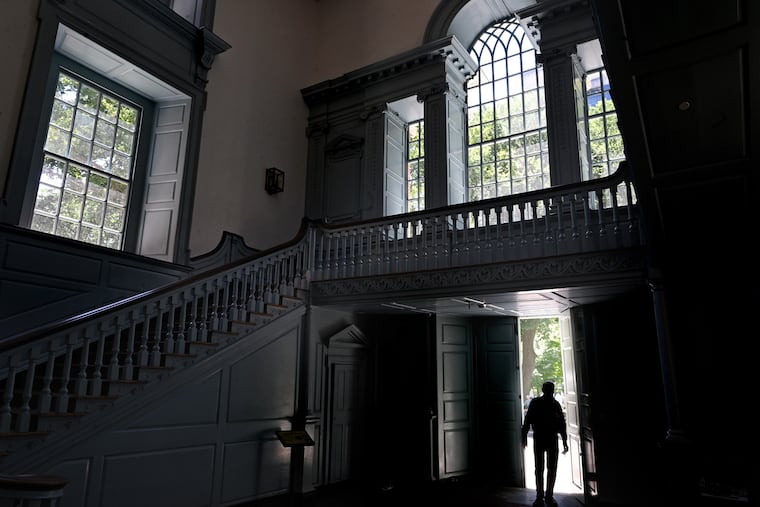
Philadelphia. June 1776.
America stands on the brink. The ultimate question of independence hangs over Philadelphia.
And Thomas Jefferson has a declaration to draft.
His heart is in Virginia. His “country,” as he calls it. But here he is at Seventh and High Streets, 33 years old, living in two sweltering rooms, with his chance to make his mark on history.
Unlike his fellow delegates, lodged in rooms along Philadelphia’s booming riverfront, Jefferson takes quarters along the city’s rural western edge, two blocks from the Pennsylvania State House, where the rebels conspire. The orchards and pastures bordering the downtown of British America’s largest and wealthiest city offer an escape from Philadelphia’s stifling summer heat and foul smells. Its stinking creeks, rotting trash, and unchoked illness. The verdant outpost, elsewise occupied by a bricklayer and his family, provides “the Squire,” as his friends back home call him, some small semblance of his mountaintop mansion, Monticello.
He is living out of leather-bound trunks. Fresh air and sunlight stream through a window overlooking High Street — Philadelphia’s main thoroughfare, busy even on the outskirts. Hinterland farmers’ wagons clatter over cobbles, headed for the market. The sweet scent of fresh loaves drifts from a shopfront bakery. Jefferson’s thoroughbred — Caractacus, perhaps, his favored bay stallion, whose regal appellation derives from a first-century British chieftain — nickers in a nearby stable.
Robert “Bob” Hemmings, Jefferson’s 14-year-old enslaved valet — and half brother of Jefferson’s future paramour, Sally — attends his every need in Philadelphia, sleeping in a garret off the writing parlor.
The rag paper resting on Jefferson’s mahogany travel desk — a small, portable lap device of his own design that the inveterate tinkerer had commissioned from a Chestnut Street cabinetmaker upon his arrival in Philadelphia a month earlier — remains blank. His quill is still. In the shadows, a grandfather clock ticks a stately rhythm.
Tick … tock … tick … tock.
The master of Monticello is working on a deadline.
A momentum for independence
Tarrying at the threshold of independence for months, the roar of rebellion echoes throughout Philadelphia by late spring.
Just weeks earlier, more than four thousand Philly patriots braved driving rains to gather in the brick-walled yard of the State House. Celebrating the Second Continental Congress’ decree to form new governments apart from King George III — the masterstroke of John Adams, 40 — the drenched Philly masses thunder for independence.
George Washington himself takes brief leave of his embattled army, digging in for an expected British assault on New York, to update the 56 congressional delegates in Philadelphia. The general’s tidings are lost to the centuries. But hear the lusty huzzahs that greet the stoic warrior at the representatives’ nightly repast at City Tavern, their unofficial headquarters.
“George Washington, and victory to the American arms!” goes the toast.
Inside the locked chamber, radicals like Adams and his older cousin, and backroom operator, Samuel, 53, lead the fight for liberty. Jefferson, whose resolve for popular government in America is unquestioned, but who detests public speaking, rarely rises.
In early June, it is Jefferson’s fellow Virginian, the passionate patriot Henry Lee, who delivers a decisive stroke, boldly uttering words hitherto unsaid in Congress: “That these United Colonies are, and of right ought to be, free and independent.”
The thunderclap is met by delay. Delegates from powerful colonies, including Pennsylvania’s own reluctant son of liberty, John Dickinson, are hesitant to cut the cord. Radicals work furiously to build unanimity.
Philly headlines — in the same papers publishing fugitive slave ads and notices for the sale of Black children far younger than Bob Hemmings — decry “our mortal enemy the King of Great Britain.”
“The people wait for us to lead the way,” Jefferson will note.
During the delegates’ fiery, closed-door debates, his long legs folded underneath his desk, Jefferson stays mum.
But now the poet-philosopher and slaveholder, whose bright brilliance and dark contradictions mirror perfectly the promise and sins of the nation he seeks to author, must find all the words.
A renaissance figure among the rebels
It is John Adams, in characteristically gruff fashion, who appoints Jefferson first quill. The good gentleman from Virginia is but one of five men appointed to draft America’s creed — including Adams and Franklin, home sick with gout and other ailments — but Adams argues it is Jefferson, with his “peculiar felicity for expression,” who should do the writing.
“Reason first, you are a Virginian, and a Virginian ought to appear at the head of this business,” Adams recalls telling Jefferson in the committee’s first convocation. “Reason second, I am obnoxious, suspected, and unpopular. You are very much otherwise. Reason third, you can write 10 times better than I can.”
Adams is right.
Both drawn to the flame of American independence — the noblest cause of their age, and any other, they believe — the freedom fighters cut an odd coupling.
Adams, short, plump, balding, cantankerous. Jefferson, tall, lean, formidable, a shock of copper hair, freckled in the Philly heat, his illusive eyes described as blue or hazel or light gray. The Southern planter and legislator who matriculated at the College of William & Mary is soft-spoken and painfully gracious and polite, charming, flirtatious. He abhors confrontation.
Behold this true renaissance figure among the rebels.
A lover of food and wine and fine things, he studies art and history, philosophy and mathematics, science, botany, astronomy. He speaks four languages and can aptly read ancient Greek. He has been building his Palladian plantation house — situated on land more than five times bigger than the core of Philadelphia, the makeshift colonial capital city, and toiled by more than 100 chained souls — since the age of 14.
Adams, obsessive even in his sightseeing, catalogs and compares the marvels of Philadelphia — its spacious thoroughfares, leafy green spaces, commanding skyline, including Christ Church’s heaven-kissing steeple, the tallest structure Washington had ever laid eyes on, its booming ports, gleaming institutions, exotic foods, and bottomless wine, porter, and punch.
During his few hours free from the rigors of revolution, Jefferson shops.
With Bob touting bulging bundles, the Squire strolls Philadelphia’s abundant artisanal shops, buying maps and books across all his tastes — so many volumes, he commissions his favorite Philly cabinetmaker to make a specialized bookcase to ship them home — and tools for Monticello. He buys fine fabrics for his wife, Martha, whom he is heartsick for. An elegant doll for his 4-year-old daughter, Patsy. He buys a straw hat for himself, and shoes and socks for Bob. At a market stall, he pays a shilling to gaze upon a merchant’s exotic monkey.
Along with his compatriots, he sups at the City Tavern most nights, enjoying as many as three glasses of wine, but also favors the regal rusticity — and punch — of the Sign of the Conestoga Wagon Tavern on High Street.
Envision him, this sun-freckled Moses of American history, in flesh and bone, a living, breathing man, donning a sun hat, whose first memory is being held on a pillow by an enslaved worker, and who will within days pen the most revolutionary, if fatally flawed, manifesto ever put to parchment, walking among, but set apart from, the working classes of Philadelphia. The laboring, the indentured, and the enslaved — all those he would conversely see lifted to the altar of democracy or sold at the auction block.
See this man. And understand America.
An expression of the American mind
He envisions his task to “place before mankind the common sense of the subject.” A justification for revolution, yes. A litany of proof that King George was a tyrant — and among other things, in an epic, and ultimately unsuccessful, act of blame-shifting, responsible for the entirety of the slave trade. But not a wholly original document. Rather, a soaring summation of the American revolutionary zeitgeist.
“Neither aiming at originality of principle or sentiment, nor yet copied from any particular and precious writing, it was intended to be an expression of the American mind, and to give to that expression the proper tone and spirit called for by the occasion,” he will later explain.
In his parlor, with the tall clock ticking and Bob tending to tea, Jefferson works fast, pulling from his own writing — including his recent draft for a new Virginia constitution — and also from a declaration of rights for Virginia, penned by pal George Mason. From the whirling stream of his intellect, he plucks at will the inspirations and ideals of the seminal works of enlightened thinkers like John Locke and David Hume, whose writings on natural rights and freedom (“Life, liberty, and property,” Locke wrote, before Jefferson amends it for the better) provide the bedrock for the revolution.
Quickly, he begins to find his words. The rag paper fills.
“We hold these truths to be self-evident,” writes the man from Monticello.
Dispatches from 1776, Part III will be published online on July Fourth. Read Part I here.
This historical sketch is based on interviews with Tyler Putman, manager of gallery interpretation at the Museum of the American Revolution, and Michael Idriss, manager of the African American interpretive program at the Museum of the American Revolution, as well as J.M. Duffin, assistant archivist at Penn Libraries, historian and author Michelle Craig McDonald, and Stephen Nepa, history professor at Pennsylvania State University’s Abington campus. The author also based this series on historical newspaper accounts and research from “John Adams,” by David McCullough (Simon & Schuster, 2001), “Declaration: The Nine Tumultuous Weeks When America Became Independent, May 1-July 4, 1776,” by William Hogeland (Simon & Schuster, 2010), “American Scripture: Making of the Declaration of Independence,” by Pauline Maier (Random House, 1997), “The Revolutionary: Samuel Adams,” by Stacy Schiff (Little, Brown & Co., 2022), “Cocked and Boozy: An Intoxicating History of the American Revolution,” by Brooke Barbier (Chicago Review Press, 2026), “Thomas Jefferson: The Art of Power,” by Jon Meacham (Random House, 2012), “Rum Punch and Revolution: Taverngoing and Public Life in Eighteenth Century Philadelphia,” by Peter Thompson (University of Pennsylvania Press, 1999), “The Thomas Paine Reader” (Penguin Books, 1987), and “1776,” by David McCullough (Simon & Schuster, 2005).