In the weeks before the Declaration of Independence was signed, Philadelphia was alive with sights, sounds, and ideas
Dispatches from 1776: What would it feel like to walk the streets of the city 250 years ago?
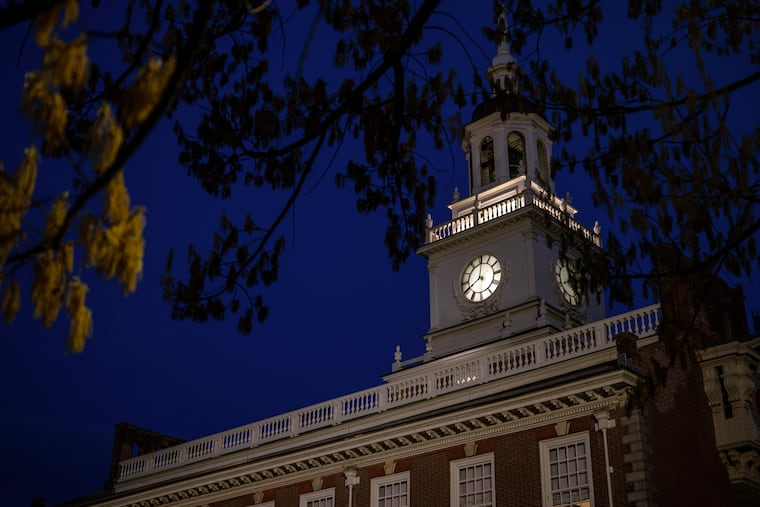
Philadelphia. May 1776.
Finally, the tide has turned. Independence is alive in Philadelphia.
And John Adams is ready to pounce.
He writes by flickering candlelight in the rented rooms of a Second Street lodging house kept by a Mrs. Sarah Yard. Like many of his fellow delegates from across the colonies, all but foreigners to each other when they arrived nearly two years earlier, Adams marvels over the largest, wealthiest city in British North America.
He strolls the spacious and planned streets, a far cry from Boston’s unorganized sprawl, taking in the city’s jaw-dropping skyline, including the cloud-piercing spire of Christ Church, the tallest building in the colonies, its leafy green spaces, its bustling port extending two miles along the Delaware.
The city’s stately public buildings, noble churches, and rows of handsome redbrick homes where cherry blossoms burst from gated yards. And the massive public market along High Street, where hucksters hawk rich buckwheat cakes, gingerbreads, plump fish and butchered meats, and cry out: “Oysters! Fine fat oysters!” and “Pepper pot! All hot!” — a popular spicy stew sold by free and enslaved Black women.
See, too, the misery Adams witnesses. The shackled, enslaved, and indentured whose freedom pleas go unheard in the sunlit chamber of the State House, at Sixth and Chestnut, where the rebels conspire. The slave auctions at the London Coffee House and merchant exchange on Front Street, where patriots plot around the big urns, while human beings are trafficked on the cobbles. The smallpox victims filling the city’s new hospital. The condemned criminals and debtors crowding filthy Walnut Street Jail. The stone prison’s stockades nearly abut the leafy State House Yard and observatory platform where the delegates break from the fiery, guarded, closed-door debates. And the city’s gleaming new almshouse — or “bettering house,” in the parlance of the day — which Adams, puritan to his brass-buckled shoes, finds especially impressive.
Adams, 40, of Massachusetts, has spent months relentlessly leading the charge for independence in the Second Continental Congress. Few of the 56 delegates to America’s makeshift government have done more to steer the country on its still-uncertain path toward independence than the unyielding farmer and lawyer from Boston.
Meanwhile his less-refined older cousin — and Britain’s most wanted man in America — Samuel, 53, commands a campaign of persuasion in the shadows. A failed maltster turned master political operator, Samuel Adams muscles wavering delegates during secret midnight parleys in smoky Philadelphia taverns and dimly lit lodging houses — and at the representatives’ nightly repasts of roasted meats and fish, turtle soup, sweet potato biscuits, pies, and bottomless porter, punch, and wine at the genteel City Tavern, the delegates’ unofficial headquarters.
Independence is a delicate dance, and the Adams are lords of the waltz.
The shooting that started in April 1775 when bands of Massachusetts guerrilla fighters confronted crack British regulars at Lexington, then continued at the bloody standoff at Bunker Hill in Boston, now threatens Philadelphia. Just days earlier, a small fleet of America’s hodgepodge Navy beat back British men-of-war not 15 miles south of Philadelphia’s prized port.
Philadelphia rises. Militias assemble. Rumors course through the panicked streets. And a Philadelphia immigrant’s plainly written clarion call for independence roars like a thunderclap.
“The cause of America is in great measure the cause of all mankind,” Thomas Paine wrote in “Common Sense” in January 1776.
Flying off the shelves of Robert Bell’s Third Street publishing shop, the 47-page pamphlet mocking the monarchy has shifted independence from a radical daydream into a public outcry. With 120,000 copies already sold, pirated editions thrive on a booming black market. At times in the winter and early spring, it seems there is a copy of “Common Sense” in every hand, read aloud in every tavern, from the regal Indian Queen on Fourth Street, where Thomas Jefferson sips sangaree, to the city’s 200 licensed tippling joints, inns, disorderly houses, dram shops, and grog shops with names like Bunch of Grapes, Tun Tavern, the Old Plough, and Man Full of Trouble, where working stiffs tip their tankards.
By May 1776, Philadelphia is a powder keg. The Adamses are content to light the match.
John Adams stands ready to reveal his endgame for freedom — a strategy he hopes can produce a revolutionary manifesto that thunders out the birth of a new nation, one forged in liberty and freedom. In his journal, he envisions it as a “Declaration of Independency.”
Colossus of independence
Adams writes. Not a declaration. Not yet. The philosophical justification of the colonies’ split from King George III will come later — and demand a better hand than his own. What is needed now is a formal motion clearing the way for independence. A blueprint for freedom. A resolution authorizing the 13 colonies to form independent governments.
Behold this unlikely colossus of independence in the trembling candlelight. Short, plump, stern, balding, a plain, powdered wig fashioned in a low ponytail in the style of a gentleman. Begrudgingly respected by even his most ardent foes, Adams readily admits to being obnoxious and unpopular. He lacks the easily alluring traits of his more celebrated contemporaries: The martial regality of George Washington. The quiet charisma and brilliance of the poet-philosopher Jefferson (yes, yes, the Virginia plantation owner will do nicely for the declaration, Adams thinks). The world-renowned wit and charm of Philly’s favorite elder statesman, Benjamin Franklin.
John Adams does not aim to move men with his words, but convince them.
“Whereas it appears absolutely irreconcilable to reason and good conscience for the people of these colonies now to take the oaths and affirmations necessary for the support of any government under the crown of Great Britain …”
He writes to the chaotic cacophony of British America’s busiest port, a colonial superhighway to the wider world. Experience the smells and sounds that must penetrate his windowsill. Sailors curse in every language. Anchors clank. Masts groan. Cargo thuds on wooden wharves: Pennsylvania timber and grain. Barreled rum, sugar, and molasses from the West Indies. And, lately, more and more smuggled gunpowder.
Church bells ring. Carriages rattle. Beggars cry. Drunkards brawl. Night watchmen cry out the hour. Pigs roam. Garbage rots. Crowds swarm the rising metropolis of nearly 30,000, where independence crackles in the May air.
The Revolutionary city
When not feverishly arguing for the cause of America, John Adams delights in the city’s abundant artisanal shops, bookstores, printing houses, and coffee shops. And he is surely serenaded by the strolling street musicians, who peddle ballad sheets for a penny, and sing the protest tune:
“Then join hand in hand, brave Americans all / By uniting we stand, by dividing we fall,” goes “The Liberty Song,” penned by Philadelphia’s reluctant rebel, John Dickinson.
Soon, Adams would write how he dreaded “the melting heat” of a Philadelphia summer.
An ardent anti-tavernist back in Boston, he can’t help but partake in Philadelphia’s fine food and drink. He writes to his wife, Abigail, about how he abstains from the local cider but “feasts on Philadelphia beer,” especially Robert Hare’s porter, brewed in Northern Liberties and a favorite of Washington’s.
“Everything which could delight the eye or allure the taste,” John Adams wrote of his Philly welcome.
But now, in these days of warm spring rain and fitful sunshine, when independence, as his cousin says, “struggles for birth,” his letters take on a more urgent tone. The strain shows.
It is Abigail, his most trusted adviser and a freedom fighter ahead of her time, who reminds him: “If there was a tide in the affairs of men,” then now is “the flood.”
‘Men of the ages’
Envision Adams, tucking a preamble for his planned resolution into his frock, putting aside his goose quill pen, and heading into the Philadelphia night.
Many evenings, unable to sleep and driven by an unshakable urgency for independence, Adams and his cousin walk these mud-splattered waterfront streets, lit ghostly yellow by whale oil lamps, and framed by the port’s forest of tall ships and topgallants.
See him guided by the dying light of a waning moon, and certainly some new measure of hope, making haste. He arrives at the City Tavern’s large brick building, set back in a lot at Second and Walnut Streets. He climbs two flights of yellow pine board stairs, and steps with purpose into a long room thick with tobacco smoke and delegates deep into their nightly conclave of wine, whiskey, argument, and “sinful feast.”
Imagine them, the future Founding Fathers. These imperfect men for the ages who don’t know it yet, but in the next two months will set the course of the country. And the world.
This historical sketch is based on interviews with Tyler Putman, manager of gallery interpretation at the Museum of the American Revolution, and Michael Idriss, manager of the African American interpretive program at the Museum of the American Revolution, as well as J.M. Duffin, assistant archivist at Penn Libraries, historian and author Michelle Craig McDonald, and Dr. Stephen Nepa. history professor at Penn State Abington. The author also based this series on historical newspaper accounts and research from “John Adams,” by David McCullough (Simon & Schuster, 2001), “Declaration: The Nine Tumultuous Weeks When America Became Independent, May 1-July 4, 1776,” by William Hogeland (Simon & Schuster, 2010), “The Revolutionary: Samuel Adams,” by Stacy Schiff (Little, Brown & Co., 2022), “Cocked and Boozy: An Intoxicating History of the American Revolution,” by Brooke Barbier (Chicago Review Press, 2026), “Rum Punch and Revolution: Taverngoing and Public Life in Eighteenth Century Philadelphia,” by Peter Thompson (University of Pennsylvania Press, 1999), “The Thomas Paine Reader” (Penguin Books, 1987), and “1776,” by David McCullough (Simon & Schuster, 2005).

- Craig LaBan’s guide to the best seafood down the Shore
- How to have a perfect Philly Day, according to children’s book author and illustrator Greg Pizzoli
- The best things we ate this week
- Citywide Quest: Do you know where these Memorial Day-related photos were taken?
- Boardwalk nostalgia and bayside bars in Ocean City and Somers Point | Field Trip
- Their agent told them to skip this house. They bought it anyway. | How I Bought This House
- My neighbors treat the sidewalk like their personal patio. Am I rude for wanting quiet after 10 p.m.?
- Our old Xfinity Live! got fancy, the Shore is stressed, and Ben Simmons is the winner | Weekly Report Card
- Buc-ee’s, brisket and the great American road trip
- See it, hear it, feel it: All the Philly art we loved this week