The Black women whose voices lifted hearts at the March on Washington
Sixty-three years later, the voices and vision of the women of the march have yet to be appreciated.
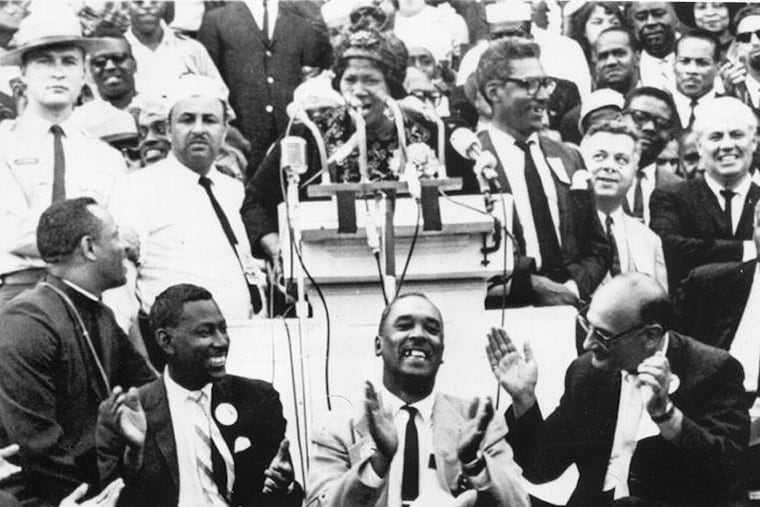
After hours of wandering and waiting in the late August heat of the nation’s capital, the hundreds of thousands gathered for the 1963 March on Washington were welcomed with a program announcement by the march’s architect, labor leader A. Philip Randolph. In his signature baritone, he announced, “Permit me to present to you to sing the national anthem, Miss Camilla Williams.”
More than a few marchers may have shared a puzzled glance. The march leaflets offered that none other than the diva Marian Anderson would open the day’s program of 18 speakers and songs. The march’s planners and crowds alike would have remembered Anderson’s historic 1939 Easter Day concert. At that time, Anderson had been barred, like all African American performers, from taking the stage at Constitution Hall — the Daughters of the American Revolution venue. With support from first lady Eleanor Roosevelt and Interior Secretary Harold Ickes, however, Anderson sang instead at the Lincoln Memorial before an interracial crowd.
The moment elevated the Philadelphia native beyond her status as a pioneer in opera and made her a symbol of a nascent civil rights struggle. In the estimation of the march planners in August 1963, there was none other than Anderson who could set the right tone for a day fueled by idealism, as well as calls to action.
But that Wednesday afternoon, the contralto was stuck in the monstrous traffic surrounding the National Mall, and Randolph, likely in consultation with his lieutenant, Bayard Rustin, called forward Camilla Williams, Anderson’s protégé.
By 1963, Williams had also fought hard to establish herself in the racist and exclusionary world of opera. Born in Danville, Va., in 1919, she landed in Philadelphia after her local community raised funds to help her continue her music education up north. When she arrived in the city, she paid the bills by selling concessions at a movie theater, while she trained with some of Anderson’s former teachers. Williams, an early recipient of a Marian Anderson Scholarship, eventually debuted at the New York City Opera in Madame Butterfly and later lent her voice to a recording of George Gershwin’s Porgy and Bess.
A seasoned performer, she opened the program for the 1963 March on Washington. The substitute rose to the occasion, and the crowd responded with the first of several rounds of rapturous applause and shouts that roiled across the rows of NAACP chapter members dressed in their church outfits, young rebels in denim, and clergy in full vestments. Eventually, traffic cleared, and Anderson arrived, as well, making her way to the multi-microphoned platform to sing “He’s Got the Whole World in His Hands” to an adoring audience.
Anderson and Williams were two of only four women whose voices were heard by the marchers that day. Most accounts of the March on Washington focus on Martin Luther King Jr.’s “I Have a Dream” speech, and to a lesser degree, John Lewis’ controversial and fiery address about the slow pace of social change in America. Sixty-three years later, the voices and vision of several key women of the march have yet to be fully recognized and appreciated.
The march was born from the struggles of Black labor organizers who understood the importance of taking up the problems of racial caste and class together, not separately. Randolph and Rustin, with political theorists, leftist activists, and labor organizers, had conceptualized the March on Washington during World War II to pressure the federal government to desegregate the military and provide fair employment opportunities for Black workers. At every turn, Randolph consulted and relied on female comrades who shared his leftist political inclinations, including legal scholar Pauli Murray, pacifist Pauline Myers, labor organizer Maida Springer, longtime National Council of Negro Women leader Dorothy Height, as well as Anna Arnold Hedgeman, the only woman on the march’s New York-based planning committee.
By the time of planning for the 1963 march, men dominated — men led all the supporting organizations, and the programming committee resolved to schedule speakers based on those groups. Despite their decades-long commitment to the March on Washington Movement, the women of the march were never able to pierce the ranks of executive leadership, nor serve as spokespeople for the larger civil rights struggle. As the movement gained steam into the 1950s and 1960s, male religious leaders — like King — and institutional heads calcified an image of who was leading.
With weeks to go before the assembly, however, organizer Hedgeman argued for a last-minute addition to the schedule. She sought to honor Black women who had struggled in the many fights to desegregate schools, eradicate Jim Crow laws, and secure voting rights. In an appeal to her colleagues, Hedgeman argued, “In light of the role of Negro women in the struggle for freedom and especially in light of the extra burden they have carried … it is incredible that no woman should appear as a speaker.” Her chastening confrontation was met with no resistance, but the depth of her frustrations was never fully recognized. A hastily planned tribute would have to do.
In the end, her recommended “Tribute to Negro Women Freedom Fighters” barely scratched the surface, offering just a nod to the depth and breadth of leadership and passion so many Black women offered the freedom movement.
The crowd heard directly from Daisy Bates, coordinator of the school desegregation battle in Little Rock, Ark., in 1957, and from gospel great Mahalia Jackson, a personal friend to King. Their words and lyrics soared. Bates pledged that Black women would “sit-in … kneel-in, and … lie-in, if necessary, until every Negro in America can vote.”
Jackson was prompted to deliver an encore, and as she sang the gospel hit “How I Got Over,” the dignitaries behind her closed their eyes and swayed to the beat.
I’m gonna thank him for heart felt religion
I’m gonna thank him for a vision
I’m gonna sing hallelujah
Oh, shout all my trouble over
But three female singers, one speaker, and one “tribute” didn’t begin to convey the contributions of Black women to the movement. In truth, Black women often struggled against the choke hold of racism and sexism they faced in local and national organizations, and their relative absence on the stage of the march spoke to a deeper silencing.
Each year, the anniversary of the March on Washington is marked by remembrances that venerate Dr. King even as they fail to recognize the depth of his message. The speeches that day touched on a range of issues: a still-prescient critique of automation, exposure of police brutality, advocacy for work training to reduce unemployment, as well as a higher federal minimum wage.
But there was more to it than that: It was an inspiring day, but also, for Black women involved in the struggle, a disappointing day. Remembering the march, as a movement and as an event, we can remedy the silences by learning about the women who, through their music and their intellect and their leadership, allow us to keep dreaming.
Marcia Chatelain is a Presidential Penn Compact Professor of Africana Studies at the University of Pennsylvania. She is the author of the forthcoming book “How Bright the Path Grows: The Untold Story of the Women Who Made the March on Washington” (Pantheon Books, 2026).
Made By History takes readers beyond the headlines with articles written and edited by professional historians. Opinions expressed do not necessarily reflect the views of The Inquirer.