Philly’s Domestic Workers’ Bill of Rights protects those working in homes
If you are one of 16,072 domestic workers in Philly, or an employer, here is what you need to know about domestic worker rights.
In Philadelphia, playgrounds and bus stops have become places where domestic workers share their job experiences. Two years ago, Tamara Baxter was sitting at a playground with the child she looked after when a fellow nanny approached her to talk about the Domestic Workers’ Bill of Rights.
It was the first time in her 22 years as a nanny that Baxter learned she had rights.
According to Nicole Kligerman, director of the National Domestic Workers Alliance Pennsylvania chapter, this experience is far too common.
Currently, there’s no federal legislation to protect domestic workers. At a local level, Philadelphia enacted a Domestic Workers’ Bill of Rights in 2020. Still, “many employers continue to fail to let their domestic workers know they have rights,” Kligerman said, putting a population that’s primarily women of color in a vulnerable position.
If you’re one of 16,072 caretakers and housekeepers in the city or an employer, here is what you should know about domestic worker rights in Philadelphia:
» READ MORE: Nannies, caregivers, and house cleaners in Philadelphia have workers’ rights, but their employers may not know that

You are considered a domestic worker if your job involves going to another person's private residence to provide:
- Childcare.
- Care or company for an ill person, elder, or a person with a disability.
- Housekeeping or house cleaning services.
- Cooking or butler services.
- Parking, laundry, gardening, or any other domestic worker activities.
Do I need a contract to be a domestic worker?
Yes, but the responsibility of crafting one is on the employer. If you work more than five hours per month, employers are mandated to provide you with a contract in your preferred language and tell you about your rights. According to Kligerman, this document keeps you and the employer safe by outlining responsibilities, rights, and benefits.
“It isn’t just about pay. It’s about what happens if there’s a cancellation or when the family is on vacation,” she said. “Are you getting paid during that time? You should be.”
Unfortunately, due to the nature of domestic work — inside a private residence, sharing intimate family moments — “many employers don’t see themselves as employers,” Kligerman said. This creates situations where your boss might not have a contract for you to review before taking the job.
Baxter knows this firsthand.
- You should be paid at least minimum wage. In Pennsylvania, that’s $7.25 per hour.
- An employer must offer you a contract before you start working.
- The Domestic Workers’ Bill of Rights protects all domestic workers in Philly, no matter if you are hourly, salary, full-time, part-time, an independent contractor, or temporary worker.
- Live-in domestic workers have special protections.
- If you need help, called the Domestic Workers Alliance at 📞 267-768-4002. They speak English, Spanish, and Portuguese.
A previous employer convinced her to make a verbal agreement before she knew what the Domestic Bill of Rights entailed. Then, they added more responsibilities to her workload for the same pay.
“It was hard to leave because of the children,” Baxter said. “I’m the one who they run to when they need a hug because the parents are too busy.”
Now, she brings her own contract to new jobs in case the employer doesn’t have one. She recommends the Domestic Workers Alliance online template, available in English and Spanish. If you are looking for a variant, the city has a template in multiple languages.
At minimum, domestic workers’ contracts must include:
✔️ A specific list of job duties.
💵Hourly, overtime wages, and paydays.
📅Weekly schedule.
🥘Length of rest and meal breaks.
🤒The amount of paid or unpaid leave, including sick time, paid holidays, and any other benefits provided.
🚎If they pay for transportation, the contract must specify what kind.
🏡For live-in workers, the contract should include the value of housing, your sleeping period, and personal time.
🖊️The length of the contract.
However, not knowing the law does not exempt employers from having to comply with it.
Julia Ticona is an assistant professor of communication at the University of Pennsylvania and has employed domestic workers since 2018. Her academic work, focused on how digital inequalities impact working conditions, led her to craft written contracts with the domestic workers she employs since before the bill passed.
“I never thought that I would be in the position to be an employer, but that doesn’t take away from my duty,” Ticona said. “Having all this information settled in advance, you don’t have to worry when inevitable situations arise because it’s all right there.”
If you are an employer looking for help crafting a contract that keeps in mind your and the domestic worker’s needs, she recommends contacting Hand in Hand, a New York-based network of employers focused on dignifying the work of domestic workers nationwide. They offer free resources and template contracts.
- You are an employer and have to comply with the Domestic Workers’ Bill of Rights, not complying can result in economic penalties.
- The rights outlined in the bill are the minimum working conditions a domestic worker can have.
- You are responsible for crafting a contract in the preferred language of the domestic worker and making sure they know their rights.
- If you need help drafting a contract check out Hand in Hand.
- Contracts are the beginning of a conversation, you and the domestic worker should sit down and negotiate the terms.
For tips on presenting the contract to domestic workers who might not know they have rights, Ticona advises approaching it as an evolving conversation, informing and directing workers to the Domestic Workers Alliance.
Another thing to keep in mind: employers have the legal responsibility of providing a translation of the contract for domestic workers who don’t speak English.
Are contracts negotiable?
Yes, both employers and domestic workers can negotiate the contract. As a domestic worker, you are not expected to sign immediately. Dominique Thurmond, an employment unit paralegal at Community Legal Service (CLS), recommends taking it home and having someone from the Domestic Workers Alliance see it.
The Alliance runs negotiation workshops at different times throughout the year. However, if you need immediate help, Kligerman said domestic workers can contact the PA chapter to review contract negotiations.
There is an added layer for Luz Bravo, a housecleaner and caregiver.
“How does one negotiate without speaking the language?” she said in Spanish.
Although the alliance has interpreters, they are in high demand.
Currently, they are trying to get the legislation to include translation services to help non-English speakers because, as Kligerman explained, “you’re not actually consenting to anything if you don’t understand it.”
Until then, Bravo — who already arrives at employers’ homes with her contract in English and Spanish — relies on her 14-year-old daughter to translate during negotiations.
Can I take a food or rest break?
Yes, but the length varies depending on how many hours you work. For every four hours, you get at least 10 minutes to rest without interruptions. This time can’t be discounted from your pay, and you aren’t on duty during break.
If you are looking after a child, ill person, or elder and can’t have uninterrupted time, you must be compensated for the time you were supposed to be on break, basedon your regular rate.
After five hours of work, you have a 30-minute unpaid meal time. If it’s interrupted, it’s considered an “on-duty meal period,” and you must be paid the equivalent of one hour of your work.
On-duty meal periods are only legally permitted when you and the employer have agreed to it in writing. The ball is in your court, if anything changes and you no longer want to be on call during lunch, letting your employer know in writing is enough to void the agreement.
Do I get time off?
Time off, paid or unpaid, is your right. Part-time domestic workers are entitled to unpaid sick time. Working 40 hours or more per week for the same employer? You must get paid for time off.
For every 40 hours worked, you get one hour of unpaid or paid sick time.
Sick time can be used for mental and physical health needs, whether for your own well-being or to care for a loved one. If you are experiencing domestic abuse, or are sexually assaulted, this time can also be used for court and criminal proceedings.
Employers can’t deny you sick time or demand a replacement to cover your hours. In case you need over two consecutive days, make sure to have a doctor’s note, police report, or a signed statement from a victim services organization, in case they ask for supporting documents.
For live-in domestic workers: Living with your employer doesn’t mean you don’t get a weekend. By law, they must give you one day of rest — paid or unpaid — for every six days of consecutive work, on top of your time off. When calculating your paid time off, count only the hours you were on duty.
Can I be let go without notice?
No. If they do so, you are entitled to compensation. The Bill of Rights requires the employer to notify you before terminating employment.
For live-in domestic workers, notice should come a month in advance. All other domestic workers should be notified at least two weeks ahead.
Let go without a heads-up? Your employer must pay a severance equal to the amount of money you would have made during the notification period. For example: If your rate is $15 an hour, working 40 hours a week, your severance should be $1,200. If they don’t pay severance, you can file a complaint with the Office of Worker Protections.
Do I have privacy at work?
Whether you live with the employer or not, you have a right to privacy.
Employers aren’t allowed to hold onto your personal documents at the basic level. Your passport, social security, or any identification document belong to you. They can’t keep you from accessing it or “save it” for you.
Another thing they can’t do is keep a record of how many times you go to the bathroom or who you talk to. And they definitely can’t record you without your consent.
It can be normal for employers to have cameras inside the house, but that doesn’t mean you are under surveillance.
Cameras aren’t allowed in the bathroom or anywhere where you can reasonably change clothes. If you live with the employer, protections are extended to your assigned room. And, no matter what, they can’t record your private conversations.
What happens if my rights are violated?
“They say you are part of the family [...], but then they don’t respect your rights, and you are left feeling frustrated and powerless,” said Bravo. But there is something you can do. File a complaint with the Office of Worker Protections.
The single-page form is offered in English and Spanish and can help you report violations of the Domestic Bill of Rights. Email the form to DomesticWork@phila.gov or mail it to the Office of Benefits and Wage Compliance at 100 S Broad St, 4th Floor.
According to the city, you should be contacted by the office within 15 days, but Kligerman said the entire process can take months. She recommends going to the Domestic Workers Alliance or CLS before filing a complaint.
“People frequently reach out for wage theft, but when you ask more questions, there’s a whole lot of other abuses happening,” Kligerman said. “You really want to be fully screened so when the complaint is filed they can investigate all violations.”
If a violation is found, your employer must pay for your severance or unpaid wages.
Can my employer retaliate?
No. It’s illegal for your employer to retaliate against you for raising a complaint.
According to Thurmond retaliation for domestic workers can look like this:
Having your hours cut.
Randomly changing the schedule set on your contract.
Threatening to call immigration on you or one of your relatives.
Do these rights and protections cover immigrant workers?
Yes, both documented and undocumented immigrants are protected. If you are undocumented and deportation worries you, Thurmond recommends visiting CLS in person, or calling 215-981-3700, to assess your risk and check for options.
For domestic workers outside of Philadelphia
Pennsylvania is home to over 28,000 domestic workers, but these protections only apply to those working in Philly.
If you are a domestic worker outside the city, Kligerman recommends reaching out to Justice at Work, an organization fighting for workers’ rights across industries.
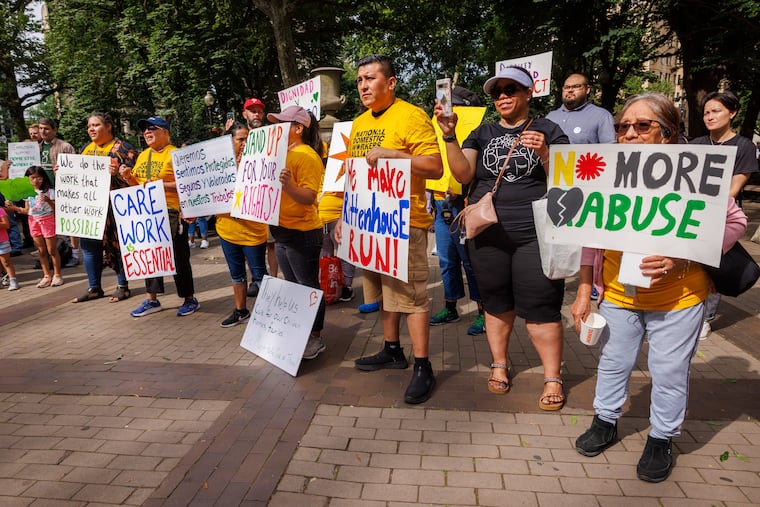
In the meantime, the Philadelphia domestic workers are rallying for new legislation for 2024. The idea is to ensure more protections against retaliation, ensure contract enforcement and greater financial fines for employers. They also are asking for city-paid therapy for workers that experienced abuse at work, and the creation of a database that allows domestic workers to know if their prospective employer has previous violations recorded.
To read this article in Spanish, click here.