This retired teacher has picked up three tons of cans littered across Philly
"For decades, he has quietly picked up trash and recyclables wherever he goes, making the city a cleaner place without recognition or fanfare."
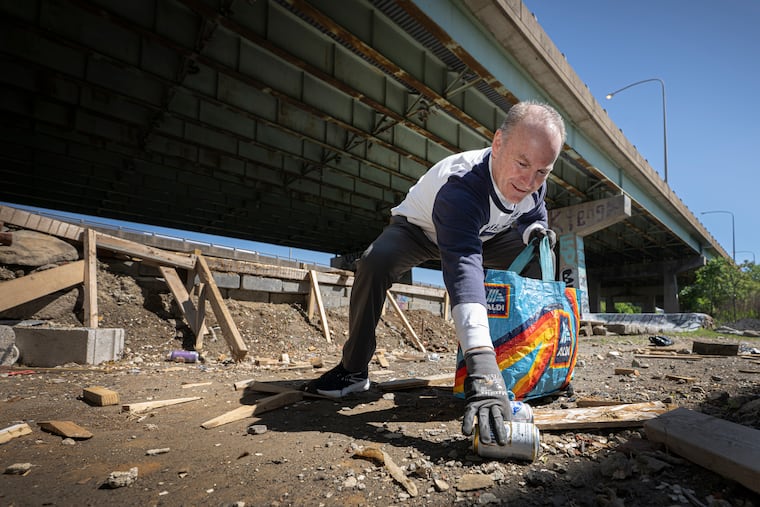
Meet Patrick Shanahan, a retired Philadelphia teacher who’s found that picking up trash has improved his mental and physical health, along with improving the city.
On litterbugs: “I wonder a lot about motivation. I don’t think I’ve ever thrown a piece of trash in the public domain. I don’t get it.”
Trashercise: “I do treat it like a workout sometimes and bust it.”

Patrick Shanahan isn’t sure his story is worth the telling. He wants me to know I can stop at anytime, trash this whole thing, and walk away.
But trash is exactly why Shanahan’s son wrote to me about his dad and it’s why I joined Shanahan recently at FDR Park, to watch him pick up garbage on a lovely spring day.
Since retiring from his 31-year teaching career at Roman Catholic High School in 2020, Shanahan has spent two or three days a week picking up litter at FDR Park, in his own West Philly neighborhood, and in other places he walks around the city.
He takes the cardboard and paper to Newman & Company in Wissinoming, to be turned into recycled paperboard. The glass bottles he drops off at Bottle Underground at the Bok building, where the nonprofit upcycles them to be used by artists. And the plastic, well he’s got nowhere to take that but to his own blue recycle bins the city picks up and he’s not happy about it (“I think we were probably lied to about plastic recycling,” he said, referring to the world at large, not just the city).
While it’s impossible to track how much cardboard, glass, and plastic Shanahan has collected and recycled in the last six years, when it comes to aluminum cans, he’s got the receipts. Literally.
Shanahan takes the cans to S.D. Richman Sons scrapyard in Port Richmond, where he gets about 60 cents a pound right now for those bad boys.
“There’s really no money in this,” he said. “The reason you don’t see people picking up cans in Philly is because the work far, far, far exceeds the profit.”
But each trip to the scrapyard, Shanahan walks away with a little scratch and a receipt detailing how much aluminum he brought in. Since 2020, he’s kept those receipts in a large plastic cashew jar with a red screw-top lid.
The first time Shanahan tallied up his hauls, he’d collected and recycled more than a ton of aluminum cans.
By the time his son, Liam, emailed me last month, Shanahan was quickly approaching three tons.
“For decades, he has quietly picked up trash and recyclables wherever he goes, making the city a cleaner place without recognition or fanfare,” Liam Shanahan wrote.
Recycling more than three tons of waste from our city certainly seemed worthy of a little fanfare to me, so late last month I joined Patrick Shanahan at FDR Park and then at the scrapyard, as he achieved his new milestone.
“I love Philly. This could be a beautiful city if we just stop trashing it,” he said.
‘What’s your why?’
Though he lives in West Philly now, FDR is Shanahan’s “home park.” He grew up the youngest of four at Third and Wolf Streets in South Philadelphia (“Our Lady of Mount Carmel Parish,” he offers up without being asked, in true Philly lifer fashion).
His dad, a Bell telephone repairman, drilled the phrase “Waste not, want not,” into his head as a kid and a “hippie older brother” steered Shanahan toward environmentalism.
“I think I am much more aware of litter than the average person, according to my wife,” he said.
A 1980 graduate of St. John Neumann High, Shanahan went on to La Salle University, where he majored in management and psychology. A run-in with his former high school principal led to a job teaching business at Neumann and at the same time, Shanahan attended night school for his real estate license, a job he still works from time to time.
After three years at Neumann, Shanahan spent a year teaching at Little Flower Catholic High before moving on to Roman Catholic, where he taught business, coached tennis, and refereed basketball. He also initiated the school’s recycling program, putting a separation process in place and taking out the recyclables himself.
“I was watching the cafeteria just produce all this trash every day and I just couldn’t look at it,” he said.
Shanahan also offered an option to students who didn’t pass his class: instead of summer school, they could do academic work and recycling work by going through the discarded contents of their classmates’ lockers and sorting the materials into trash, recyclables, and reusable items.
In 2020, Shanahan — a married father of two adult sons — retired from teaching, though he hoped to continue on as a basketball referee. But an ankle reconstruction surgery did not go well and he was forced to get a replacement that left him only able to do low-impact activities.
Uncertain of his purpose anymore, Shanahan hit a low point in his life. His doctor suggested he read, Man’s Search for Meaning, by psychiatrist and Holocaust survivor Viktor Frankl.
“His message is that everyone needs meaning in their life, you have to have a why when you wake up each day. What’s your why?” Shanahan said. “I needed to feel like I was contributing to the world and I was still useful. … I could no longer play tennis or referee basketball, but I could get out of my car and clean up the park and it felt good to do that.”
The good, the bad, and the beer
Shanahan arrived at FDR Park to meet me in his 2017 Toyota Prius c hybrid. The vehicle was nearly packed to the roof with bags of cans already.
“For efficiency purposes it’s good to have a full car load,” he said.
Shanahan only needed a few more cans to ensure he’d have 41 pounds, which would put him over the three-ton mark, and he knew just where to go — FDR’s skate park, “where there’s always trash.”
And he wasn’t kidding. The place was teeming with garbage. There were Pringles cans, Chick-fil-A packages, Twisted Tea Light cans, red plastic Solo cups, empty cases of Surfside, Fanta bottles, a Wawa cookies-and-cream milk jug, motor oil bottles, Taco Bell containers, empty cigarette packs, cigarette butts, and wood glue (which I’m sure was used for its intended crafting purposes).
Shanahan took several reusable shopping bags from his car and got to work. When the shopping bags got full, he’d dump the cans into a contractor-size garbage bag and start again.
“Keeping up with these litterers is something,” he said.
Shanahan wore MaxiFlex work gloves and poured out each can before putting it in his bag. He must have picked up a hundred cans in 10 minutes. He said he finds more Modelo and Miller Lite cans than anything else.
“Miller Lite must not be too good because they all still have a few ounces left in them,” he said as he emptied one.
The best thing Shanahan ever found picking up trash in Philly was a $20 bill. He draws a blank when I ask about the worst thing he’s found, until I tell him I once saw someone throw a dirty diaper out of their parked car window onto a Philly street. He’s found a few full diapers too, he said.
But Shanahan still believes “the good people outweigh the bad people, by far.” He tells me about another retired South Philly guy he’s met at FDR, Jack Carr, who also cleans up litter around the park.
“He’s not much for conversation. He’s doing his thing and does not want to be bothered, but I eventually cracked the ice and … we have this secret spot where he leaves cans for me now,” Shanahan said.
Only in South Philly would two guys have a top-secret drop point for recyclables (and no, I was not told the location or coordinates).
After being certain he’d grabbed enough cans, I watched Shanahan actually shove them into his packed car. I feared that the bags might rip open and thousands of cans would spill out from his Prius like beer-soaked clowns, but this wasn’t Shanahan’s first rodeo and he maneuvered the litter perfectly in like he was playing a game of garbage Tetris.
“Does your car smell like beer?” I asked.
“Oh, there’s always a stale beer odor in my car but I enjoy washing my car,” he said, adding that he uses a protective seat cover for dogs his son got him.
‘In the game’
We drove separately to S.D. Richman Sons scrapyard because there was no room for me in Shanahan’s car and he was’t about to leave the cans behind.
The scrapyard was buzzing with machinery and people. Shanahan likes it here, he likes hanging with the scrappers, and he likes that the yard workers treat everyone with respect.
“I’m in the game with these guys, we’re contributing to recycling effort and it’s gritty. I enjoy it and I feel good here,” he said.
When it was his turn, Shanahan put his cans on the scale and they totaled 57 pounds, which earned him $34 that day. I asked what he does with the money, expecting the do-gooder to say he donates it to help elderly three-legged dogs find homes or something, but he tells me he tends to use it as “fun money” for things like pizza and beer, and I love that for him.
That day’s haul marked 6,016 pounds of cans collected by Shanahan over six years, which is impressive when you consider that an empty 12-ounce can weighs about a half ounce. That’s roughly 32 cans to a pound, or 192,512 cans that aren’t littering up Philly anymore.
A few days later, I confessed to Shanahan on the phone that the litter in Philly bothers me too, but I do little about it, having long ago relegated myself to it being a dirty fact of life around here.
“What difference can one person make?” I asked him.
Shanahan’s response was kind — like many people, I’m probably very busy, he said — but he also didn’t absolve me, or any of us, of responsibility.
“It reminds me of a great quote: ‘It’s better to light one candle than to curse the darkness,’” he said. “Of course in this situation the darkness is litter, so we can sit around and say how dirty Philly is or just do something about it.
“If you light a candle and I light a candle before you know it, it’s not so dark.”

Know someone in the Philadelphia area whose story deserves to be told — or someone whose story you’d like to know? Send suggestions for We the People profiles to Stephanie Farr at sfarr@inquirer.com or call her at 215-854-4225. Send tips via Bluesky to @farfarraway.bsky.social or via Threads to @farfarraway0444.
Want more We the People?
At 86, baker George Wright still rises to the occasion five days a week.
Delco lawyer Adam Barrist created a secret British pub in his law office.
Check out more We the People here.