Kathy O’Connell signs off
After nearly 40 years on “Kids Corner,” Kathy O’Connell is leaving the show that made generations of Philly kids feel heard.
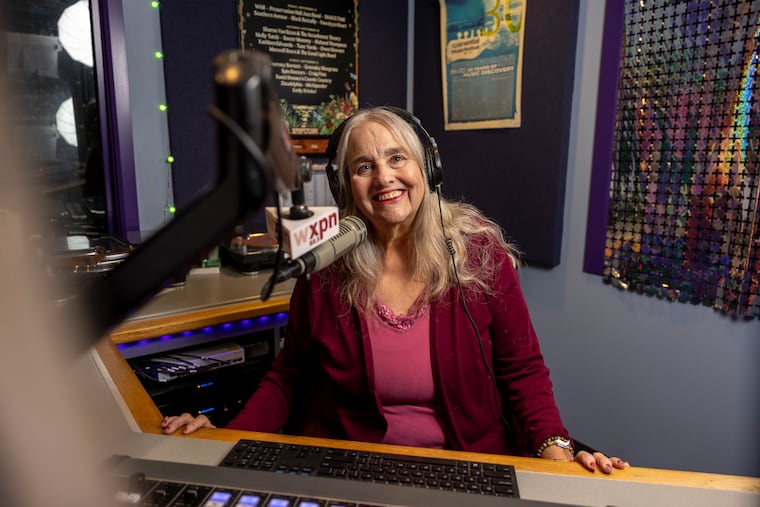
Kathy O’Connell cannot believe what she is hearing right now.
This kid, Ryder, from West Grove, is telling her all about his family trip to Mexico, and she is hanging onto his every word. “I went down a giant water slide and jumped off a cliff with my dad,” he says. O’Connell, host of the long-running radio show Kids Corner on WXPN, jumps back in her seat. Her eyebrows shoot up. She lifts her hands to her forehead as if her mind has just been blown.
“Tell me all about jumping off a cliff with your dad,” she says, her mouth hanging open in astonishment.
“We held hands,” Ryder says. O’Connell practically melts.
“I was hoping you were going to say that,” she says, bringing her hands to her heart. Ryder, of course, cannot see this. He is in West Grove, and she is in WXPN’s studios at 30th and Walnut.
Ryder from West Grove tells her that holding his dad’s hand helped him feel less scared.
“That really makes everything better, doesn’t it?” O’Connell says back, nodding reassuringly.
For almost 40 years, kids have been calling into Kids Corner every weeknight at 7 p.m. to tell O’Connell all sorts of things, from the heart-melting to the heartbreaking, from the simplest facts, like their favorite television shows, to the harder things, like how they deal with feeling sad. For almost 40 years, their tender voices have been a reliable source of evening company for Philadelphia’s public radio listeners. But sometime during COVID-19, when the world stopped abiding by a schedule, the kids started calling less. Calls dropped from their peak of thousands per week in the mid-’90s to maybe 250.
“You could smell that things were shifting,” says longtime Kids Corner producer Robert Drake. Soon after, O’Connell got it in her head that maybe it was time to hang up the headphones. Now she’s making it official. On Thursday, O’Connell announced her retirement. She will be leaving Kids Corner on June 23. The show will not go on without her. How could it?
As Drake says, “Kathy is Kids Corner.”
Or as O’Connell herself says, “I’m irreplaceable.”
And while kids will have no shortage of other things to listen to once Kids Corner is gone — it’s something of a miracle the show survived as long as it did, given the podcasts and satellite radio stations and YouTube channels competing for their attention — its departure is still a loss for Philly kids, who came to know themselves, each other, and their city through the show.
O’Connell likes to say she fell into kids’ radio. That none of it was planned. That she always wanted to be a star, and that if she had gotten her way, she’d have grown up to be Carol Burnett. “But I was fat,” she says. “The doctor put me on diet pills when I was eight.”
So she wound up in radio instead.
The Soupy Sales of it all
O’Connell, who grew up on Long Island, started her career as a volunteer at the progressive radio station WBAI in New York City. A few years later, she was hired as an engineer at WNYC, where she worked on an adult program called Senior Edition. For a while, at least, this looked like the life she would have. And then came the part she never saw coming. The fall. The nonplan. One evening, O’Connell had to fill in for her boss on the other show he hosted after he and his cohost stormed out 15 minutes before airtime.
It was a children’s program called Small Things Considered (later renamed to Kids America). O’Connell was only meant to host it temporarily, but one evening turned into two, then three, until eventually the job became hers, and O’Connell remained a children’s radio host for the next 40 years.
As O’Connell says, her whole career is a fluke. But just because something happens by accident does not mean it wasn’t destiny. Otherwise, how do you explain the Soupy Sales of it all? You see, you cannot talk about Kathy O’Connell, the legendary children’s entertainer, without talking about her personal hero, the legendary children’s entertainer Soupy Sales.
For the uninitiated, Soupy Sales was a comedian best known for his children’s television series, The Soupy Sales Show, and young Kathy was obsessed with it. Growing up on Long Island in the mid-’60s, she often took the train into Manhattan to attend live tapings. Her family was falling apart at the time. Her dad had just moved out. The Soupy Sales Show was a refuge.
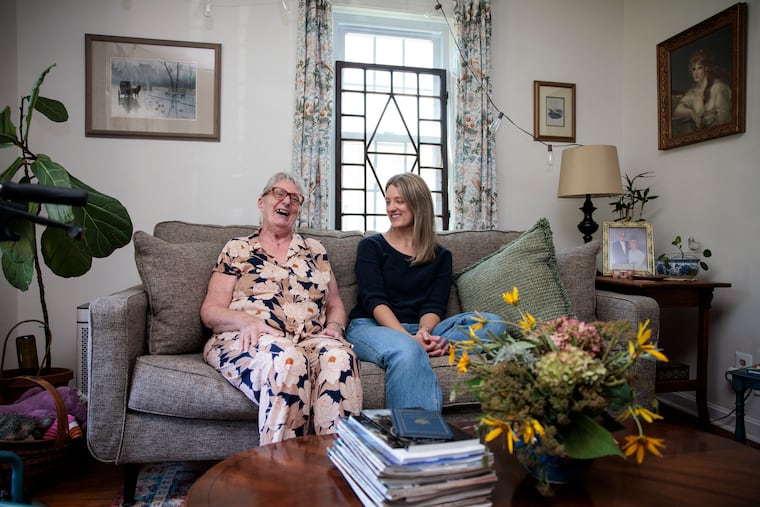
“He made me feel safe,” O’Connell tells me. We’re sitting in the living room of her West Philly home. One room over, near the front entrance, hangs a giant poster of Soupy Sales. She never outgrew him. “He would laugh at my jokes, and he would smile,” O’Connell says, bending over to give her terrier, Tammy, a carrot. “I just thought he was the funniest thing in the world.”
She made friends with a few other kids who regularly went to the tapings. They referred to themselves as Soupy’s Gang. “This was what my life was centered around from 1965 to 1969,” O’Connell tells me. It was the happiest part of her childhood. She even got to know Soupy. She told him to call her Oaky, her nickname at school, because it was easier to remember than Kathy. O’Connell continued to follow Soupy for a few years, catching him on shows like What’s My Line?
But eventually, life moved on. She grew up. Got married. Got a job. Her childhood receded into the background, as childhoods do. That is, until she “fell” into children’s entertainment herself. Then Soupy Sales, and everything he meant to her, came rushing back, not as some relic of childhood, but as a blueprint for the entertainer she would become. So, sure, she “fell” into it. Or, as one of her mom’s friends who knew O’Connell when she was part of Soupy’s Gang told her years later, “Well, of course, this is what you wound up doing.”
Kids Corner
Kids Corner launched in January 1988, one week after WNYC canceled Kids America. WXPN had started broadcasting Kids America the year before and wanted to continue with children’s programming, so it asked O’Connell to move to Philadelphia and launch something similar. She agreed and went on the air for the first time on Jan. 4, saying, “I’m not sure what to call this thing yet, but we’re going to do a show.”
Robert Drake, who was working at Wawa at the time, just so happened to be tuning in and heard O’Connell say the show needed volunteers. He showed up the very next day and started fielding calls, screening potential interviewees, and helping O’Connell develop the framework of the show they decided to call Kids Corner. He was hired as a producer in 1989 after WXPN received a start-up grant from the William Penn Foundation.
Eventually, they refined Kids Corner into two segments: music and conversation. The first half hour is all about the former. O’Connell and Drake curate the playlists. In the early days of the show, they stuck to the classics, novelty songs like “Hello Muddah, Hello Fadduh! (A Letter from Camp)” by ’60s comedian Allan Sherman and “Star Trekkin” by the British group The Firm. Of course, O’Connell played the occasional Soupy Sales track, too — not his 1965 hit “The Mouse,” because she hated it, but other songs from his 1969 album A Bag of Soup.
At some point, though, Drake and O’Connell began making more daring selections. Stephanie Mayers, a children’s music publicist and former Kids Corner listener and caller, remembers hearing John Lennon’s “Imagine” for the very first time on an episode of Kids Corner. She went out and bought Imagine, the album, on cassette a few days later. To this day, she remembers lying on her bedroom floor with the cassette cover unfolded, and the album’s lyrics spread out in front of her, listening to the song.
“It was one of those musical blow-your-mind moments,” Mayers says. That moment, and Kids Corner in general, left such an impression on a young Mayers that it influenced her entire career, bringing her back to Kids Corner decades later as an early promoter of so-called kindie (kids + indie) music.
Kids Corner became a platform for kindie artists like Audra Rock, Brady Rymer, and Gustafer Yellowgold in the early ’00s, soon after New York indie artists Laurie Berkner, Dan Zanes, and David Weinstone all independently started releasing children’s music and unofficially launched the kindie movement.
By the time sales of children’s CDs increased 38% in 2006, Kids Corner was a certified tastemaker, helping put kindie artists, like the Grammy Award-winning Lucy Kalantari, on the map. Kalantari credits O’Connell with helping make her song “Balloon” a hit.
“She played it, everybody started listening to it, and other radio stations picked it up really quickly,” Kalantari says. “She totally understood what was up.”
But as important as music was (and remains) to Kids Corner, it doesn’t hold a candle to the other half of the show, a segment called “Kathy and the Kids,” when O’Connell talks to Philly kids about, well, anything.
“Kathy and the Kids” was even Lennon-loving Mayers’ favorite part of the show. What she remembers most is how much O’Connell seemed to care.
“Whatever the subject was, she engaged us,” Mayers says. Indeed, on a recent segment about favorite TV shows, O’Connell listened closely. She wrote down the titles kids mentioned and asked follow-up questions.
To Mayers and others, that kind of attention made O’Connell an exceptional listener, but O’Connell doesn’t see herself that way. “I’m a bad listener,” she says. “I’m a good interrupter.” She claims to be more of a performer than anything, and says she learned how to talk to kids from, who else, Soupy Sales.
She is deflecting, to an extent. She’s not entirely comfortable taking compliments. But her version of the story also contains its own truth. O’Connell isn’t great at talking to kids just because she’s a good listener, or still a kid at heart. It’s not just whimsy, in other words.
As WXPN general manager Roger LaMay explains: “Kathy may come across as a little chaotic and disorganized, but she’s actually a total pro when it comes to broadcasting. It goes back to her whole Soupy Sales thing. She knows exactly what she’s doing.”
She knows, for instance, that when she tells one caller whose favorite movie is KPop Demon Hunters that another kid she has just spoken to also loves it, she is forging a connection between them. And for some children, the potential for connection is the entire reason to call.
Take Desmond, for example, a frequent caller in the early ’90s who grew up in what was once called the Badlands section of North Philadelphia. Drake remembers when Desmond called in and told them he was not allowed out at night while his mother, a single mom, was at work. It was too dangerous. Kids Corner, he said to O’Connell on air, was his only chance to interact with other kids his age. Maybe that kid lived nearby. Maybe that kid lived in the suburbs, like Mayers. The point is they could reach each other.
That is the magic of Kids Corner. At its peak, it brought Philadelphia’s children together in a way no school zone or neighborhood gathering ever could. “You’d end up with wealthier kids from the Main Line and poor kids from North Philadelphia, Black and white and all different religions calling in,” says longtime volunteer Doug Woodworth.
O’Connell’s gift is becoming whoever each child needs her to be when she picks up the phone: a coconspirator, a guide, a grown-up who does not condescend. Kids Corner is a shared experience for Philadelphia’s children, but each caller, in some sense, gets a host of their own: a distinct version of the one and only Kathy O’Connell.
Philly famous
For all her gifts on the air, O’Connell never really wanted out of Philadelphia. But watching her in action, it is hard not to wonder what might have happened if she had. She is charming like a late-night television host, warm and chatty like a daytime one; she simply seems too big, too charismatic, for a public radio program, and when I tell her as much, she laughs and nods, like she’s heard what I’ve said before.
In fact, an ex-boyfriend once asked whether she hated Rosie O’Donnell because she had the life O’Connell wanted. Well, does she? “Not really,” O’Connell says. “She had to be on TV. She had to look good. And all anybody did was talk about how fat she was.”
In Philadelphia, on the radio, the spotlight was less punishing. She got recognized — “I got recognized during my first colonoscopy!” — without getting judged.
O’Connell says she has no regrets about how her career unfolded, or the things that never happened. The bigger pond, she says, is not always the better answer. Just look at what happened to Soupy Sales when he moved his show from a local station in Detroit to ABC in Los Angeles. The network canceled it within a year. O’Connell, having already been laid off once, was content with the stability offered by WXPN.
She did, however, once hope to franchise Kids Corner — not the show itself, but its recipe for success. “I wanted to consult other stations and teach them how to do Kids Corner,” she says, “because all you need is an idiot who talks on the radio and knows not to curse.” But there was no money for it, and the station had other priorities. So if she is wistful at all, it is only over “aspects of what could have been,” she says.
Mostly, though, she is at peace with the career she built in Philadelphia. She likes being “Philly famous.” Of course, she wants a plaque on Broad Street, Philadelphia’s own Walk of Fame.
Walking past it with a friend one afternoon, she turned and said: “You see that? I’m gonna be in that someday.”
The legacy
Kids Corner might have turned O’Connell into a local celebrity, but it was never a huge success in the conventional radio sense. “If you were just viewing Kids Corner on a sponsorship or total audience basis,” says LaMay, “you wouldn’t call it a hit.” So when it goes off the air in June, WXPN won’t be losing a ratings juggernaut.
What it will be losing, LaMay says, is something far rarer: a multigenerational phenomenon. Kids who grew up listening to Kids Corner shared it with their children. The show became an entry point to WXPN for members of Gen X all the way through to Gen Z, and an essential point of differentiation for the station. “I’ve always appreciated the fact that there’s nobody in the country, to my knowledge, who does exactly what Kathy does,” LaMay says.
There are, of course, other options for children now. Kids have Ms. Rachel. They have podcasts like Wow in the World. But those shows talk to kids, not with them. They are not live. The hosts cannot listen. They cannot ask a follow-up question. As Mayers, who has an 11-year-old daughter, puts it: “It’s all so isolating, the stuff that they have now. What Kathy offers is something that everyone is experiencing together.”
Except they aren’t really, at least not anymore. The world of appointment listening that made Kids Corner possible has been disappearing for years. O’Connell knows that as well as anyone. It’s why she feels ready to go. “Radio is changing,” she says. “I’m going at a good time under good circumstances. Nobody is dead, and nobody is mad at me.”
At the same time, she feels as though she is staring at the end of a dream she didn’t even know she had, and she cannot quite make out what comes next. Is she still Kathy O’Connell if she’s not on the radio? “It’s a question mark in my life,” she says. “What do I really like to do in life?”
One thing she likes to do is watch television, and she plans to spend at least part of her retirement kicking back on her couch, watching reruns of Gunsmoke and Parks and Recreation. She’s still figuring out the rest of her plans.
At least she knows who is going to take care of her. O’Connell never had children herself, but she’s counting on a few of her most devoted listeners to step up, just like she did for Soupy toward the end of his life. “She calls us her dotage kids,” says one such listener, Chrissy Rockwell, who has already agreed to care for O’Connell. She isn’t too worried about the rest of her life.
In that sense, O’Connell is far less anxious about the end of Kids Corner than the adults who grew up with it. They fret about what Philadelphia children are losing in a post-Kids Corner world — that shared connection to one another and to their city — but O’Connell, who knows Philly kids better than most, is not especially concerned.
“I believe in kids. I really do,” she says. “Because no matter what you throw at kids, they’re going to be all right.”

- Kathy O’Connell signs off
- How to have a Perfect Philly Day, according to Phillies head groundskeeper Jeremy Wilt
- Should I fake sick so I can go to the Phillies’ home opener?
- Harper gets it, robots arrive, and PHL invents a new line to stand in | Weekly report card
- A spring escape in the Brandywine Valley with wine, art, and gardens | Field Trip
- The best things we ate this week
- Citywide Quest: Do you know where in Philly these St. Patrick’s Day-related photos were taken?
- It’s spring! There are still piles of snow.