Supreme Court upholds birthright citizenship in momentous immigration ruling
The decision handed a key loss to President Donald Trump, who had signed an order to end birthright citizenship for children born in the U.S. to undocumented immigrants.
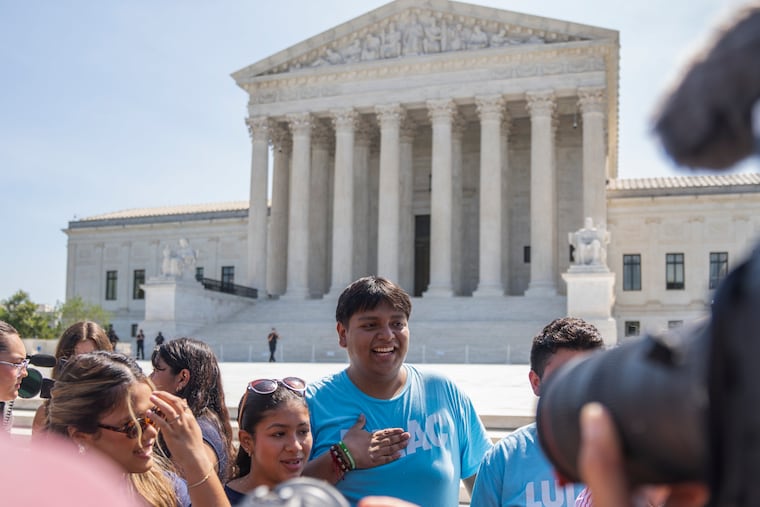
The Supreme Court upheld the principle of birthright citizenship in a ruling for the ages on Tuesday, affirming amid rancorous national debate that people born in this country are American citizens.
The decision handed a key loss to President Donald Trump in a case that represented a major goal of his administration ― the denial of citizenship for children born on American soil to undocumented parents.
Instead, the court upheld what has been recognized as the law of the land for nearly 160 years, enshrined in the Constitution by ratification of the 14th Amendment shortly after the Civil War.
“Citizenship, then and now, was the right to have rights — to freely participate in our political community. The Framers of the Fourteenth Amendment extended that promise to ‘every free-born person in this land,’” Chief Justice John Roberts wrote for the court. “We keep that promise today.”
The court ruled 6-3, with three conservative justices voting to let Trump’s proposed restrictions take effect.
Reaction flooded in immediately, with Cathryn Miller-Wilson, executive director at HIAS Pennsylvania, the immigrant-support organization, saying the decision fell “on the right side of history.”
“It shouldn’t be a surprise because birthright citizenship is enshrined in our Constitution,” she said of the decision. “But unfortunately there are many other things that have been enshrined that the Supreme Court has ignored. So it was a point of anxiety, I think, for all of us.”
Trump’s planned restrictions had been blocked by lower courts and had not taken effect.
The Pennsylvania Immigration Coalition, an advocacy organization based in Philadelphia, called the decision “a victory for families, for immigrant communities, and for the shared values that should guide our country: belonging, safety, and unity.”
“Today’s decision affirms what our communities have always known: no child’s belonging should be up for debate,” said Jasmine Rivera, the coalition executive director.
Democratic Gov. Josh Shapiro said on social media that Trump’s effort to end birthright citizenship was cruel and “goes against centuries of hard work to advance American freedom.”
Days before the nation’s 250th birthday, Shapiro said, the court affirmed “that the fundamental promise of America still rings true — that this is a land of freedom and opportunity for all.”
In New Jersey, one of the first states to sue over the issue, Attorney General Jennifer Davenport said she was thrilled by the decision.
“The president cannot change our citizenship laws with the stroke of a pen. We stood up for the rule of law, we stood up for our residents, and we won,” said Davenport, an appointee of Democratic Gov. Mikie Sherrill.
Meanwhile, House Speaker Mike Johnson (R., La.) said that he was “very disappointed” by the ruling, that it will subject the country to “serious challenges going forward and we’ll have to deal with that.”
Johnson, who has worked as a constitutional lawyer primarily on religious issues, said the 14th Amendment is being abused by people who are coming to the U.S. to have children in a practice called birth tourism.
U.S. Rep. Scott Perry, a York County Republican, railed against the court, saying that it had “failed the American people,” and that justices Roberts and Amy Barrett were joining an effort to protect birthright citizenship specifically for the children of undocumented immigrants.
“Now, more than ever, we must ensure the security of our borders and to prevent those who wish to do us harm by exploiting our immigration system are unable to do so; which means closing EVERY. SINGLE. LOOPHOLE,” Perry said in a statement.
U.S. Rep. Chrissy Houlahan, a Chester County Democrat, mentioned the path trod by her father, a Polish-born Holocaust survivor who emigrated to the U.S. as a child.
“I’m deeply grateful for the Supreme Court’s protection of the 14th Amendment, and for all of the first-generation Americans who make our community stronger,” she said on social media.
On April 1 the Supreme Court heard oral arguments on one of the most important cases of the time, one that had been expected to define who gets to be a citizen of the United States. Trump traveled to the court to hear the arguments in person, departing after government lawyers wrapped up their presentation.
There was no indication at the time of how the justices might rule, though several of the justices seemed skeptical of the administration’s arguments and peppered government attorneys with sharp questions.
When Solicitor General John Sauer argued that “we’re in a new world now,” Roberts responded, “It’s a new world. It’s the same Constitution.”
On Tuesday, the longest-serving justice, Clarence Thomas, joined by Neil Gorsuch, offered a 91-page dissent, saying the ruling added “to the sad history of the Fourteenth Amendment, which was designed and understood to secure equal rights for the freed Blacks but has instead been repurposed for political projects that the Reconstruction Congress did not support.”
On the day he was inaugurated for a second term in 2025, Trump signed an executive order to end birthright citizenship for children born in this country to undocumented immigrants. That marked an attempt to reverse legal and Constitutional precedent, which has long held that people born in the United States are U.S. citizens.
The ACLU sued within hours, and New Jersey officials went to court the next day, with then-Attorney General Matt Platkin saying, “Presidents in this country have broad powers, but they are not kings.”
Birthright citizenship, simply put, is the legal foundation under which American citizenship is automatically conferred upon people who are born in the United States, with limited exceptions. The formal term is jus soli, Latin for “right of the soil.”
Automatic citizenship also extends to children who are born abroad to U.S. citizens.
Birthright citizenship is guaranteed in the Constitution by the 14th Amendment, ratified in 1868 after the end of the Civil War. It says that “all persons born or naturalized in the United States, and subject to the jurisdiction thereof, are citizens of the United States and of the state wherein they reside.”
Trump and other opponents argue that the practice encourages people to enter the country illegally, so that children who are born here will automatically gain American citizenship. Those citizens, at age 21, can sponsor close family members to live permanently in the United States.
The Trump administration contended that birthright citizenship had limited intent, meant only to ensure that formerly enslaved people and their children were U.S. citizens.
The administration focused on the clause “subject to the jurisdiction thereof,” saying that excludes people with temporary or unlawful presence. The president’s order would have denied citizenship to babies born in the U.S. unless at least one parent is a U.S. citizen or lawful permanent resident at the time of the birth.
Trump’s opponents said reliance on those five words makes no sense, that of course people who live in the United States without permission are subject to its jurisdiction ― its laws, orders, and government regulations ― the same as everyone else.
The administration also invoked the practice of birth tourism as a main argument for revocation, elevating what was a side issue to a central cause.
Birth tourism is when people from other countries travel to the U.S. for the purpose of giving birth, thereby obtaining citizenship for their babies.
It’s relatively rare, the high estimate at 26,000 births a year, from the Center for Immigration Studies, which advocates for low immigration. That’s a fraction of the roughly 3.6 million children born annually in the United States.
In Pennsylvania, all eight Democratic federal lawmakers who represent the state opposed Trump’s attempt to end birthright citizenship.
Along with 208 other Democrats in Congress, they signed an amicus brief in February arguing that the 14th Amendment set a “constitutional minimum — a floor — for birthright citizenship” and that the administration’s arguments were incoherent.
The Democrats who signed were U.S. Sen. John Fetterman and U.S. Reps. Houlahan, Brendan Boyle, Dwight Evans, Madeleine Dean, Mary Gay Scanlon, Summer Lee, and Chris Deluzio.
Some Republicans in Congress filed amicus briefs supporting Trump’s case, though none of the 11 Republicans representing Pennsylvania signed on to them.
The Republicans argued that within the 14th Amendment, the words “subject to the jurisdiction” were key.
“The Framers would have recoiled at the present debasement of citizenship, understanding that ‘jurisdiction’ requires more than mere physical presence,” they wrote. “It demands total allegiance to the sovereign. To hold otherwise places sovereignty, citizenship, and our nation’s survival in jeopardy.”
Staff writers Andrea Padilla, Sam Janesch, and the Associated Press contributed to this article.

