Bristol Health explosion spurs new bill aiming to boost emergency preparedness at high-risk care facilities
Two Bucks County lawmakers announced plans to make it easier for first responders to evacuate personal care homes, assisted living residences, daycare centers, and recovery homes.
In the hours after a December explosion rocked Bristol Health & Rehab Center, leaving three dead and another 20 injured, first responders could not be certain they had evacuated everyone.
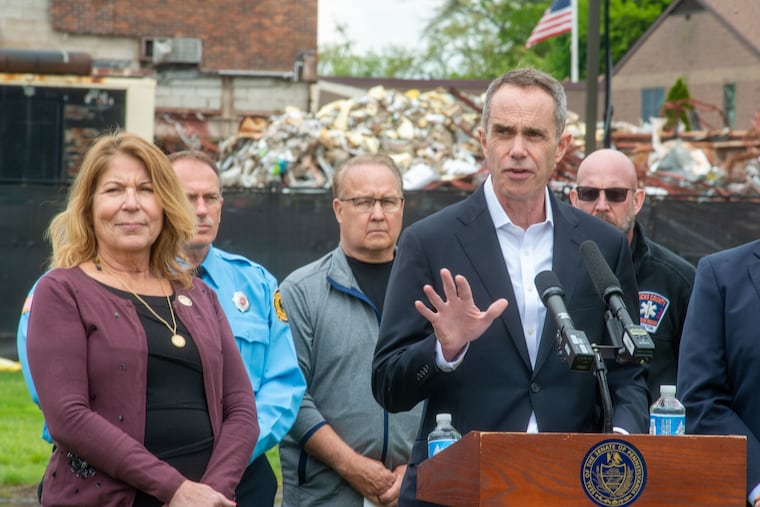
“There were probably extended searches that went on in that building that were unnecessary because we thought we had everybody, but we continued searching and searching to make sure, because we didn’t know,” Bristol Township Fire Chief Kevin Dippolito said Thursday, the nursing home rubble behind him.
Two Bucks County lawmakers joined Dippolito at a news conference to announce plans to make it easier for first responders across Pennsylvania to evacuate personal care homes, assisted living residences, child daycare centers, and drug and alcohol recovery homes.
Current law requires nursing homes and facilities regulated by the Department of Human Services, such as personal care homes and daycares, to have such emergency plans, which are typically reviewed by regulators during inspections.
Still, the law doesn’t require these plans to be shared publicly or with first responders.
“The danger of that, of course, is that you’re asking our first responders to go into harm’s way, into a dangerous situation where there’s a threat of building collapse, a threat of further explosion, a threat of fire, when perhaps they didn’t have to do that,” said State Sen. Steve Santarsiero (D., Bucks) who along with State Rep. Tina Davis (D., Bucks), plans to introduce the legislation as early as next week.
Their proposed changes to the law would require facilities to have “accountability procedures” to track not only residents and staff, but also any visitors. Vendors were hard to account for in the Bristol explosion, said Dippolito.
Santarsiero also said the emergency plans must prepare for fires, explosions, evacuations, shelter-in-place orders, along with other hazards, and be shared with local first responders as well as county emergency management services. The plans would have to be shared annually or within 30 days of significant revisions.
Davis lamented how it often takes an emergency to tackle gaps in Pennsylvania’s old laws. The emergency plan oversight was brought to light by a Bucks County Courier Times reporter , the lawmakers noted.
Because new details about the facility and the explosion continue to come to light, such as how the facility had no gas detectors, Davis and Santarsiero did not rule out additional legislation in an effort to prevent another tragedy.
The explosion put the 174-bed facility under the microscope. It had been cited for more than 70 health and fire safety violations since 2023 and incurred more than $418,000 in fines in 2024. The facility and its parent company, Saber Healthcare Group, have faced multiple lawsuits since the blast, with residents alleging the facility was negligent in responding to a gas leak. Peco and its parent company Exelon Energy have also been named in suits.
Some residents told The Inquirer they had smelled gas in the days leading up to the explosion. Even after Peco came, hours before the explosion, residents said they were never told to evacuate.
The National Transportation Safety Board, the federal agency investigating the blast, has not yet assigned fault. In its initial finding published in January, the NTSB said a Peco technician identified a leak in the gas meter valve in the basement boiler room, adding that the gas was not fully cut off until more than 90 minutes after the blast.
Lawmakers expect the NTSB to have its full report by the end of the year.