Philly’s cherry blossoms appear to be on schedule despite a cold and snowy winter
The peak bloom period is likely to occur in early April.
Philadelphia spent three restive weeks under a glacial snow and ice blanket unrivaled since the first days of President John F. Kennedy’s administration, and the winter of 2025-26 ended up being one of the region’s snowier and colder winters in the period of record.
Evidently the cherry trees were not impressed. And it’s likely they will have not been fazed by this week’s foray into June. Nor should they be rattled by the snowflakes that reappeared Thursday, or the chill to come next week. They have long familiarity with the atmospheric volatility of late winter fading into spring.
Barring an unusually vigorous late-March or early-April freeze, said Sandi Polyakov, head gardener for the Japan America Society of Greater Philadelphia, it won’t be long before the region gets to savor the annual harvest of their resilience. Any delay should be minor.
“Plants and trees are more resilient than we give them credit for,” he said.
When the blossoms should peak in Philly
Polyakov said that he expects the peak to occur in early April, as per usual, and the trees have been budding on schedule. However, blossoming never occurs linearly since the region has several cherry-tree species in elevations ranging from near sea level along the Delaware River to 400-plus feet in Chestnut Hill.
So, just what is peak?
For reference, the National Park Service, which monitors conditions for the famous Cherry Blossom Festival in Washington, D.C., defines peak bloom as the day that 70% of the popular Yoshino cherries are in their spectacular rose and white fullness.
Green budding was observed on Tuesday in D.C. and peak was forecast to occur March 28, the Park Service said, with the caveat that the date was “almost impossible” to predict more than 10 days in advance. Philly, typically, is a week or so behind Washington.
In terms of what could affect the timing, forget the winter, said Linda Eirhart, director of garden at the Winterthur Museum, Garden & Library, in northern Delaware. “It really depends on what the weather does from here on out.” She added that barring significantly colder temperatures, “I don’t expect a delay.”
» READ MORE: Your guide to cherry blossoms in Philadelphia
What could go wrong with the blossom show
The worst case would be a blossom-killing freeze, say, a couple of nights with lows in the 20s, later in the month or early April. It is rare for temperatures to get that cold during the blossom peak, but it has happened. In 2022, it dropped into the mid-20s on March 28 and 29.
Winterthur garden manager Carol Long said she actually was more concerned about this week’s June-like outbreak.
“My hope is that this hint of summer does not advance growth too much,” she said. “Early bloomers … are subject to the whims of temperature fluctuations.”
Said Tyler Altenburger, associate director of grounds at Longwood Gardens, “The rising and dropping temperatures in the coming days can impact bud break and blooms, but be patient, Mother Nature has a system.”
For now, Polyakov said, he wasn’t too worried about the chill expected next week, when temperatures are forecast to drop below freezing Tuesday and Wednesday. Given the state of the trees, he said, “It wouldn’t really make a difference.”
If freezes did fry the blooms, it wouldn’t damage the trees, he said, adding, “They’ll just try again next year.” Cherry trees appear to have a healthier relationship with winter than a lot of humans have.
What to expect if all, or most, things go well
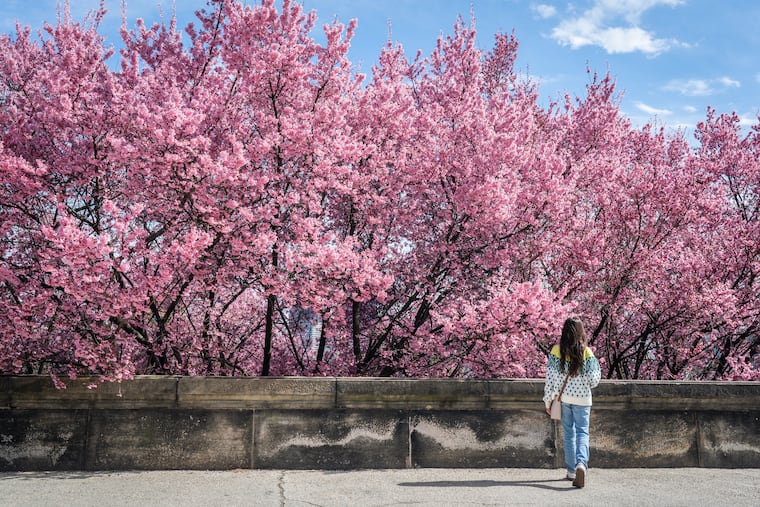
Yoshinos are the most plentiful cherry species in the Philly area, but it is the Okames that open the show, and their blooms will become evident before the end of March in South Philly, and perhaps several days later at the Morris Arboretum & Gardens of the University of Pennsylvania in Chestnut Hill. In addition to its lower elevation, South Philly likely would get first crack, thanks in part to urbanized heating, said Polyakov.
The Yoshinos, which constitute as much as 70% of the inventory in the city, would follow a week or so later.
They are nature’s way of decorating Philly for spring, and about the only way to miss them is not to look. They are abundantly evident along the Schuylkill, around the Art Museum, at Morris, along Delaware Avenue, on the western flank of Fairmount Park, and elsewhere.
One of the beauties of the Yoshinos is that in the early going, the blossoms have the stage to themselves since the leaves wait their turns. “You basically have these bare branch trees that explode with flowers,” said Polyakov.
The brilliantly pink Kwanzans, visible around the museum and in South Philly, close the show, peaking in late April. More than 1,400 of them line two miles of Chapel Avenue in Cherry Hill, the handiwork of a local couple that began in the 1970s.
Japan’s blossoming relationship with Philly
For their bounty of cherry trees, whose numbers have grown substantially in the last century, Philadelphians owe a significant debt of gratitude to the government of Japan. In 1926, when the U.S. was celebrating its 150th birthday, Japan gifited Philly with 1,600 cherry trees.
In a 20-year period starting in 1998, the Japan Society planted 1,000 more, and to mark the semiquincentennial, it is the process of planting 250 additional trees.
Along with the grounds of the Horticultural Center and nearby Shofuso Japanese Cultural Center, both on the west side of Fairmount Park, and the vicinity of the nearby Blankenburg Elementary School, new trees are being planted near the Grant Statue on the east side of Kelly Drive. Nearly 1,000 cherry trees now reside in the Horticultural Center area.
Japan also has powerful connections with the world-famous Washington festival. According to the Park Service, the cherry tree grove along the Arakawa River near Tokyo was the “parent stock” for the Washington trees.
If you are impatiently waiting for the Philly version and can’t get to Washington festival, the Park Service is offering live coverage of the unfolding of the cherry blossoms in the Tidal Basin.
A word of warning, you’re not going to see much in the way of compelling drama just yet. But it’s coming.
Keep in mind that while the peak season ripples across the species over about a month, each tree’s blossoms last only a week or two before the they litter the ground magically, so much confetti to mark a true end of winter.