N.J. comptroller alleges conflicts of interest involving George Norcross’ firm and local government insurance funds
Representatives for both Norcross and Conner Strong denied the allegations and accused the comptroller of abusing the power of his office.
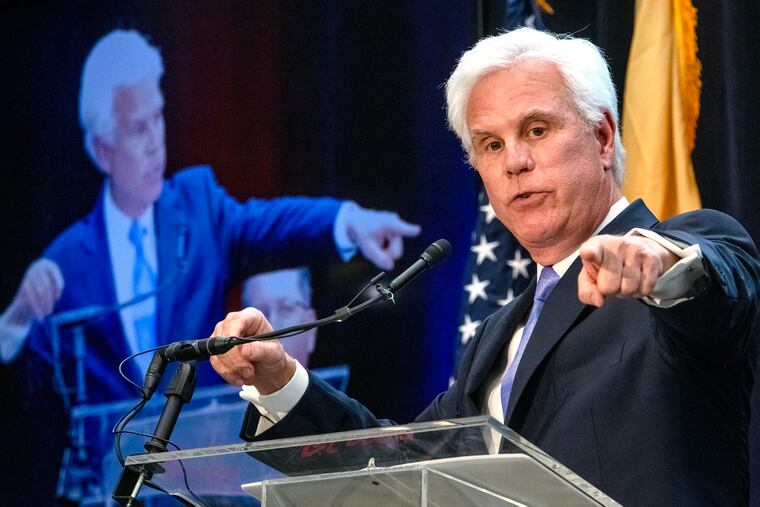
Health insurance funds that serve more than 100,000 local government employees in New Jersey have been hijacked by a single private company that effectively controls their contracts, a state watchdog agency said in a report Tuesday.
The New Jersey Office of the State Comptroller said Conner Strong & Buckelew, the Camden-based insurance brokerage founded by Democratic power broker George E. Norcross III, and a related entity have violated public contracting laws and failed to disclose conflicts of interest to state regulators.
“There is no clearer conflict of interest than when a company writes the RFP [request for proposals], reviews the bids, and then steers the contract to itself,” acting Comptroller Kevin Walsh, an appointee of Gov. Phil Murphy, said in a statement. “What makes this worse is that the vendor concealed from the State and its public entity clients that it was operating on all sides of contracting processes that are supposed to protect taxpayer funds.”
Representatives for both Norcross and Conner Strong denied the allegations and accused Walsh of abusing the power of his office.
Norcross spokesperson Dan Fee likened Walsh’s inquiry to the racketeering indictment that was brought against Norcross last year by Attorney General Matthew J. Platkin and that a judge dismissed in February. Platkin’s office is appealing that decision.
“Stop me if you’ve heard this before: an underqualified, politically ambitious government appointee decides to look at an extremely complicated issue and finds a grand conspiracy with George Norcross at its center,” Fee said in a statement.
“Like Matt Platkin’s case against Norcross and his allies in rebuilding Camden … today’s Comptroller report is rife with factual inaccuracies and evinces a fundamental lack of understanding of the issues, here how insurance markets work.”
Conner Strong accused the comptroller’s office of waging a “yearslong, baseless assault” on the company and its affiliate PERMA, an administrator of public health insurance funds. “This is not oversight — it is a calculated abuse of government power,” Conner Strong said in a statement, adding that the agency’s actions have delayed procurement processes and cost the public up to $2 million in lost savings.
The company said it was demanding a public apology and the retraction of the “slanderous” report; that Murphy appoint a special counsel to investigate the comptroller’s office’s “missteps and heavy handed actions”; and that the state legislature rein in the “rogue agency.”
At issue in the 49-page report are taxpayer-funded public entities known as health insurance funds that are designed to allow local governments and school districts to pool resources and lower the cost of managing insurance.
The report said the comptroller’s office — which oversees large public contracts to ensure compliance with the law — in 2024 and 2025 reviewed proposed procurements from three funds: the Southern New Jersey Regional Employee Benefits Fund, the Schools Health Insurance Fund, and the Municipal Reinsurance Health Insurance Fund.
In the course of reviewing the proposals, the report said, investigators found that Conner Strong and PERMA have often written the rules for how contracts were to be awarded — and then won the contracts.
State regulations prohibit a vendor from simultaneously serving as both a fund administrator — responsible for managing day-to-day operations — and program manager, providing services like claim administration and benefits consulting, according to the comptroller’s office.
But at these health funds, Conner Strong and PERMA have done exactly that, the report said, with the former serving as program manager and the latter acting as administrator.
“They present themselves as separate and independent companies, but OSC found that CSB and PERMA are effectively the same business operating under two names,” the report said. “Their employees overlap, they share leadership, and the same people work on both sides of the contracts.”
As Conner Strong was seeking to renew a contract with the Schools Health Insurance Fund, the person who oversaw that process was a Conner Strong employee, as well as a minority shareholder in the company “or one of its affiliated entities,” the report said, adding that neither the health fund’s trustees nor regulators were informed of the conflict.
From fiscal year 2021 to fiscal year 2025, the fund paid more than $36 million to Conner Strong and PERMA, “often with overlapping fees charged per employee for different roles CSB held,” Walsh’s office wrote.
The comptroller’s office said the report was “necessary to provide transparency and because the [funds], PERMA, and CSB dispute that any laws have been or are being violated, claim there are no conflicts of interest, and have clearly indicated their intention to continue with business as usual.”
Walsh said he had directed the three health insurance funds to submit corrective action plans.
In response, the chairs of six health insurance funds issued a statement saying the report made “false and unfounded accusations” that reflect “a fundamental misunderstanding of how joint insurance funds operate and why they have been successful for New Jersey taxpayers.”
The statement said regulators at the New Jersey Departments of Banking and Insurance and Community Affairs have “overseen and audited the [health insurance funds] without material infraction” for three decades.
The comptroller’s contention that “we as Chairs and Commissioners of various [health insurance funds] are unaware of the operations of these programs is an insult to the tremendous work we all apply to deliver high quality, affordable benefits for public workers and their families,” the statement said.