Government employees back to work ... but still in ‘shutdown mode’
As federal employees head back to work and institutions like Valley Forge National Historic Park get back up and running, some wonder if this is truly the end.
Monday, the first business day after the partial government shutdown ended — or at least went on pause — brought a sense of relief to many of the 800,000 federal workers who had been furloughed or working without pay since Dec. 22. But Brian Turner says he’s still in “shutdown mode.”
Turner, 28, a Transportation Security Administration agent at Philadelphia International Airport who was one of those who worked without pay during the 35-day shutdown, said his attitude is a practical one.
A father to an infant son, he knows the government might shut down again after Feb. 15 if lawmakers can’t come to an agreement over if or how to fund President Donald Trump’s proposed wall along the southern border. So he’s stocking up on groceries and still keeping an eye out for other jobs.
“As long as the shutdown seems to be a negotiation tactic, I have to prepare for the worst,” he said.
Despite the agreement to end the shutdown at least temporarily, Turner and hundreds of thousands of others — federal employees who returned to work, immigrants awaiting hearings, families relying on food stamps — haven’t put the shutdown behind them completely. Trump has said that he does not think a deal is likely and that he would use his emergency powers to fund building of the wall if it came to that.
The shutdown, the longest in U.S. history, likely will mean a $3 billion hit to the $20 trillion-plus national economy, according to a report the Congressional Budget Office released Monday.
It will add years to many immigrants’ court cases, immigration lawyers and former judges said. And because of the shutdown, people got their February food-stamp benefits early, which means they have to last for more than a month. Stores that rely on shoppers' using Supplemental Nutrition Assistance Program benefits also stand to miss out on sales by the end of February. Meanwhile, some restaurants extended their deals for federal employees. The airport will keep its food pantry open for workers until Thursday.
On Monday, a red banner still appeared at the top of the National Park Service’s website warning that the shutdown had closed some parks and limited operations in the rest.
The Philadelphia region has one of the nation’s largest bloc of federal workers, more than 40,000.
About 60 work at Valley Forge National Historical Park, where employees gathered Monday for a morning briefing, together again after more than a month away.
"They are relieved the shutdown is over, they’re pleased to be back in the parks, and we’re ready to resume where we left off,” said Jonathan Parker, the park’s public information officer.
"One of the first orders of business here today is to have amended our time cards so that they can be sent to Washington to facilitate the back pay,” Parker said.
Parker said employees would begin to receive back pay as early as Wednesday. Since federal workers could get one big check of back pay, they likely would get more taxes taken out of their paychecks, said Nurel Story, a revenue agent with the IRS and union leader. Employees who got unemployment benefits will also have to repay them; more than 41,000 federal workers in New Jersey and Pennsylvania applied for those benefits in the first four weeks of the shutdown.
Fourteen employees had continued to work at Valley Forge during the shutdown, mostly federally commissioned law enforcement rangers and some maintenance staff.
Parker said the park should be back to full operation at midweek. During the shutdown, most of the park’s restrooms were closed, so they need to be cleaned and reopened. The park was open for normal business hours Monday, but some historic buildings were not yet accessible.
School field trips canceled because of the shutdown need to be rescheduled. Paused discussions about budgeting and hiring need to resume.
What will be the long-term impact of the shutdown on the park, and when will employees be caught up from a month away from work?
“That’s a great question I’m not sure internally we even have an answer for yet,” Parker said. “That remains to be seen.”
Two nonprofits — the bookstore and souvenir shop the Encampment Store and the Valley Forge Tourism and Convention Board — kept basic visitor operations going during the shutdown. According to national policy, these groups will not be reimbursed.
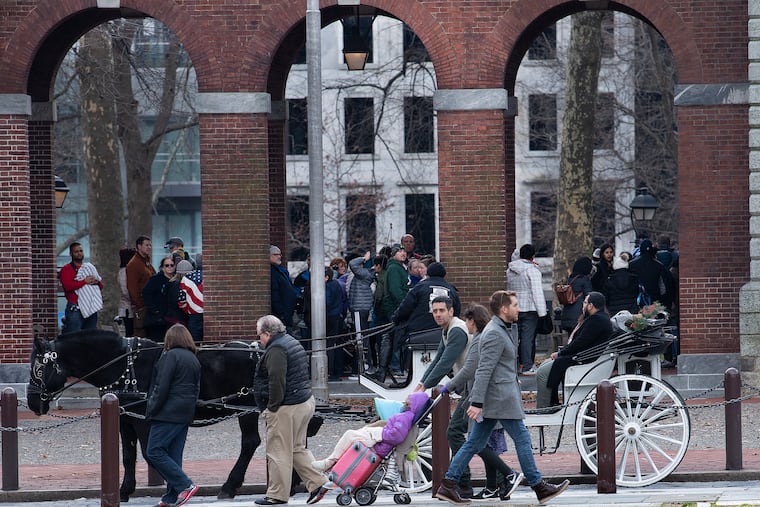
In Old City, the Independence Visitor Center, which resumed normal operating hours on Sunday, saw a 126 percent increase in attendance over the same weekend last year, said spokesperson Nicole Woods. The Visitor Center’s staff went unpaid one day per week during the shutdown and will not receive back pay because they are not federal employees.
Rich Gennetti, a national representative for the union for federal government employees in Pennsylvania and Delaware, said workers “are all delighted to be back, at least temporarily.”
“We hope sanity prevails,” he said, "and everyone figures out no one wants to go through this again in three weeks.”