Kilmar Abrego Garcia is freed from immigrant detention center in Pennsylvania after judge’s order
Abrego Garcia was being held at the Moshannon Valley Processing Center.
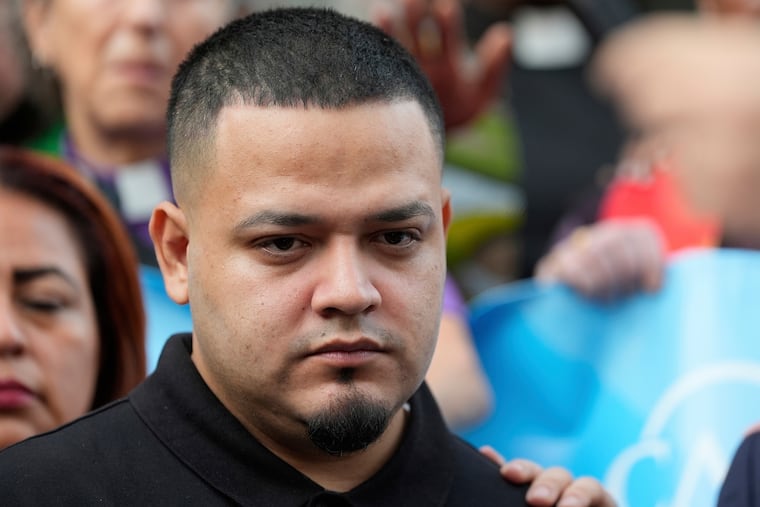
Kilmar Abrego Garcia was freed from an immigration detention center in Pennsylvania on Thursday evening following a federal judge’s order earlier in the day that compelled his release, marking a significant development in a case that has served as a test of the deportation powers of President Donald Trump’s administration.
An attorney for Abrego Garcia confirmed his client’s release, telling the Associated Press that he left the Moshannon Valley Processing Center, where he had been held since late September, just before 5 p.m. Abrego Garcia, whose case gained international attention earlier this year after he was deported to the notorious CECOT prison in his native El Salvador before being ordered returned, will return to Maryland.
“The government still has plenty of tools in their toolbox, plenty of tricks up their sleeve,” attorney Simon Sandoval-Moshenberg said. “We’re going to be there to fight to make sure there is a fair trial.”
Abrego Garcia’s release came after Maryland U.S. District Judge Paula Xinis found that Immigration and Customs Enforcement had detained him with no legal basis. In an order issued Thursday morning, Xinis ordered ICE to release him immediately.
“Since Abrego Garcia’s return from wrongful detention in El Salvador, he has been re-detained, again without lawful authority,” the judge wrote. “For this reason, the Court will GRANT Abrego Garcia’s Petition for immediate release from ICE custody.”
The Department of Homeland Security was highly critical of the release order, calling it “naked judicial activism” by a judge who was appointed by President Barack Obama, a Democrat.
“This order lacks any valid legal basis, and we will continue to fight this tooth and nail in the courts,” said Tricia McLaughlin, the department’s assistant secretary.
Abrego Garcia entered the United States without permission at age 16, then settled in Maryland, and later married and started a family. An immigration judge ruled in 2019 that he could be deported, but not to El Salvador, where he faced threats of gang violence. The Trump administration, which claimed Abrego Garcia was a member of the MS-13 gang, nonetheless deported him to that country in March, and his wife successfully sued to bring him back.
His case went on to become a rallying point for those who oppose Trump’s immigration crackdown. Upon his return, he was charged with human trafficking — an allegation his lawyers called preposterous and vindictive. Abrego Garcia has pleaded not guilty in that case and filed a motion to dismiss the charges.
Though Abrego Garcia cannot legally be deported to El Salvador, ICE has sought to deport him to several African countries, including Eswatini, Ghana, and Uganda. In her order, Xinis wrote that “none of these countries were ever viable options” and noted that Costa Rica — where Abrego Garcia indicated he would prefer to be deported should he be removed — never rescinded an offer to accept him, as officials previously alleged.
“But Costa Rica had never wavered in its commitment to receive Abrego Garcia, just as Abrego Garcia never wavered in his commitment to resettle there,” Xinis wrote.
A transfer to Pennsylvania
After being held at a detention center in Virginia following his return to the United States in June, Abrego Garcia was transferred to Moshannon Valley Processing Center in Western Pennsylvania. Known as Moshannon, the facility is run by the Florida-based private prisons giant GEO Group.
In a recent Inquirer report, current and former detainees described grim and crowded conditions at the facility, with 75 men sleeping together in a pod, sharing six toilets and three showers among them. The facility is the largest detention center in the northeastern United States, capable of holding nearly 1,900 prisoners, The Inquirer previously reported.
ICE officials said at the time of Abrego Garcia’s transfer that his detention to Moshannon would allow his lawyers easier access to their client. Abrego Garcia’s attorneys, however, raised concerns about the conditions at the facility, saying there had been reports of “assaults, inadequate medical care, and insufficient food” there.
In a separate immigration court action filed in August, Abrego Garcia petitioned to reopen his immigration case to seek asylum in the United States. That case remains ongoing.
In her order releasing Abrego Garcia, Xinis wrote that federal authorities “did not just stonewall” the court: “They affirmatively misled the tribunal.” Xinis also dismissed the federal government’s arguments that the court did not have jurisdiction to rule on a final order of removal, noting that such an order had not been filed.
“Thus, Abrego Garcia’s request for immediate release cannot touch upon the execution of a removal order if no such order exists,” she wrote.
Staff writers Jeff Gammage and Max Marin contributed to this article, which contains information from the Associated Press.