Eroded Jersey Shore beaches could soon get federal money for replenishment. Will it be enough?
Projects set for Cape May, Stone Harbor, Avalon, Sea Isle, Strathmere, Ocean City, and Long Beach Island have all been stalled because of the lack of funding.
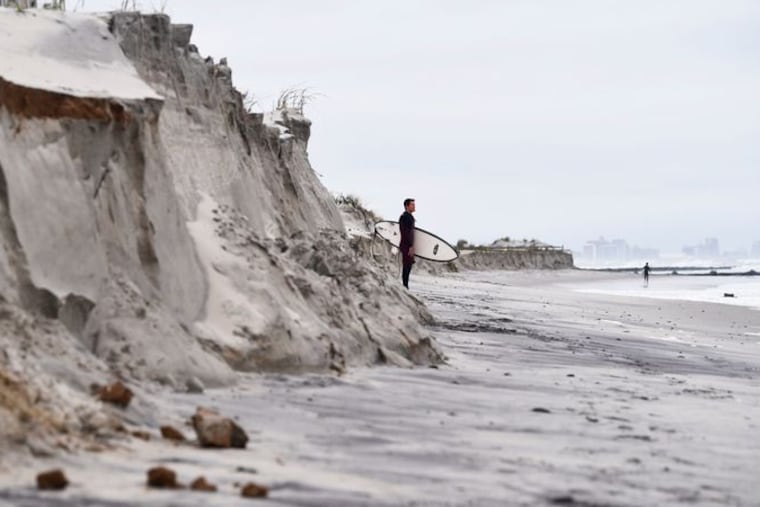
Congress appears poised to spend money in 2026 on beach replenishment projects in wake of the zero dollars it allocated this year.
But bills proposed in the House by U.S. Rep. Chuck Fleischmann (R., Tenn.) and in the Senate by U.S. Sen. John Kennedy (R., La.) appear to still fall woefully short of what is needed, a coastal advocacy group says. U.S. House Rep. Jeff Van Drew, however, believes there will be adequate funding.
Dan Ginolfi, executive director of the American Coastal Coalition, an advocacy group for coastal communities and beaches, said the current best case would be the Senate bill, which proposes to spend $62.2 million. The House bill proposes $23 million.
However, both proposals fall short of the approximately $200 million needed to fund approved projects in various states that received no money last year, he said.
Any approved money would go to the U.S. Army Corps of Engineers, which would choose which beach erosion projects to manage.
In New Jersey, projects set for Cape May, Stone Harbor, Avalon, Sea Isle, Strathmere, Ocean City, and Long Beach Island have been stalled because of the lack of funding. So, too, have projects in Maryland, Delaware, Georgia, and Florida.
That means “the level of risk in New Jersey right now is unacceptable,” Ginolfi said.
» READ MORE: Shore towns get no federal dollars for beach replenishments for the first time in almost 30 years
He noted that it’s not only beaches at risk, but homes, businesses, public property, and infrastructure.
“It really is imperative that the federal and state government work together to achieve a solution,” he said.
Ginolfi noted that coastal communities in the U.S. generate $36 billion in federal and state tax revenue. So he sees $200 million as a good return on investment.
He said his numbers for potential beach replenishment projects in the bills were confirmed with appropriations committees in both the House and Senate.
However, the office of Van Drew, a Republican who represents many New Jersey beach communities, said the coalition’s numbers “misrepresent the true amount of funding available.”
Paxton Antonucci, a spokesperson for Van Drew, said there is actually $166 million available in the House bill “for costs associated with shore protection like beach replenishment, which is the typical amount.”
He said that number will come close to $200 million “after we compromise with the Senate.”
In reality, Van Drew said, most beach replenishment funding comes from outside the regular budget process. He has actively sought such money.
In October, Van Drew wrote to the Army Corps, requesting that it “activate disaster recovery authorities … to repair shore protection projects at the Jersey Shore, in response to damages caused by Hurricane Erin and by the recent nor’easter over the weekend of Oct. 10-12.”
» READ MORE: Ocean City declares emergency over beach erosion, urges state and federal help
And he wrote to Gov. Phil Murphy and Gov.-elect Mikie Sherrill this week urging that New Jersey declare a state of emergency to secure federal money “for the severe coastal erosion and storm damage affecting the Jersey Shore.”
Van Drew said the Shore has been battered since July by “intense wind, wave, and water impacts from storm events including Hurricane Erin, Hurricane Imelda, offshore Hurricane Humberto, and a succession of destructive nor’easters.”
He said the result has been “significant dune loss, beach profile collapse, and damage to public infrastructure in multiple municipalities.”
Indeed, the Ocean City Council declared a local emergency over beach erosion from the storms and urged state and federal officials to help.
The American Coastal Coalition has faulted Murphy’s office for failing to request disaster repair projects from the Army Corps in the wake of the storms.
However, Murphy’s office said the storms this year did not meet financial thresholds needed to qualify for major federal disaster declarations.
In addition, the office said that, even if they did, replenishment projects at Army Corps-engineered beaches are not routinely eligible for Federal Emergency Management Agency reimbursement.
Rather, the office blamed Congress for putting forth a budget that cut beach replenishment projects, and said that blue states are a target of the Trump administration.
