In Harrisburg, Philadelphia Mayor Parker asks lawmakers to double school renovation fund to $250 million
Mayor Cherelle L. Parker hosted a two-hour news conference in Harrisburg calling on Pa. lawmakers to increase funding to update school buildings, but the idea faces an uphill battle.
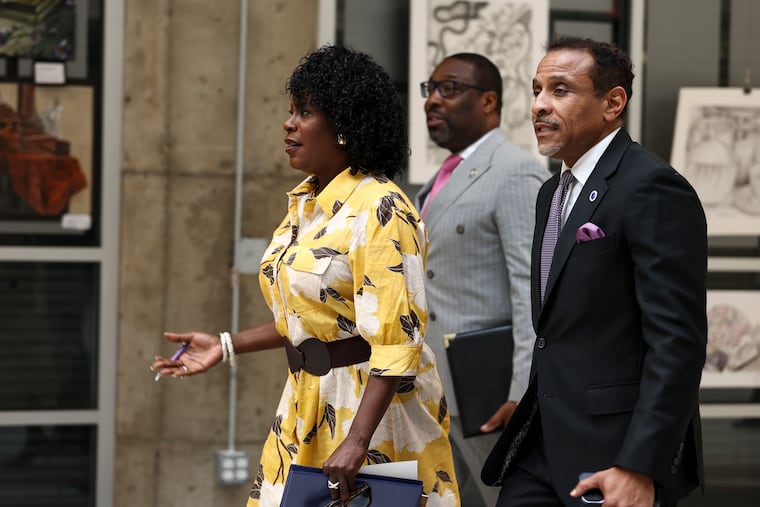
HARRISBURG —Philadelphia Mayor Cherelle L. Parker called on Pennsylvania’s General Assembly to double what it sets aside for school districts to update their aging buildings, as the School District of Philadelphia embarks on a $3.3 billion plan to modernize 169 school buildings.
Parker hosted a two-hourlong news conference at the state Capitol building on Monday, asking Pennsylvania’s split legislature and Gov. Josh Shapiro to increase the amount of money available for school facility renovations from its current $125 million to $250 million as part of this year’s state budget, which is due at the end of the month.
The school district is now on track to close 17 schools as part of the larger modernization efforts, following months of protest and controversy over the facilities plan.
Parker appeared alongside City Council President Kenyatta Johnson, School District of Philadelphia Superintendent Tony B. Watlington Sr. and school board President Reginald L. Streater following several weeks of tensions with state and city legislative leaders over her proposed tax plans to raise revenue for the city and the school district, which ultimately failed.
But on Monday, the city leaders appeared as a united front in Harrisburg, showing their commitment to “right-sizing” Pennsylvania’s largest school district, which is also the ninth largest in the nation.
“We are here united to let you know that we are proud that the city of Philadelphia has some skin in the game, and we are not coming here simply with our hat in hand, asking the commonwealth of Pennsylvania to come save the school district of Philadelphia,” Parker said, noting that the city was able to stave off classroom cuts.
“It is the General Assembly who told us last year we will not give additional funding until you come back with a facilities plan. So we went to work,” Johnson said during the news conference Monday.
Now it’s on the state to set aside additional funding to help school districts update their facilities, Parker and Johnson said.
Shapiro, a first-term Democrat, proposed keeping the pot of money at $125 million for the upcoming fiscal year, as part of his $53.2 billion budget proposal.
Pennsylvania is facing its own budget problems, as the state is on track to spend more than it brings in in revenue this year and in future years. Shapiro’s budget proposal would spend $4.3 billion more than the state’s projected revenue for the upcoming fiscal year, meaning Parker’s funding increase request faces an uphill battle.
The event highlighted a coalition of advocates, from labor leaders from various unions, to recent graduates, to public education advocates — all calling on the state to increase the state’s capital fund, in addition to continuing to increase the city’s adequacy funding.
The school district is facing a $300 million structural deficit, and had planned to cut more than 300 school-based positions before city officials cut a deal to keep funding the positions with a yet-to-be-determined revenue source.
Several of the speakers recalled recent times when their young children did not have access to bathrooms, or the instances when schools had to shift to virtual learning because the buildings are unequipped to handle cold or hot weather.
The speakers, including Parker, emphasized that the issue of aging school buildings is not exclusive to Philadelphia. It’s an issue faced by school districts around Pennsylvania, including rural and suburban ones.
“So goes the decision-making in this building, so goes the future of rural, urban, and suburban Pennsylvania, and all of our children,” Parker said.
In a letter sent Monday to members of the General Assembly, top leaders from the Pennsylvania League of Urban Schools and the Pennsylvania Association of Rural and Small Schools echoed the calls
“Safe, modern school buildings should not depend on a community’s zip code, and we stand with Mayor Parker in calling for Harrisburg to make that needed commitment to students in every corner of the Commonwealth,” the letter said.
In a letter to Shapiro earlier in January 2026, ahead of his annual budget pitch, Parker requested that the state double the amount available for school facility improvements, as well as a revision to the guidelines to allow a single district to receive up to 25% of the total grant funding in a given year. That would open approximately $50 to $60 million annually for the district to tap into to improve school buildings, according to the letter.
Parker, who served as a state representative for 10 years before joining City Council and her election as mayor, received a major blow to her tax plans from Harrisburg in the final days of city budget negotiations, when three sources with knowledge of the closed-door state budget talks told The Inquirer they wouldn’t approve increases to the city’s hotel and long-term rental taxes she requested to help expand the city’s homelessness services.
Only one state lawmaker joined the mayor’s event: Sen. Art Haywood (D., Philadelphia/Montgomery). Parker met separately in a private meeting with Philadelphia’s House delegation to Harrisburg.
