Judge denies challenges to a 1.5 million-square-foot East Whiteland data center project
The appeals had challenged the local zoning hearing board’s 2018 decision to permit for a data center at 13 S. Bacton Hill Rd., and the board of supervisors’ 2024 approval of the development plans.
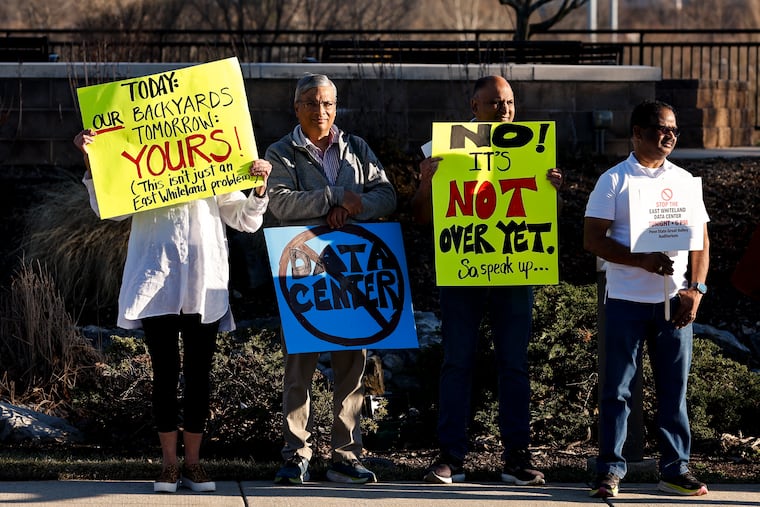
Calling it “frivolous,” a Chester County judge on Thursday quashed a land use appeal seeking to halt the construction of a 1.5 million-square-foot data center proposed for East Whiteland Township.
It’s the second time this week Court of Common Pleas Judge Anthony Verwey has denied appeals challenging approvals of the controversial data center project, proposed for a Superfund site near a residential development and the popular Chester Valley Trail.
“None of the four ‘errors’ complained of by the Appellants constitutes a decision subject to review by this Court,” Verwey wrote in his order denying the challenge to East Whiteland elected officials’ approval of the development plans. “... Appellants are attempting to collaterally attack an approval, that had ‘no deficiencies.’ The appeal, filed well out of time, is frivolous.”
The appeals challenged the zoning hearing board’s 2018 decision to permit for a data center at 13 S. Bacton Hill Rd., and the board of supervisors’ 2024 approval of the development plans.
Lou Colagreco, an attorney representing the developers Green Fig LLC and Sentinel Data Centers, said they “are pleased that the court acted quickly and decisively in dismissing” both appeals. Colagreco said work is underway for the project’s stormwater management facilities in adjacent West Whiteland, and that the developers are securing the perimeter of the East Whiteland site in advance of construction.
The judge’s denial is a hit for residents who have for months shown up adamantly against the data center.
Attorney Andrew Schneider, a resident of the nearby development Malvern Hunt who argued on behalf of other neighbors, said he “respectfully disagree[d] with the Court’s decisions.” Schneider has another case filed in opposition to the data center project.
The data center project has been through a winding saga, after it secured initial approvals years ago with little community fanfare. But when it approached the township to amend its original plans — at first requesting to scale up the project by 600,000 square feet — it kicked off a slew of contentious public meetings. When too many people showed up to one planning commission meeting in February, officials had to postpone it.
Developers Green Fig LLC and Sentinel Data Centers abandoned attempts to amend the plans when “it became apparent to us … that it was simply data center vs. no data center,” Colagreco said previously.
During a hearing last week challenging the board’s approval of the project, Schneider argued that the township had erred in its decision to approve the plans, saying that the final plan was deficient and didn’t meet conditions the municipality initially laid out. Allowing the construction would cause irreparable damage to the health of the community, he said.
Colagreco dismissed those arguments, saying the residents hadn’t produced enough evidence to support their allegations. But delaying the project was a threat to the developers being able to complete the data center on time and risked them losing approvals, he said.
Colagreco and an attorney representing the township argued that the appeal came too late, and the township’s decision shouldn’t come before the court.
Verwey ultimately agreed.
“Appellants cite not a single case to support the proposition that any of the four ‘errors’ are appealable,” he wrote in Thursday’s order. “This is likely because no such citations exist.”
Verwey wrote in his order regarding the 2018 zoning decision that the appeal, “filed 8 years after issuance, is out of time and must be quashed.”
As data centers are beginning to populate Pennsylvania and surrounding states, residents have become stauncher opponents. In nearby East Vincent, the community saw an early victory when supervisors denied a proposed data center at the historic Pennhurst State Hospital and School site last month. It will also likely end up before a judge, as the developer there plans to appeal the decision.

Want to get Inquirer Chester County straight to your inbox every week? Sign up here for our guide to the news, stories, and events shaping life in your community.
This suburban content is produced with support from the Leslie Miller and Richard Worley Foundation and The Lenfest Institute for Journalism. Editorial content is created independently of the project donors. Gifts to support The Inquirer’s high-impact journalism can be made at inquirer.com/donate. A list of Lenfest Institute donors can be found at lenfestinstitute.org/supporters.