Honesdale’s massive Himalayan Institute is no longer so secret after more than 50 years of yoga and meditation
The institute moved into the former seminary on 400 hilly, forested acres in 1977.
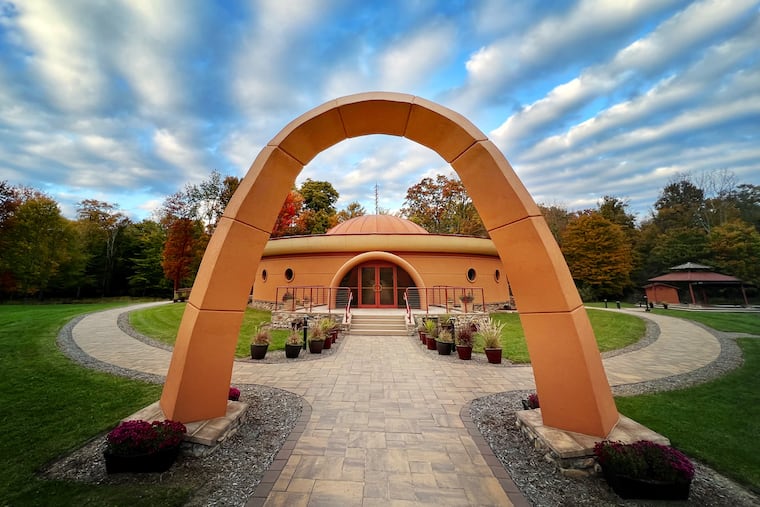
The silence in the Himalayan Institute’s shrine redefines silence, quiet enough to hear your heartbeat, to pick up a whisper from across the room, and, perhaps most importantly, to feel every breath, in and out, while you meditate.
The institute, founded in 1972, moved into the massive, former seminary on 400 hilly, forested acres in Honesdale, Wayne County, in 1977, a time when yoga was still a niche practice. For more than 50 years, the institute has been offering yoga training, spirituality, meditation, and holistic health practices, along with getaways and retreats.
“It’s for anyone, for any creed, religion, sex, or gender,” said Greg Capitolo, a California native who became the institute’s president after attending retreats there. “There’s really no religious affiliation at all.”
As yoga exploded in popularity and modern meditation apps abound, the Himalayan Institute has seen growing interest worldwide. It hasn’t hurt that downtown Honesdale has seen its own popularity grow over the last decade as Philadelphia and New York City residents look for properties and business opportunities outside of traditional urban escapes, like upstate New York.
“I like to say this is the best-kept secret in Wayne County,” Capitolo said. “I hope we become less of a secret to the people here. ”
The Inquirer went to Honesdale during a frigid weekend last December and confirmed it: even in single-digit temps, the town’s gift shops, bakeries, buzz-worthy restaurants, art galleries, and book stores were alive with tourists and locals up and down Main Street.
Afterward, several readers mention the Himalayan Institute as a “must-visit.”
On a Monday in late November, the main, dormlike building was abuzz with “residents” who were doing volunteer work in the kitchen for access to classes, yoga training, and other programs the institute offers. Capitolo said the institute can house up to 80 residents, who commit to staying for a year as part of the $800 per month "Residential Service Program."
Meals are vegetarian, and on this afternoon, lunch was beet subzi and kimchari. The Himalayan Institute follows Ayurvedic principles, which discuss balance and digestion, among other things.
“The Ayurvedic system says you should eat your biggest meal around lunchtime, when the sun’s at its highest, point, because your digestion will be optimally ready to break down food,” Capitolo said.
There’s also a gift shop and a trail network at the Institute, along with a popular Wellness Center that offers several types of massage, including hot stone. One of the Wellness Center’s most popular offerings is an Ayurvedic therapy known as Shirodhara Treatment, which includes “streaming warm oil onto the forehead to clear and calm the mind.”
The simplest structure and offering at the Himalayan Institute may be the Sri Vidya Shrine, a simple, domed building that sits behind the former seminary on the campus. The shrine is the twin of the Sri Vidya Shrine at the Himalayan Institute’s Khajuraho campus in central India, and its meditation hall is not so simple: that unique silence was part of the design.
The shrine’s meditation hall is referred to as the mandapa, literally “the canopy for seekers to gather.”
Capitolo sat silently in the hall for several minutes, hands folded, focusing on his breath. He, too, was a seeker, leaving a lucrative job in Silicon Valley to head east to Honesdale, before it was hip.
“I was happy and seemingly had everything I needed,” he said outside the shrine. “But something was missing. This place satisfied what was missing.”
