A SNAP benefits freeze could mean food insecurity doomsday for the Philadelphia region
Local organizations that fight hunger have experienced millions of dollars of cuts in federal funding this year.
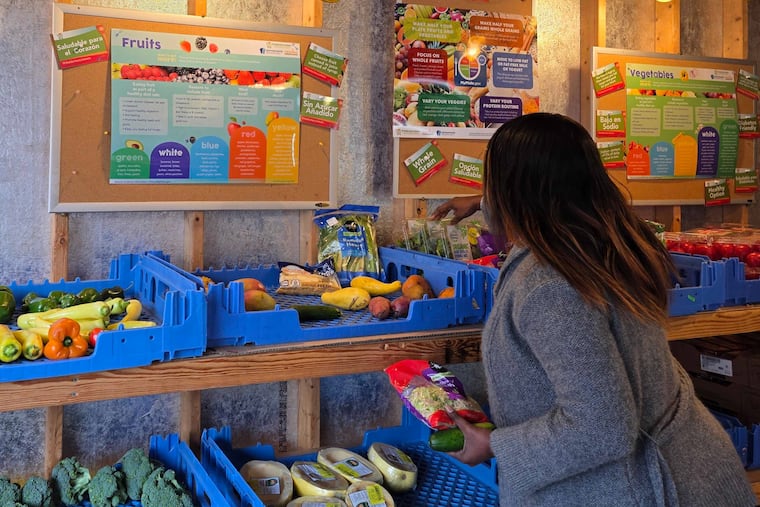
For decades, what is now known as the Supplemental Nutrition Assistance Program has been a lifeline for the country’s most vulnerable families — even through federal shutdowns. As the program appeared poised to grind to a halt this week, many experts and pantry officials feared a food insecurity doomsday.
“I’m worried,” Loree Jones Brown, CEO of Philabundance, said Thursday, describing the moment as unprecedented. It would be “the first time that this SNAP program has not functioned since it started.”
Republicans and Democrats have failed to pass a federal budget to keep the government open, and as a result the U.S. Department of Agriculture (USDA) has said SNAP benefits will run out. Advocates for the program have called for President Donald Trump’s administration to tap into a $5.5 billion agency reserve to fund SNAP while budget negotiations continue. The administration has refused to release the funds before legislators reach a budget deal.
With mounting public condemnations yielding no results, a coalition of attorneys general and governors from 25 states, including Pennsylvania, sued the Trump administration Tuesday to stop the benefits freeze.
On Friday, a federal judge in Rhode Island ordered the administration to tap into contingency funds to continue paying SNAP benefits, and a federal judge in Massachusetts ordered the administration to share a plan by Monday of how it will continue to fund the program.
It is unclear what the immediate impact will be on those who depend on the program, if and when funds will be available to them. Some disruption in benefits is still expected because those tasked with loading SNAP cards haven’t had the usual allotted time to do so.
Gov. Josh Shapiro said Friday, after releasing $5 million from the state to Feeding Pennsylvania, that after the federal courts’ decision it will take about 10 days to get SNAP benefits flowing to recipients again. And Shapiro said he doesn’t trust that the Trump administration will follow the federal courts’ rulings.
The USDA has billions in reserves, but those funds would only cover half a month’s worth of benefits. Families would be left in the lurch unless other funding is used or a federal budget is passed.
All this, at the heels of the Thanksgiving holiday.
Food assistance programs across the Philadelphia region already report a surge in demand, even before the threat to SNAP, with many local pantries seeing spikes in October.
At Philabundance, Jones Brown plans to increase the amount of food the program gives out by 25% the next three months — an additional cost of $300,000 a month. Still, that can’t cover the expected demand, she says.
“Even that — it feels inadequate,” she said.
Adjusting to a shifting need
Montgomery County resident Rhonda Cosme would have described herself as comfortably middle-class until she was one of the 450 people laid off by Amtrak in May.
On Wednesday, she was stocking up on groceries ahead of a potential benefits freeze at Ambler’s Mattie N. Dixon Community Cupboard.
Since losing her job, the 51-year-old human resources professional has drained her savings, depleted her 401(k), and, a few months ago, she applied for Medicaid to help pay for her life-saving diabetes medication and SNAP.
“Now you have people who are losing SNAP benefits, and there are going to be all new families here,” Cosme said.
Pantries such as Mattie Dixon plan to add food distribution days, regardless of what happens Nov. 1, to accommodate a rising need. The pantry helps feed close to 500 families in a typical month. But with a week left in October, Mattie Dixon’s two locations in Ambler and North Hills had already helped 600 families, or about 1,800 individuals.
The pantry’s leaders said they have exceeded half the year’s food budget only a few months into their fiscal year, but the plan is to keep feeding people until they can’t, though they are bullish on their ability to keep up with demand as donations come in.
Still, other pantries are struggling to keep up.
Marlene Trice, founder and director of Kitchen of Love in East Mount Airy, said she had to cut a distribution day because she doesn’t have enough food to give out.
To deal with the surge, she’s reaching out to partners that donate food for additional support.
“They say they’re doing the best they can,” Trice said.
At St. Mark’s Church in Center City, which runs a food pantry on Thursday and Friday mornings, there has been a surge in the last week of people calling for basic information about when to pick up food and if distribution is still happening.
The food pantry caters in large part to seniors, and Antonia Benson, who manages it, says it’s a “supplement” for people who are “trying to make ends meet after using SNAP” or other resources.
If people are no longer able to use SNAP, “that’s all going to fall on programs like ours, which are rushing to try to fill the need, but are not designed to handle this amount of traffic, really,” she said.
Even larger nonprofits that focus on fighting hunger find themselves working with fewer resources as a result of the compounding effects of a budget impasse in Harrisburg, a federal shutdown, rising food costs, inflation, layoffs across the region, and general cuts to social services.
Vincent Schiavone, CEO of Caring For Friends, says the organization was already seeing growing demand before the shutdown.
It’s unable to pick up a donation of $600,000 worth of food waiting in North Carolina because it doesn’t have the budget, he said on Wednesday. And in Philadelphia, 450 seniors are on its wait list for food deliveries — but there isn’t enough transportation or volunteers, Schiavone said.
A SNAP freeze would be different from past food crises
Some organizations in the region were already facing financial setbacks this year before the shutdown started.
Philabundance’s federal funds were cut, and about 250,000 pounds of food it was expecting to get through a federal program were also canceled in the spring.
Share Food Program, a nonprofit that serves Philadelphia and the four collar counties, lost $8.5 million in federal funding over the course of this year, according to executive director George Matysik.
As a result, the organization has “much less food” than it would typically have around this time of year. Meanwhile, its demand has increased 120% over the last three years.
The organization, which provides food to several hundred pantries and 800 schools in the region, also can’t currently use two state programs it has relied on in the past because of the state budget impasse. Those programs have allowed the nonprofit to purchase $5 million to $7 million a year in local food for food pantries.
Share Food typically serves 500,000 people each month. Amid the federal government shutdown, some pantries the organization works with are reporting as much as 12 times more new registrations over the course of the last two weeks, Matysik said.
“We’re really seeing unprecedented numbers across the board of new folks, many of whom are showing up to a food bank for the first time in their lives,” Matysik said.
A regional food fund launched this week aims to provide the largest food banks in the region with more funding.
The program — from the Philadelphia Foundation, William Penn Foundation, and United Way of Greater Philadelphia and Southern New Jersey — intends to raise $6 million.
“This is intended to both try to fill the gap, but also to tell others we are in real need here,” said the Rev. Bill Golderer, president and CEO of United Way of Greater Philadelphia and Southern New Jersey. “This really is a crisis, and people are going to go hungry if we don’t do more.”
Matysik, of the Share Food Program, says this moment is different from “previous crises” the organization has faced. During the 2008 recession and the pandemic in 2020, he says the “federal government came in with myriad resources that allowed us to be able to have the resources we needed to get food out to folks.”
But now, he says, “we are seeing our own federal government choosing to do this to its people.”

Some 800,000 people receive SNAP benefits in New Jersey – nearly 360,000 of whom are children, according to Mary Coogan, president and CEO of Advocates for Children of New Jersey.
In South Jersey, here’s how many children use SNAP:
- Camden County: 33,000
- Gloucester County: more than 7,200
- Burlington County, around 9,000
Rent or food?
Advocates and experts say a lapse in SNAP benefits would kick off a cascade of hardships that transcend hunger.
“When food assistance disappears, parents don’t just skip meals, they fall behind on utility bills, defer medical care, and risk eviction,” said Mary Coogan, president and CEO of Advocates for Children of New Jersey (ACNJ), a research and advocacy group.
“This freeze won’t just create hunger. It will trigger hardships for months to come,” Coogan said earlier this week.
For Dana Brown-Touré, 52, a disabled woman living in Camden who’s losing her sight, the potential loss of even a few weeks of food dollars from the SNAP program could be catastrophic for her and her 7-year-old daughter.
Brown-Touré said she tries to supplement her food supply with items from local pantries, but “you see more and more people there these days.”
“If there’s no SNAP, I don’t know what we’re going to do,” she said. “My rent is $800, and I get $300 in SNAP a month. That’s not enough now. What happens to us if SNAP goes?”
Even with food aid, she said, “I still have to skip meals so my girl can eat.”
Editor’s Note: This story has been updated to note federal court decisions on Friday.