Tick-related illnesses on the rise as the Philly region reaches peak season
The 30 inches of snow that fell in the Philadelphia region and lingered on the ground for weeks swaddled ticks as snugly as bugs in an igloo.
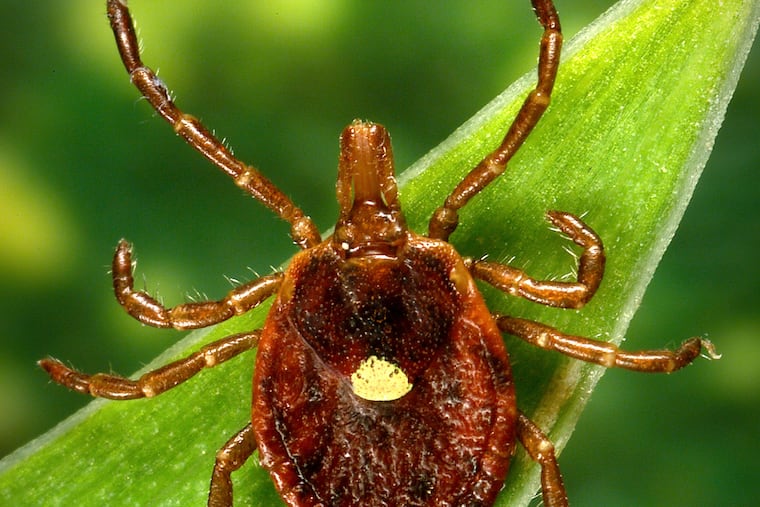
This summer could be one of the tickiest tick seasons in years, some experts warn.
June and July mark the height of tick-borne illnesses, from Lyme disease to the emerging alpha-gal syndrome, but it is the winter that may have laid the groundwork. The 30 inches of snow that fell in the Philadelphia region and lingered on the ground for weeks swaddled ticks as snugly as bugs in an igloo.
“Snow acts as an insulator, so it’s protecting them even if it got super cold,” said Erika Machtinger, an associate entomology professor at Pennsylvania State University.
Ticks, tiny arachnids, slow their metabolism, burrow beneath leaf litter, and wait out the cold months. A thick layer of snow fortifies their shelter, creating a protected pocket.
However, Machtinger said, plenty of other factors play into why tick-borne illnesses are growing: more deer, more awareness, and more people going outside.
A growing number of cases
The Northeast is traditionally the region hit hardest by ticks, according to data from the Centers for Disease Control and Prevention (CDC).
And Pennsylvania consistently ranks near, if not at, the top among states in reported cases of Lyme disease and other tick-borne illnesses.
Lyme disease cases have exploded since 2021, according to the Pennsylvania Department of Health.
In 2021, there were 2,900 cases reported. Last year, there were 18,747. So far this year, there are 4,240. Cases dipped during the pandemic but had been on the rise before that.
A statement by the CDC in late April cautioned that visits to emergency rooms for tick bites were higher than normal in many parts of the country. It noted that in all regions except the south-central U.S., weekly rates of emergency room visits for tick bites were the highest for this time of year since 2017.
Machtinger said it is difficult to gauge whether there are actually more ticks this season. The level of ticks can vary from county to county.
“It depends on what’s going on in that specific area and the ecology of that area,” she said.
Rise of alpha-gal syndrome
More emergency room visits are not necessarily an indicator of more ticks, Machtinger said.
It could mean that people have been more active outside because of the nice weather, she noted. Or it could be because people are more vigilant when it comes to ticks, especially given how much attention alpha-gal syndrome (AGS) has gotten.
AGS, a food allergy primarily related to red meat, is a reaction to the alpha-gal sugar molecule found in many mammalian products, such as red meat and dairy, according to the Pennsylvania Department of Health.
It is linked to the bite of the lone star tick (Amblyomma americanum), though other tick species may also cause AGS. Patients with alpha-gal syndrome can have reactions ranging from mild to life-threatening and should be managed by a healthcare provider.
Most cases have so far been reported in the southeastern and south-central regions of the country, where higher populations of lone star ticks are found.
Pennsylvania has launched a new AGS tracking effort, asking labs to report cases. The state health department is aware of about 600 cases in the last two years, based on voluntary reports. The first documented death from the red meat allergy was reported last year in New Jersey.
» READ MORE: Pennsylvania starts tracking red meat allergy caused by tick bites as hundreds of cases appear in state
More tick species spread to the area
Machtinger said her experience looking for ticks this year in central Pennsylvania has not convinced her there are more than in other years. In some places, she has found fewer. But tick season is only now going into its peak.
The number of tick species found in Pennsylvania has grown over the years. Of the more than 900 species of ticks worldwide, at least 25 are thought to exist in Pennsylvania.
Of those, two species account for more than 90% of identification requests submitted to Penn State — the blacklegged tick (also known as the deer tick) and the American dog tick. The lone star tick, Asian longhorned tick, and winter tick have also been found.
Deer could be a main reason humans seem to be encountering more ticks, Machtinger said. Ticks love to feast on deer and hitch rides on them, causing deer to become major vectors.
“Ticks can feed and reproduce on other hosts,” she said, “But because there are so many deer, they move around a lot, and they’re big, they can carry a lot more ticks than a fox. And deer do well in spaces where there are people. That increases the risk of not only more ticks, but more ticks in the same areas as people.”
Those encounters only grow as the amount of woods shrinks to make way for development, pushing deer into suburbs.
Additionally, more people began venturing outdoors since the pandemic in what seems to be a lasting trend.
Pets and ticks
Pets and livestock are also threatened by tick-borne pathogens. Dogs and horses are susceptible to Lyme disease and anaplasmosis, a tick-borne bacterial disease spread to humans and pets by the bite of infected blacklegged ticks. Symptoms in humans include fever, headache, and muscle aches but are treatable with antibiotics.
And Asian longhorned ticks can transmit the virus Theileria orientalis to cattle, leading to anemia, weakness, and possibly death.
Machtinger cautioned that pet owners should routinely check animals and remove ticks. They should also cut tall grasses and remove leaf litter and brush near where pets may roam.
People, she said, should also protect themselves this time of year by avoiding dense vegetation. If they can’t, they should wear long pants and closed shoes and perform regular tick checks. She recommends using insecticides like permethrin to treat clothes and using repellents such as DEET.
