Seeing culture ‘under attack,’ Philadelphians gathered in Germantown to celebrate Kwanzaa
About two dozen people gathered to celebrate the holiday by lighting candles and tending the flame of unity.
In the roughly 20 years that Pamela “PJ” Johnson-Thomas and her husband, Weller Thomas, have celebrated Kwanzaa, they have usually marked the holiday at their home or the homes of friends.
This year, they wanted to expand their celebration. So they gathered about two dozen people at the Omega Psi Phi Fraternity Inc. House in Germantown on Saturday, the second night of Kwanzaa.
This holiday “focuses on culture,” and “culture’s under attack,” Johnson-Thomas said. For example, this year, the Trump administration has targeted programs focused on diversity, equity, and inclusion; aimed to sanitize the history of American slavery; and disparaged Black immigrants and their home countries.
“It’s up to us,” Johnson-Thomas said, to continue cultural traditions.
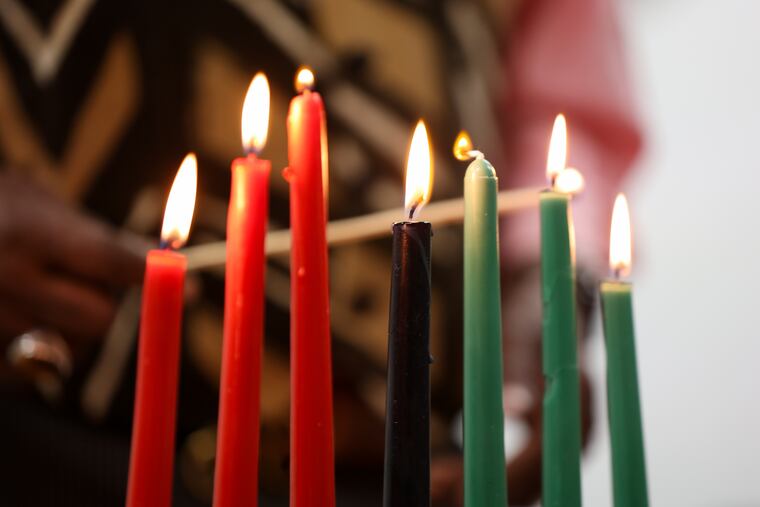
Children and adults dressed in fine clothes with African prints lined up in the fraternity house’s meeting hall to light the seven candles of the kinara and talk about the seven principles of Kwanzaa: unity, self-determination, collective work and responsibility, cooperative economics, purpose, creativity, and faith. Traditionally, families light one additional candle each night of the seven-day holiday.
Since Friday, families across the Philadelphia region and the world have been celebrating the annual African American and Pan-African holiday created in 1966 with the goal of uplifting people of African descent. The nonreligious holiday honors culture, community, and family.
On the south side of City Hall, the candles of a Kwanzaa kinara are lit each day of the holiday, which ends on Jan. 1. Each year since 2017, Boathouse Row has been lit in Kwanzaa colors — red, green, and dark purple, which represents black — to celebrate.
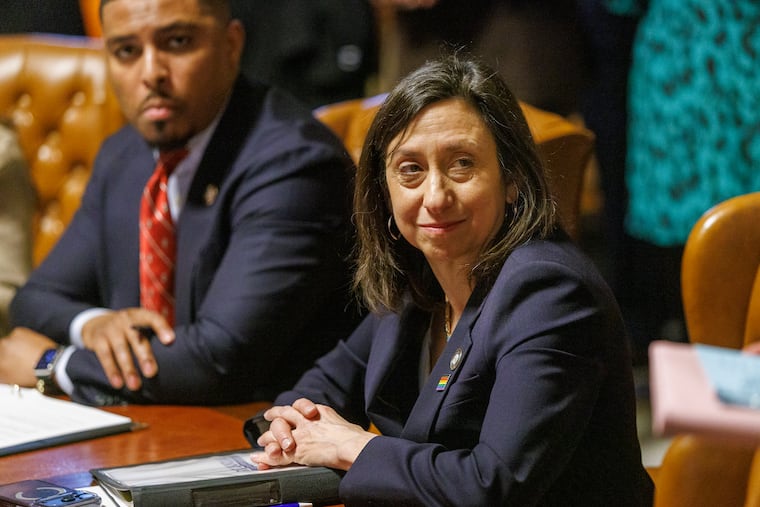
State Sen. Sharif Street, who is running to represent Philadelphia in Congress, told the people gathered in Germantown that “community is built from culture.”
“This year I think we’ve seen more robust Kwanzaa programs than in any year in recent history,” Street said. “The purpose of Kwanzaa was to have a cultural celebration that united our people across religious, regional boundaries. … It’s great that we continue to have spaces and places where people can celebrate it.”
Attendees of the celebration talked, laughed, danced, sang, ate, and played games together. They honored ancestors by calling out the names of family members and Black activists and cultural icons who have died.
Vincenteen Paige, a friend of the hosts’, usually has yearly Kwanzaa gatherings at her house but was happy to join the broader celebration.
“With all the things that are going on in politics and all the things that are being changed, you need something to hold. What did we have? What has meaning? I think people are looking for that,” she said.
Thomas told the crowd that Kwanzaa is about unity. “It’s about bringing us all together and pulling together,” he said.
He and Johnson-Thomas own a travel company called Pathfinders Tours & Travel, which formed out of the publication they ran for 25 years called Pathfinders Travel Magazine for People of Color. They regularly travel with groups to places inside and outside the United States.
On a future trip, they want to return to Egypt with some young people, Johnson-Thomas said, because “I think they need to see their greatness.”
“Everything we do,” she said, “we want to highlight the culture as it relates to African American people.”