Prosecutors in District Attorney Larry Krasner’s Office move to unionize
A majority of the approximately 275 prosecutors in District Attorney Larry Krasner’s office want to unionize in hopes of a transparent, predictable pay scale, they said.
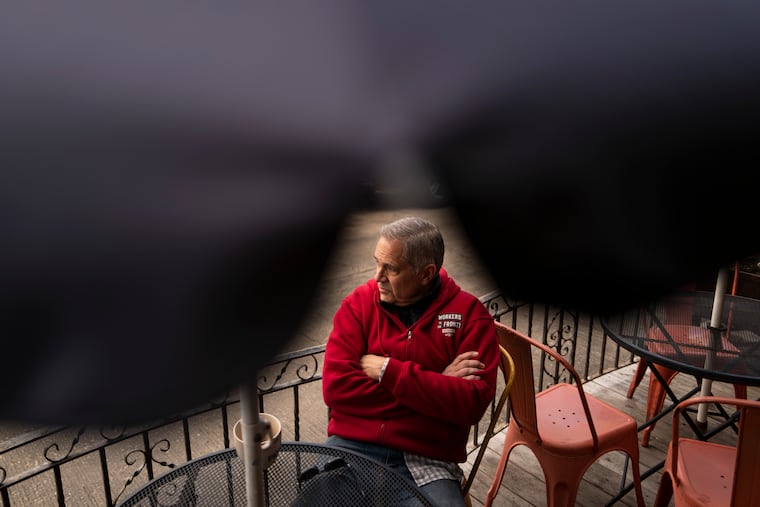
A majority of the approximately 275 prosecutors in District Attorney Larry Krasner’s office are backing a plan to unionize and be represented by the city’s white-collar municipal workers’ union.
Organizing attorneys sent a letter to Krasner earlier this month notifying him that well over half of the assistant district attorneys in his office had signed authorization cards to form the Philadelphia Assistant District Attorneys Union, or PADAU. It would be a new local represented by the American Federation of State, County and Municipal Employees District Council 47.
The staff members asked Krasner to either voluntarily recognize the union or “remain neutral and not interfere with our democratic right to unionize.”
“As a union of, by, and for the Philadelphia District Attorney professionals, we will help reduce turnover, improve job satisfaction, and create a more fair, just, and equitable workplace,” the organizers wrote.
In addition to the ADAs, more than 100 paralegals and victim witness coordinators in the office are also seeking to unionize, according to people familiar with the plans, though it was not immediately clear which union would represent them.
The unionization effort could represent a major shift in the culture at the district attorney’s office, where prosecutors make up a significant portion of the 600-person staff. It could also be a flashpoint for Krasner, a three-term progressive Democrat who has cast himself as a supporter of organized labor.
DC 47 has backed left-leaning political candidates in recent years, and the union endorsed Krasner in his run for reelection last year.
Krasner, in a statement, declined to comment on the effort, but said he sees an upside.
“While I have always been, and I remain, very pro-union, as the chief of the organization, it’s inappropriate for me to weigh in in favor of this particular union,” he said.
“But I will say that, from the perspective of the legacy of reform of the District Attorney’s Office carrying on into the future, it is a positive thing that whatever person might take my seat later cannot easily undo what we have done in hiring almost all the lawyers who are here, and hiring them for their moral compass, their talent, and their hard work.”
Paul Dannenfelser, the council representative and organizing director at DC 47, said the process began late last year, when a group of assistant district attorneys approached the union about organizing a drive.
“They were interested in a clear and transparent pay structure, and something that was predictable,” Dannenfelser said.
He said a “supermajority” of the staffers who would be in the unit signed authorization cards, and the union submitted a petition to the Pennsylvania Labor Relations Board earlier this month.
The PLRB said the matter remains under review, and an election has not yet been scheduled.
Dannenfelser said staff in the unit haven’t yet decided on specific provisions that they want included in a future contract. He said DC 47 typically surveys workers after an election takes place in order to establish priorities.
In recent years, Krasner has asked lawmakers for increased city funding to raise attorney salaries as a means of attracting and retaining talent. Mayor Cherelle L. Parker included $1.3 million in additional funding for “priority attorney positions” in the budget proposal that she unveiled earlier this month.
The office’s budget has grown from about $43.7 million in 2022 to $60.4 million in the current fiscal year.
The salary ranges for assistant district attorneys have increased, too. In 2022, the starting salary for a young prosecutor was $61,000, compared to $79,500 today.
But some prosecutors say extra funding has not been distributed equally, and that raises came sporadically, or were sometimes delayed.
At one point earlier this year, newly hired prosecutors — most fresh out of law school and not yet licensed to practice law — were earning more than some more senior colleagues, they said. This happened because new city funding raised starting salaries for recent hires but didn’t immediately include raises for prosecutors who had been there longer and were earning less.
Some staff have also complained about how the office distributed money earmarked by City Council for units focused on specific crimes, like carjacking and retail theft. Prosecutors assigned to those units typically receive significant pay bumps, which caused friction among colleagues who felt the only path to a meaningful raise was transferring into one of those units, according to multiple staffers who spoke on the condition of anonymity to discuss internal matters.
An assistant district attorney at the center of the organizing effort, who requested anonymity to avoid retribution before a union is in place, said the hope now is to create a transparent and predictable pay scale.
“People want to be paid fairly and they want to know how much money they’re going to make this year and next year and the year after that,” the prosecutor said.
The organizer said the pay disputes exposed how unpredictable compensation can be without a contract to formalize it. Staff are grateful for what Krasner has done to increase pay in recent years, the organizer said, calling him their “strongest advocate in that realm.”
Forming a union, the prosecutor said, is “a way of affirming his legacy and building on it.”
Francis Ryan, a professor of labor relations at Rutgers University, said there’s a long history of lawyers unionizing, and that it’s not surprising to see it in Philadelphia.
“Considering the kinds of pressures they’ve been under, in terms of caseload and also in terms of salary, which can lead to turnover,” he said, ”I think this is an effort to provide a little bit of stability."
Other district attorney’s offices and public defenders have organized across the state in recent years, he said, including in Lancaster in 2019. Philadelphia’s Defender Association also unionized in 2020.