Divided Pa. appeals court gives Philadelphia’s ‘driving equality’ policy a green light
Four Commonwealth Court judges said Philadelphia controls how it allocates police resources. The three dissenting judges pushed back, saying the driving equality policy is preempted by state law.
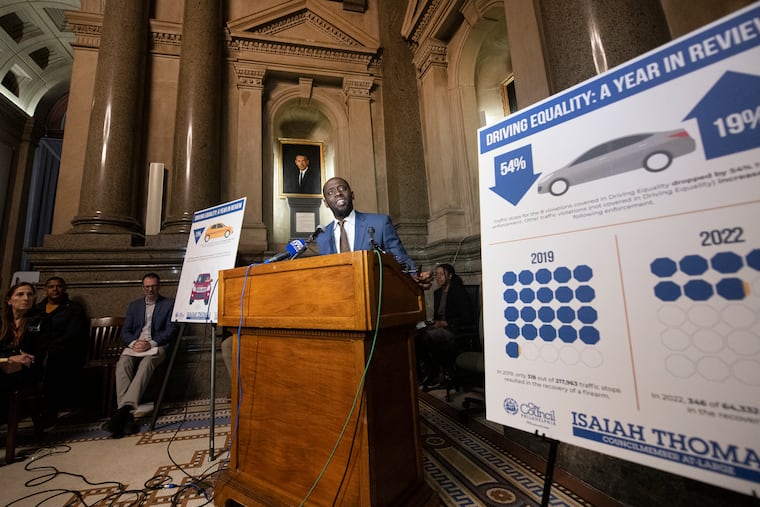
A divided panel of Pennsylvania appellate judges ruled that Philadelphia has the authority to limit the enforcement of eight traffic violations, a policy city officials call “driving equality.”
The Commonwealth Court affirmed a Philadelphia Common Pleas judge’s decision to toss out a lawsuit brought by the Fraternal Order of Police Lodge 5, which challenged legislation passed by City Council in 2021 and a subsequent executive order by then-Mayor Jim Kenney.
Writing for the four-judge majority, Chief Judge Renée Cohn Jubelirer said Philadelphia can choose how to use its police department.
“Directing police resources is within Mayor’s prerogative,” Jubelirer said.
City Council enacted the ordinance in 2021 to reduce racial disparities in vehicle stops by police. The law classified eight low-level traffic violations, such as driving with a damaged bumper or a broken headlight, as “secondary.” The policy prohibits police officers from stopping a driver solely for a violation of these eight offenses.
A week after Kenney signed the bill into law, he also signed an executive order reiterating that police officers should not initiate stops based on those offenses alone.
The FOP sued the city in 2022 over the law. The police union contended the ordinance and executive order were preempted by state law.
The FOP argued that the bill and executive order violated the state’s vehicle code.
The executive order “literally recategorizes certain violations so that numerous offenses will not be enforced, at least by themselves,” the union argued in court filings.
The FOP and its attorneys did not respond to requests for comment.
Local governments are prohibited from enacting or enforcing “ordinances” on issues covered by the state vehicle code. But the city has bypassed this restriction by arguing in court that the driving equality ordinance isn’t being enforced — only the executive order has been implemented.
The Commonwealth Court’s majority opinion ignores whether the ordinance is preempted and focuses on the executive order, which it calls “standalone.” The court said that the mayor’s order didn’t conflict with the state vehicle code, and compared it to the discretion of a prosecutor on whether to charge a crime.
Decisions rooted in discretion are not reviewable by courts.
“Simply put, that is what the Mayor has done here, and this Court cannot second-guess policy decisions,” Jubelirer wrote.
Three judges disagreed with the majority.
The dissenting judges chastised the majority for failing to address whether the driving equality bill was preempted.
“It is unfair of the Court to ignore a claim by a litigant aimed at a clearly preempted ordinance,” Judge Matthew Wolf wrote in a dissent.
The judges in the minority concluded that state law superseded the ordinance and executive order, and noted that the vehicle code is intended to set uniform standards for drivers. By designating violations as “secondary,” and instructing officers not to pursue stops solely based on the eight violations, Philadelphia created its own set of traffic laws, they argue.
“This renders those violations unenforceable, while those same violations are enforceable elsewhere in the Commonwealth,” Judge Stacy Wallace wrote, in a dissent that Judge Patricia McCullough joined.
A spokesperson for Philadelphia’s law department said that the city was grateful for the court’s decision, and “will continue with lawful enforcement of the ordinance.” A day after this story was published, the spokesperson said the city meant lawful enforcement of the executive order would continue.
Councilmember Isaiah Thomas, who wrote the driving equality bill, said that the majority opinion vindicates the work that went into putting the legislation together.
Philadelphia is the first large city in the nation to ban minor traffic stops. More than a dozen other cities are looking to replicate it, Thomas said. Police vehicle stops decreased in the year following the implementation of the policy, but racial disparities persist.
“We are trending in the right direction, but we still have work to do,” Thomas said.