July in Philly has become 4.4 degrees hotter since 1940 on average. Nights are even warmer.
Average nighttime July temperatures for Philadelphia show a rise of 4.8 degrees between 1940 and 1925.
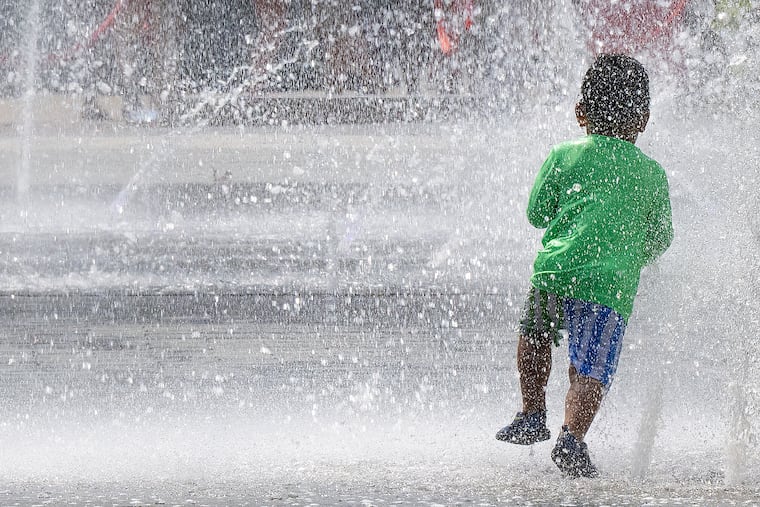
Philadelphians sweated through Julys in the 1940s, brooding over World War II as temperatures averaged in the mid-to-upper 70s, including nighttime lows.
Today, as the city prepares to mark the nation’s 250th anniversary, they swelter under average July temperatures of around 80 degrees — and those nighttimes have gotten warmer.
Over the past 85 years, Julys in Philadelphia are running on average 4.4 degrees warmer than in 1940, based on an analysis of historical weather data. That translates to an increase of about 0.52 degrees per decade.
Nights are even toastier, showing a rise of 4.8 degrees over the same time period.
“Science shows that while summer heat is nothing new, climate change is pushing it beyond what we’ve experienced in the past,” Zachary Labe, a climate scientist at the nonprofit Climate Central, said in an email.
The Inquirer used 1940 as a base year in its analysis because it is the oldest year for consistent records at Philadelphia International Airport. The data from the National Oceanic and Atmospheric Administration’s Regional Climate Centers ends at July 2025.
The data does not include this July, which could set records.
105 degrees possible
The National Weather has issued an extreme heat warning with possible record highs starting Thursday and heading into the July 4 weekend.
And Philadelphia has declared a heat emergency, activating the city’s pioneering heat-response system.
» READ MORE: Philly declares a heat emergency and Welcome America alters events as 100-degree temperatures loom
High temperatures Thursday, Friday, and Independence Day are all forecast to top 100 degrees and threaten daily records. The current record highs for those dates are 103 degrees for Thursday, 104 for Friday, and 103 for the Fourth.
The record-warmest lows are 82, 77, and 79 for those days respectively, according to data from the National Weather Service’s Mount Holly office.
The weather service says dangerously hot conditions with heat index values between 100 and 110 degrees are expected each day. Very warm low temperatures in the mid-70s to the low 80s at night won’t offer much relief, the office noted.
When combined, multiple days of such high temperatures and humidity will exacerbate impacts, say those meteorologists. The hottest conditions are expected Thursday through Friday.
Climate change
Although it’s difficult to pin any single heat wave to climate change, the majority of climate scientists say the burning of fossil fuels has led to ever-increasing amounts of heat-trapping greenhouse gases in the atmosphere and transformed the climate.
The Princeton-based Climate Center says human activities have warmed the planet by about 1.2°C (2.2°F) above pre-industrial levels. The Princeton-based organization of scientists says that since 1970, July has warmed in 94% of the 243 U.S. cities it studied. Temperatures for the month have risen by 2.6 degrees on average.
“That includes hotter and more humid nights like those this week, which raise health risks because the body has less time to cool down and recover,” Labe said.
A big impact on cities
Excessive heat hits urban areas like Philadelphia hard, said Mathy Stanislaus, of the Philadelphia Climate Justice Collective.
The collective is a partnership of the Mantua Civic Association, SEAMAAC, Esperanza, Overbrook Environmental Education Center, and the Environmental Collaboratory at Drexel University. Stanislaus is vice provost and executive director of The Environmental Collaboratory.
In the most densely populated, least tree-lined parts of Philadelphia temperatures can soar 20 degrees higher than in greener, wealthier neighborhoods, he notes.
That’s because of the heat island effect, which occurs when cities are significantly warmer than surrounding areas because of the lack of tree canopy combined with high concentrations of heat-absorbing pavement, dark roofs, and buildings.
It’s something many people in the suburbs, or wealthier areas, might not think about, Stanislaus said.
“I don’t think people realize the gravity of the circumstances for lower income urban communities who have an affordability crisis compounded by the heat crisis,” he said.
Stanislaus said some households in the city don’t have air-conditioning, and those that do can face a choice as to whether they should use it or not.
“Even if they have an AC, they may not be able to afford to actually run it,” he said.
According to a report by the collective, Philadelphia households overall on average spend about 6.7% of their income on energy, but that the burden is much higher for Black and Hispanic households. The poor conditions of many homes because of their age contribute to the strain.
Stanislaus says temperatures strain critical public and healthcare systems.
He credits Philadelphia for its array of cooling centers, pools, and spraygrounds. But, he said, many residents are not aware of them or lack transportation. He’d like to see more money devoted to public awareness during heat waves.
In addition, he said healthcare systems need more staff trained in heat-related care and education, as well as better tracking heat-related illnesses and deaths.
There has been one death attributed to heat so far this year, according to data from the Philadelphia Department of Public Health. In the past two decades, the biggest number of deaths came in 2011 and 11 with 35. But the city has upped its response measurably since then and the number of deaths has trended down.
Stanislaus believes heat-related deaths and illnesses are underreported.
“There’s an urgency to heat,” Stanislaus said. “We need to meet the moment.”