A Philly juror changed their mind during a verdict reading. Should it have led to a mistrial?
The confusion occurred during a civil trial for two physicians who were accused of causing a 26-year-old man to become addicted to opioids, and eventually fatally overdose.
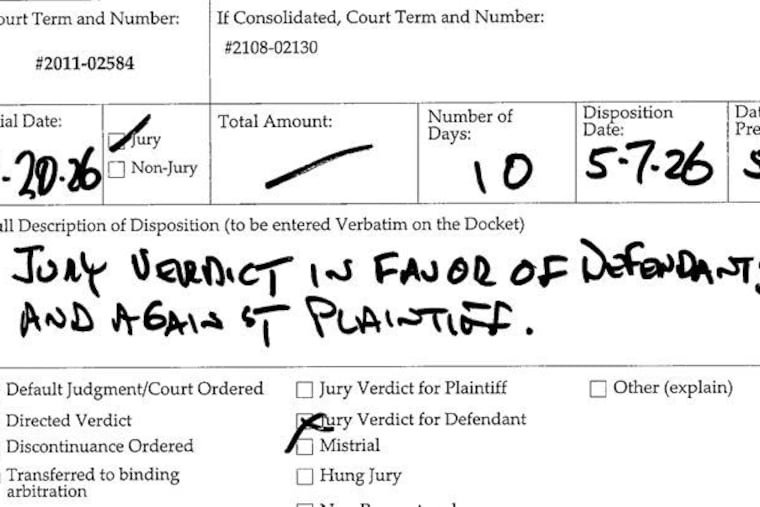
After an emotional two-week trial, and a day of deliberation, the jury reached its verdict. Or so everyone thought.
The 12 Philadelphians walked into a City Hall courtroom shortly after noon on a Friday earlier this month to conclude the civil trial of two physicians who were accused of causing 26-year-old Matthew Tarnopol to become addicted to opioids and, eventually, fatally overdose.
The foreperson read the verdict, and the judge asked each juror if they agreed. Ten out of 12 jurors said “I do,” as required for a civil verdict in Pennsylvania. The trial was about to be over, with the defense winning.
One juror stood up.
“I think I misunderstood your question,” she said.
Common Pleas Court Judge Craig Levin asked again: “Juror No. 2, do you agree with the verdict stated by your foreperson? If so, please say, ‘I do.’”
“No, I do not,” the juror responded.
Calling the situation “uncharted territory,” Levin gave the jurors another chance to clarify confusion and potentially reach a verdict.
The jury system is predicated on the ability of citizens who are not trained in law to follow legal proceedings that are often highly technical. And at the conclusion of the physicians’ trial, the clash between lay English and legalese came to a head.
What followed was tedious questioning of jurors into the afternoon, calls for a mistrial, a tense exchange between the judge and an attorney, and so much confusion that jurors left the case not knowing if their eventual verdict was recorded.
“We didn’t know anything about the verdict,” one juror, who did not want to be identified, told The Inquirer. “We had no room to inquire about what happens next.”
Back pain to overdose
The trial centered on the August 2019 fatal overdose of Tarnopol, who had graduated from Chestnut Hill College with a master’s degree in clinical psychology a few months earlier and spent his summer as a camp counselor.
The Philadelphia resident’s family alleged in a 2020 lawsuit that Abhijeet Rastogi, a pain medicine physician, sparked and fueled Tarnopol’s addiction by prescribing him thousands of opioid pills starting in 2015 to treat back pain following multiple procedures and surgery.
Rastogi terminated Tarnopol’s prescription in 2018, according to court records. Nearly a year later, Tarnopol reached out to psychiatrist Jonathan Beatty for addiction treatment.
“I am very motivated to succeed in treatment but have come to realization that I need help and I can’t do it on my own,” Tarnopol wrote in an intake questionnaire, the suit says.
Beatty did not follow standard protocol when attempting to detox Tarnopol, who had stockpiled pills from Rastogi’s prescriptions, the family said in court records.
A week later, Tarnopol died from an accidental drug overdose, the suit said, after having consumed prescription opioids, fentanyl, heroin, benzodiazepines, and xylazine.
“Matthew was caused to become dependent and addicted to opioids and this dependence and addiction ultimately and tragically took Matthew’s life,” the family said in court records.
The physicians, who were represented separately at trial, defended the treatment and noted that Tarnopol died after consuming drugs he had not been instructed to take.
The death was a result of drugs “illegal to ingest absent a prescription from a licensed medical professional,” Rastogi’s lawyers argued in court filings.
The doctors’ attorneys did not respond to requests for comment.
‘Stop talking’
The jury had to consider whether, and how much, the actions of three people contributed to Tarnopol’s death — Rastogi, Beatty, and Tarnopol himself.
The hitch: If the jurors decided Tarnopol‘s own actions accounted for more than 50% of the harm he suffered, they could not award his family monetary damages.
After the juror changed her mind, the jury deliberated for another hour. The panel returned with a verdict, again, reassuring the judge 10 jurors were in agreement.
As in the first verdict, the jurors placed 35% of the blame on Rastogi and 65% on Tarnopol. They did not find Beatty negligent.
This time, the attorney for Tarnopol’s family, Aaron Freiwald, asked that each juror confirm they agreed with the response to each of the nine questions on the verdict sheet.
But the jurors again came short of the required 10 for every question. In an effort to reach resolution, the judge asked each juror for their verdict as they stood alone in the courtroom.
The experience of standing alone in front of the judge was tense and confusing, two jurors told The Inquirer. Jurors changed their answers but eventually 10 came to an agreement on every question.
The jury was obviously confused, Freiwald said, making the verdict “improper” and “invalid.” The attorney demanded a mistrial.
“This is a disgrace to the jury system that we all love and respect,” Freiwald told the judge.
The judge interrupted the attorney and chastised him.
“I’m telling you to stop talking,” Levin said. “I control the courtroom, not you.”
Misunderstandings
The tension between law and plain English was present as Levin polled the jurors one by one.
“The terminology made it kind of hard for me,” one juror told the judge, according to a court transcript.
“I don’t understand the question,” another said.
“No,” a juror responded to the judge before quickly adding, “could you repeat that?”
“I’m sorry,” a third juror said after failing to answer a yes-no question in multiple attempts.
After the daunting process, 10 jurors were in agreement on each question — affirming the verdict that had been read initially. Beatty was not negligent; Rastogi and Tarnopol were. And because Tarnopol was responsible for more than half the harm, the jury could not award his family damages.
Freiwald was not satisfied, and again asked for a mistrial. Jurors changed their votes, he said, and some jurors’ verdicts were inconsistent. For example, one juror did not think Tarnopol shared responsibility for his own death, but assigned him 65% of the liability.
The physicians pushed back, saying all that matters is that five-sixths of the jury agreed.
“Thus, because here the jury’s bottom‑line determinations is clear, and the legal conclusion the jury actually reached is clear, there are no grounds for a mistrial," Beatty’s attorney said in court filings.
A week after that confusing Friday afternoon, Levin formally entered the verdict.
“That confusion, we believe, requires a new trial,” Freiwald said in a statement, ”and we will continue to fight that on appeal.”