Amid City Hall tensions, Mayor Cherelle L. Parker seeks public support at Philly churches for her H.O.M.E. initiative
The mayor's speech circuit appeared to be a retort to moves by Philadelphia City Council to amend the initial budget and eligibility requirements for her housing initiative.
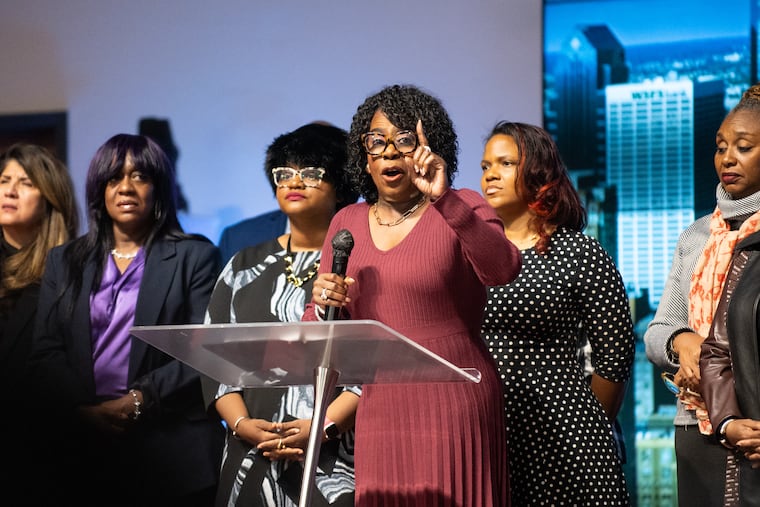
Mayor Cherelle L. Parker traversed pulpits across West and North Philadelphia on Sunday, promoting her vision for her signature housing initiative that’s heightening tensions in City Hall.
The 10-church circuit appeared to be a retort to moves by City Council last week to amend Parker’s Housing Opportunities Made Easy (H.O.M.E.) program, changing the initial budget and eligibility requirements to prioritize the lowest-income Philadelphia households.
Parker, who wants to ensure the initiative helps those with varying incomes, largely opposes the changes, which has caused one of the most notable standoffs between the city’s executive and legislative branches during her mayoralty. From West Philly’s Church of Christian Compassion on Sunday morning, she lobbied her constituents, saying her vision for the housing plan is to avoid “trying to pit the ‘have-nots’ against those who have just a little bit.”
“We should be about addition, not subtraction,” she said to a packed sanctuary, as she sought to reclaim the narrative surrounding H.O.M.E. Her rousing 10-minute address was met with acclaim and applause, bringing some in the crowd to their feet.
“We’ve got to take care of the people who are most in need, but we can’t penalize the people who are going to work every day, pay their taxes, contribute to the city, and they can’t benefit from home improvement programs.”
» READ MORE: City Council took a rare stand against Mayor Parker by allotting more housing funds to the poorest Philadelphians
The H.O.M.E. initiative calls for spending $800 million across dozens of existing programs. The bulk of the funding would go to affordable-housing preservation, the Turn the Key program, the Basic Systems Repair Program, affordable housing production, and One Philly Mortgage, which would provide loans to low income households.
Councilmember Jamie Gauthier, chair of the Committee on Housing, Neighborhood Development, and the Homeless, and whose district includes Church of Christian Compassion, called Council’s proposal reasonable and compromised and a fiscally responsible response to “Philadelphians who need our help the most in this moment.”
“The mayor has every right to get out into the public, to tell her side, to talk about her vision,” Gauthier said in an interview, “but I will say there was plenty of time to negotiate with Council on this, and plenty of attempts made from the Council’s side.”
Despite the disagreement over eligibility rules, Parker and Council are on the same page about the broad strokes of the housing plan; critical pieces of legislation Parker proposed as part of H.O.M.E. were approved by Council earlier this year. The changes last week did not alter the fundamentals of the program, which Parker hopes will achieve her goal of creating or preserving 30,000 units of housing in her first term.
The main sticking point in recent negotiations has been eligibility criteria for several programs: Parker, for instance, had proposed that H.O.M.E. funding for the Basic Systems Repair Program — which subsidizes critical home improvements — is open to any homeowner who makes Philadelphia’s area median income, about $119,400 for a family of four. Council’s amendments, however, require 90% of the new funding to go to families making 60% of the area median income or less, about $71,640 for a family of four.
The changes also raise the first-year budget for H.O.M.E. from $194.6 million to $277.2 million. The city plans to sell a total of $800 million in bonds as part of the housing initiative.
Gauthier likened what’s in dispute to an emergency room: “The person who’s having a heart attack is going to be seen before the person with a broken leg, because that person who’s experiencing a heart attack might not make it if they don’t get immediate assistance.”
The squabble has given way to the most significant public dustup between Parker and Council President Kenyatta Johnson. In an uncharacteristically blunt statement last week, Johnson broke from his usual alignment with the mayor and defied her administration’s analysis of the situation.
» READ MORE: Philly lawmakers approved $800M for Mayor Parker’s housing plan in June. Now they have to redo it.
In a statement Sunday, Johnson’s spokesperson Vincent Thompson said “Johnson heard clearly and directly from Councilmembers and housing organizations in Philadelphia about critical issues they want addressed in the first-year H.O.M.E. Plan spending. Those concerns center on accountability, neighborhood equity, and — most importantly — making sure that the deepest investments reach the poorest and most vulnerable Philadelphians.”
The amended budget could be up for a final vote as soon as Thursday, Dec. 11, Council’s last meeting before its winter break, according to Johnson’s office.