Philly police to produce annual report for city officials on drone use
City Councilmembers asked Police Commissioner Kevin Bethel for more transparency about police drone activity during a city budget hearing.
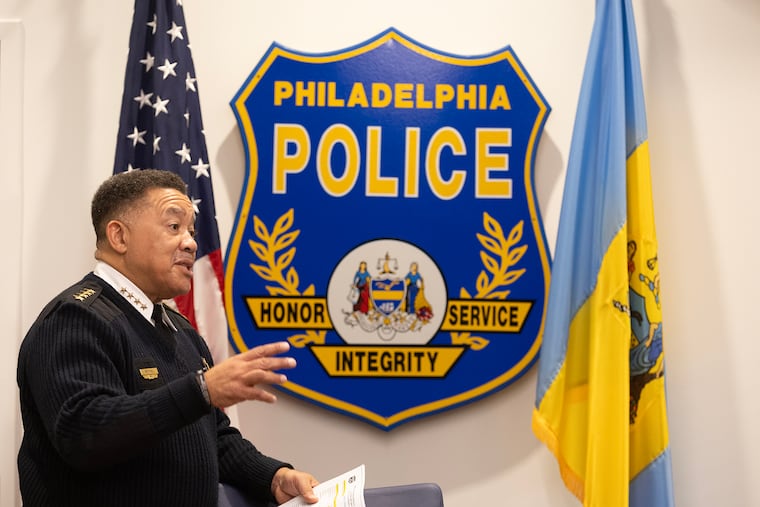
Police Commissioner Kevin Bethel told City Council members Tuesday that the Philadelphia Police Department will produce an annual report for them that details how the department uses its 21 drones.
Councilmember Rue Landau and Council President Kenyatta Johnson each asked Bethel during a city budget hearing whether he would commit to creating such a report to address concerns about a lack of transparency surrounding the department’s drone first responder program, which operates in Kensington, North Philly, and the Lower Northeast.
Landau cited a recent Inquirer report, which found that Boston and other cities require their police forces to compile annual reports on their surveillance tools, including drones. Philadelphia has no such oversight measure in place for its drone program, which police officials want to expand citywide during the next four years.
Landau, the chair of Council’s Technology and Information Services Committee, said she has been concerned that the department began its drone program through a donation from a nonprofit, the Philadelphia Police Foundation — a transaction that did not require input or approval from City Council or the public.
“After [Monday’s Inquirer] report, I remain alarmed,” Landau said. “There are not proper guardrails in place, and there’s a lack of transparency.”
Landau asked Bethel if he was open to submitting an annual report about the drone first responder program.
Bethel initially demurred, saying he was unfamiliar with what Boston police report about their drones. Bethel noted that Philadelphia police plan to publish drone flight data on a public dashboard at some point.
Johnson then asked Bethel if he would be willing to provide an annual report on police drones “as a matter of transparency.”
“Yeah, that’s not a problem,” Bethel responded.
Bethel told Johnson that the department could create a report based on data that will be included in the drone dashboard. “So, no pushback there, sir,” he said.
But Bethel added that he would first want to discuss with Council members the scope of the information that will be included.
Landau also asked whether the police department has shared drone footage with U.S. Immigration and Customs Enforcement.
Bethel said police have not provided the agency with footage, “but if we were to receive a federal subpoena for any of that activity, we would be required to turn that over.”
The department’s proposed budget for the 2027 fiscal year shows it wants to spend roughly $1 million from its general fund on body-worn cameras, Tasers, and drones.
The proposed budget also shows that the department wants to hire two drone pilots for $75,000 each.
The police department’s drone first responder program was launched in 2024 in Kensington’s 24th and 25th Police Districts. It then expanded last year to the 22nd District, in North Philly, and the 15th District, in the Lower Northeast.
Police officials told The Inquirer that drones in those districts have been deployed nearly 8,000 times, and have aided in shooting investigations, fugitive arrests, and drug busts.
Drones have served as the primary source of information in 15 arrests in Philadelphia, but the department has declined to disclose the name of those suspects, their alleged offenses, or the outcomes of the cases.
Bethel reiterated during the budget hearing that the drones will not be used to patrol neighborhoods or infringe upon residents’ civil liberties.
He told Landau the department created a promotional video that showed how drones helped locate a child with special needs who had gotten lost on the Benjamin Franklin Parkway, and assisted officers serving a “high risk” arrest warrant on a suspect.
The video was intended to be shown to Council members at the start of Tuesday’s hearing. Technical problems prevented it from being played until the afternoon.

The Inquirer’s journalism is supported, in part, by the Lenfest Institute for Journalism and readers like you. News and editorial content are created independently of The Inquirer’s donors. Gifts to support The Inquirer’s high-impact journalism can be made at inquirer.com/donate. A list of Lenfest Institute donors can be found at lenfestinstitute.org/supporters.