More than 100 burst water mains, freezing rivers puts Philadelphia Water Department on alert
A frozen river is a harbinger for the Philadelphia Water Department, which draws its drinking water from intakes along the Delaware and Schuylkill rivers, and signifies pipes will burst.
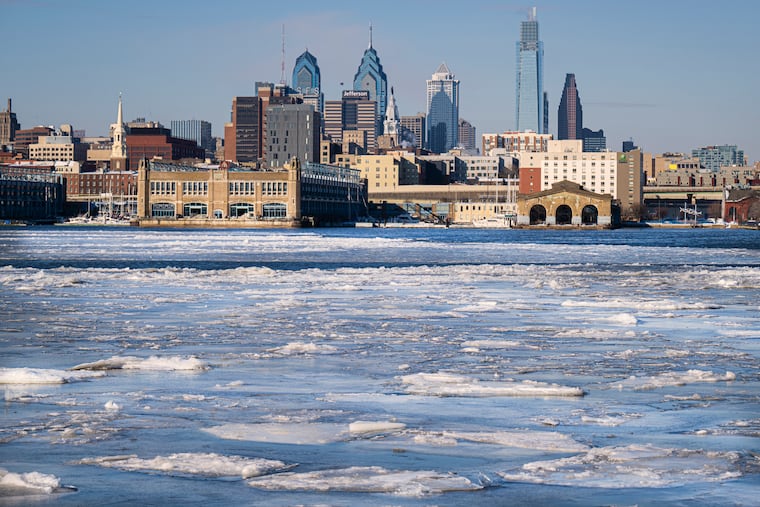
Large slate-shaped slabs of ice in the Delaware River this week have been like a floating harbinger of things to come for the Philadelphia Water Department (PWD).
PWD, which draws its drinking water from intakes along the Delaware and the Schuylkill, takes a freezing river seriously.
It has implemented emergency plans to provide for 24-hour ice patrol at its river water intake plants — and it is on high alert for freezing and bursting water mains and pipes.
The department has two intakes on the Schuylkill and one on the Delaware that help provide drinking water for about 1.6 million people.
There is no easy way to say how much of the rivers are icing. But the Middle Atlantic River Forecast Center at State College, an office of the National Weather Service, uses gauges placed in the rivers by the U.S. Geological Survey. At various times this week, officials could not get readings from some gauges because they were affected by ice.
Brian Rademaekers, a spokesperson for PWD, said the city can also pull from already stored water if ice does became a problem at an intake.
“We’re getting into a stretch where we haven’t been above freezing for days,” he said, “And I think at least through Feb. 1 it looks like we’ll remain below freezing.”
Indeed, the region has been subjected to an Arctic blast for nearly a week. Daily highs have been below freezing since Saturday. The top temperature in that stretch was 28 degrees on Monday. Wednesday hit a low of 14. Overnight Thursday into Friday is forecast to drop to 2 degrees.
The National Weather Service is not forecasting a high of 32 until Tuesday. And then it’s back to below-freezing temperatures.
Bursting pipes
PWD is warning residents and businesses that the extreme cold is affecting city water mains and reminding them that water lines that are the responsibility of property owners.
As the city faces unbroken stretches of below-freezing temperatures, PWD knows pipes will begin to freeze or, worse, burst, Rademaekers said.
Pipes can start to be seriously affected after 72 hours, or three days, of below-freezing weather. Philadelphia is past that benchmark.
PWD’s call center is already inundated with reports of water outages and leaks. But the department cannot help people with frozen pipes because that takes away from crews responding to public water main leaks.
Rademaekers said PWD has responded to 147 water main breaks in January, but noted that is a preliminary figure.
Last year, 256 breaks were reported in January. In recent memory, he said, 2018 was the worst year, with 366 breaks.
City mains are public property and range in size from 96 inches in diameter to 48 inches, 12 inches, and 6 inches.
Breaks in smaller pipes are most common. PWD is currently fixing a 6-inch main at 16th and Federal Streets.
Property owners are responsible for the lateral pipes that run from the curb into a home.

- Wrap and insulate pipes in unheated areas.
- If your pipes have frozen before or are in a space you can’t keep warm, let the faucet drip.
- The first sign of freezing is reduced water flow from a faucet.
- If there’s no water at your tap, ask a neighbor if they are having problems. If not, it’s likely that your pipes are frozen.
- If they are frozen, turn on a faucet so melting water can drip out.
- Heat the area around the pipes with a hairdryer but don’t apply it directly to a pipe.
- Look for damage after a pipe thaws.
- Check your meter. If it is leaking, call 215-685-6300.
- If a pipe is damaged, turn off the water using the house-side valve near the water meter.
- PWD will not fix a pipe, even if it is outside the home. Call a plumber.
Rademaekers said residents who suddenly find themselves without water should check with a neighbor first. If the neighbor has running water, it’s likely the homeowner has a frozen pipe.
In that case, PWD suggests trying to bring the pipes near your water to 40 degrees and opening faucets so that thawing water can drip out and release pressure.
He said running a hair dryer or using another source to gently warm the pipes could help them thaw. He said residents should be cautious trying to use space heaters to warm on pipes.
The department has tips online for how to deal with frozen pipes.
Homeowners should not to wait for the department to respond to take these steps, PWD advises. Doing so could lead to burst pipes.
Rademaekers said many homes in Philadelphia have their main water meter by the wall facing the street, often in uninsulated basements, some with cracked windows.
“When it falls to 6 degrees overnight, even if the heat’s on in your house, that particular space right there might just get cold enough to freeze that pipe up, and then ice kind of spreads through the system,” Rademaekers said. “Once the freezing starts, the pressure will build.”
Rademaekers cautioned customers against calling 311 if they have a frozen pipe. Instead, he said, they should call the PWD hotline at 215-685-6300 and press 1.
“Certainly whenever we see freezing temperatures for more than two days we start to see a surge of calls into the call center,” he said. “Over the last week, the top three reports we have been getting are water in the basement, leak in the street, or no water at the tap.” Some of those could be water main problems, he said, ”but most often they are traced back to private lines.”