A coastal ‘bomb’ and single-digit temperatures are expected this weekend in the Philly area
Snow likely at the Shore; an outside chance inland
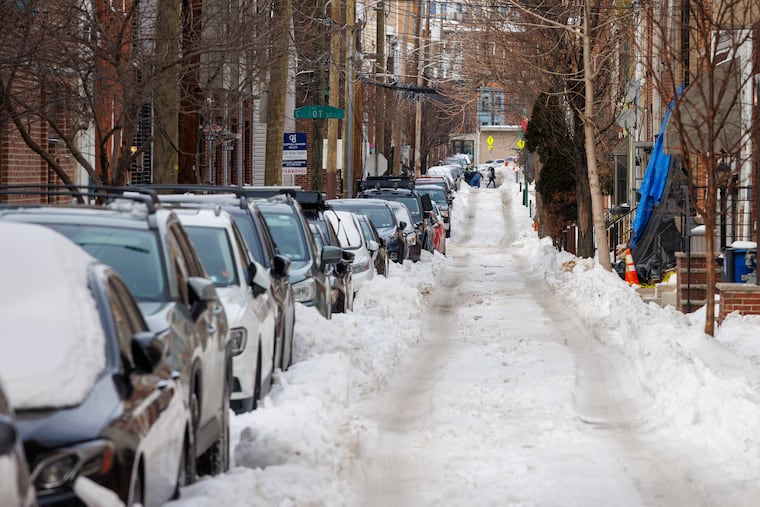
It remains a long shot that a fresh layer of frosting will coat the hardening and tenacious snowpack, but evidently that street-congesting frozen mass isn’t exiting in the near future.
As of Friday morning, it appeared that a potent coastal storm that is expected to qualify as a meteorological “bomb” was going to spare the Philadelphia region from another snowfall.
But it is expected to have serious impacts on the New Jersey and Delaware beaches, with a combination of onshore gales and a tide-inciting full moon, forecasters are warning.
On the mainland, it is poised to generate winds that would add sting to what has been one of the region’s most significant outbreaks of Arctic air in the period of record.
Lows at Philadelphia International Airport both Thursday and Friday mornings — 13 and 11, respectively — were several degrees above what was forecast.
But they are to drop into single digits Saturday morning, and flirt with a record. Wind chills during the weekend are expected be in the 10-below range, said Mike Silva, a meteorologist with the National Weather Service in Mount Holly.
“Even though there might not be much or any snow in Philly,” he said, “it’s going to be cold, and we’re still going to have the wind impacts.”
Is the snow threat off the table for Philly?
Computer models continue to keep the storm far enough off the coast to preclude a major snowfall inland.
But “it wouldn’t take much of a jog west to really mess up the forecast,” said Tom Kines, senior meteorologist with AccuWeather Inc. It’s been known to happen.
On Friday morning, the National Weather Service was posting a 30% chance that Philly would get something measurable — technically 0.1 inches — Saturday night into Sunday, with about a 10%shot at an inch.
The weather service was expecting an inch at the Shore, but with a slight chance of several inches.
Forecasters are certain that a storm is going to blow up off the Southeast coast as frigid air that is penetrating all the way to Disney World interacts with the warm waters of the Gulf Stream.
Gusts at the Shore during the day Sunday might be as high as 40 mph as the storm could reach “bomb” status.
What exactly is a ‘bomb?’
The technical definition of a meteorological bomb is a drop in central barometric pressure of 0.7 inches in a 24-hour period, about a 2% to 3% change in the weight of the air. That might not seem like much, but it’s a big deal if you’re a column of air.
Such a drop in pressure indicates a rapidly developing storm. Air is lighter in the centers of storms, as precipitation is set off by lighter warm air rising over denser cold air.
As a weather term, bomb first appeared in an academic paper in 1980 by atmospheric scientists Frederick Sanders at the Massachusetts Institute of Technology and John Gyakum at McGill University.
They found that the western Atlantic, in the proximity of the Gulf Stream, was one of two regions on the planet most prone to bombs. The other was the area near the Kuroshio Current in the far northwestern Pacific.
Both are massive reservoirs of warmer waters that interact with cold air coming off land masses. Some of the European settlers in the colonial era learned about the effects the hard way, experiencing mega-storms that were alien to areas in England.
Gyakum, who was Sanders’ graduate student at MIT, recalled Thursday that the duo took some blowback for using the word bomb.
But with a cyclone of such ferocity, the term was worth using to draw the public’s attention to potential impacts, which sometimes exceed those of hurricanes, Gyakum said.
He said he had no doubt this weekend’s storm would reach bomb status.
While any heavy snows from this storm are likely to bypass the Philly region, some accumulating snow is possible the middle of next week, Kines said, although nothing in a league with what happened Sunday.
When can Philly expect a thaw?
Temperatures during the coming workweek are due to moderate, at least slightly, with highs around freezing Monday through Thursday, 10 to 12 degrees warmer than what is expected this weekend.
The cold “certainly eases up,” Kines said.
But that 9.3 inches of snow and sleet that accumulated Sunday evidently has taken a particular liking to the region. As for when it will disappear, he said: “It’s going to take a while.”
The overall cold upper-air pattern looks to persist, said Paul Pastelok, AccuWeather’s long-range forecaster. And the extensive snow cover is going to have a refrigerant effect on temperatures.
So when will it warm up and go away?
“We’ll find out Monday,” Kines said. He was referring to Groundhog Day, of course, when Punxsutawney Phil will issue his extended forecast.
Nevertheless, he said, meteorologists will be on call if needed.
“It never hurts to get a second opinion,” he said.