Amid uncertain future, the President’s House Site celebrates 15th anniversary
Just a few months ago, the fate of the President’s House Site on Independence Mall seemed ill-fated, but as of Sunday, it as yet to be altered.
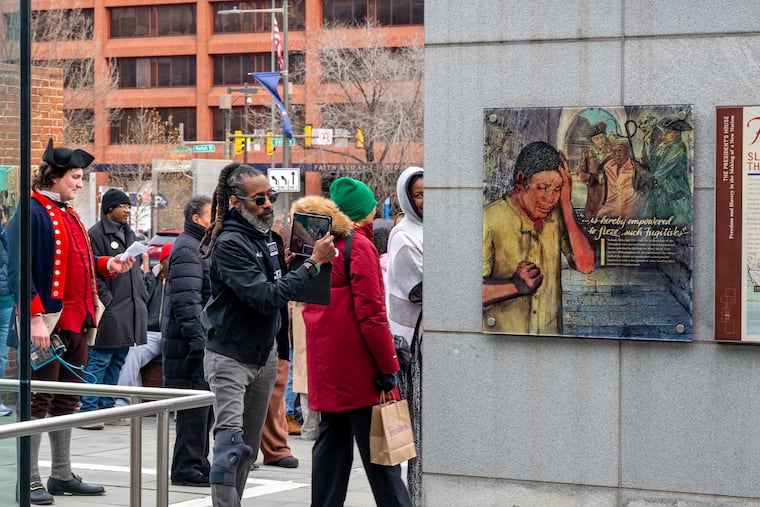
Just a few months ago, the future of the President’s House Site on Independence Mall seemed ill-fated: By presidential executive order, contents deemed disparaging by federal officials were to be removed.
But as of Sunday, the outdoor exhibit at the corner of Sixth and Market Streets, memorializing the nine people enslaved there by President George Washington — and capturing the somber paradox of a young America that exalted freedom for some, while depriving it for others — remains unaltered. Instead, the President’s House Site surpassed a milestone last week: the 15th anniversary of its opening.
More than 75 activists, preservationists, historians, and public officials gathered at the site Sunday afternoon to commemorate the occasion and mobilize resistance amid its uncertain future. (The event was initially scheduled for Dec. 15, the date of the site’s opening in 2010, but was rescheduled due to snow and subfreezing temperatures.)
» READ MORE: Black activists helped shape the President’s House Site. Now they’re working to save it from Trump.
The President’s House Site has become a lightning rod for President Donald Trump, who seeks to remove content from national parks that his administration says “inappropriately disparages Americans past or living” — what activists have said is an effort to sanitize history by omitting slavery from the narrative.
Starting in 2002, Black leaders and the Avenging the Ancestors Coalition (ATAC) fought to put slavery at the forefront of the exhibit built around the remnants of the country’s original White House. It was a chapter of history the National Park Service was initially hesitant to put on display.
“America is a great country today because they enslaved us yesterday,” Michael Coard, an attorney and founding member of ATAC, said.
Over the summer, 13 items across six displays at the President’s House were flagged for review as part of Trump’s executive order, and federal authorities set a Sept. 17 deadline to change or remove the disputed content at national parks nationwide. Ninety-five days after the deadline, the President’s House is unchanged, but the exhibit could be seemingly upended any time.
» READ MORE: More than a dozen slavery displays in Philly have been flagged for a Trump admin review
In an email Friday, a spokesperson for the National Park Service said all “interpretive signage” is under review in accordance with the executive order.
“As we carry out this directive, we’ll be evaluating all signage in the park along with the public feedback we’ve received,” the statement reads. “This effort reinforces our commitment to telling the full and accurate story of our nation’s past.”
The turmoil comes ahead of the nation’s semiquincentennial, when its birthplace, Philadelphia, will be in the spotlight. The fate of these displays is poised to be a larger battle over who gets to tell America’s history.
» READ MORE: Coalition strategizes how to protect President’s House Site from Trump administration
“We cannot allow [Trump] to erase our history,” said State Sen. Sharif Street, who was among more than a dozen public officials at Sunday’s event. Speakers included seven Philadelphia City Council members, District Attorney Larry Krasner, and fourth, fifth, and sixth graders from the Jubilee School in West Philadelphia.
Street’s father, former Philadelphia Mayor John F. Street, legitimized ATAC and Coard’s efforts decades ago as the first elected official to start funding their project.
“America is a great country because we overcame those things, not because they never happened,” Sharif Street said. “We’ve always marched towards progress, not backwards. But the progress we have [made] will only remain if we are willing to fight to preserve it.”
The message Sunday was clear: Activists will continue to fight for the integrity of the site.
“You cannot erase, you cannot take away,” said the Rev. Carolyn Cavaness, of the historic Mother Bethel A.M.E. Church, “you cannot delete, you cannot attempt to distract or detour.”