Here’s why the Schuylkill River Trail sinkhole hasn’t been filled yet
The trail has been closed and fenced off between Race Street and JFK Boulevard since October due to a “chasm”-sized hole that formed under the asphalt.
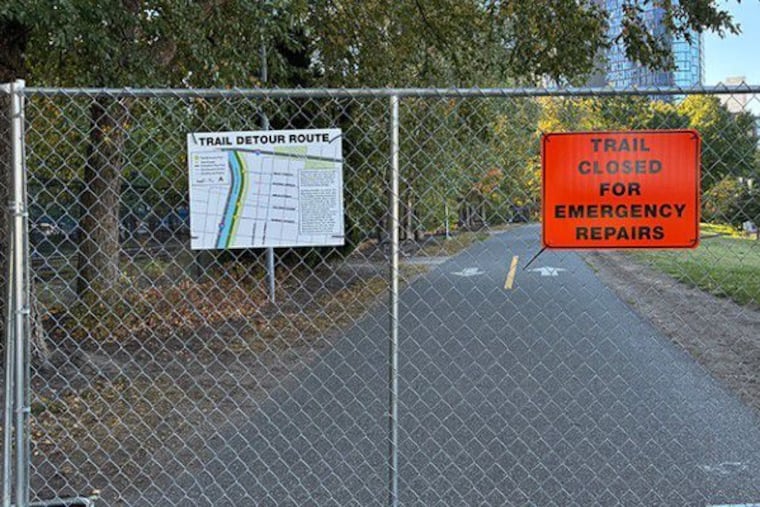
A sinkhole that shut down a segment of the popular Schuylkill Banks trail in Center City in October remains unrepaired, though work could begin early in the new year — if weather allows.
Joe Syrnick, executive director of the Schuylkill River Development Corp. (SRDC), a nonprofit that has driven the revitalization of the section of the Schuylkill River Trail known as Schuylkill Banks, said he expects repairs to start soon, though he could not offer a firm timeline.
The trail has been closed between Race Street and JFK Boulevard, just north of the SEPTA Bridge, after a “chasm”-sized void opened beneath the asphalt.
According to Syrnick, the city Streets Department will handle the repairs. The hole presented a challenge, Syrnick said, because of its size and position next to the river.
A representative for the Streets Department could not be reached Monday for comment.
Syrnick explained that the sinkhole has been far from a simple fix.
» READ MORE: You could park a car down there’: Sinkhole closes part of Schuylkill Trail in Center City
“It took a while to figure out the problem and develop a solution,” Syrnick said. “There were several dye tests and a drone flight into the sewer channel and visual observation from topside.”
The problem stems from a steel bulkhead that was built for the trail in 1995 to extend land farther into the river and create more parkland, he said.
Gaps developed in a seal between the bulkhead and concrete sewer infrastructure. It’s unclear, Syrnick said, whether those gaps occurred at the start or developed over time.
Regardless, the gaps allowed soil to seep away as the tide ebbs. Over the decades, enough soil was washed away “to create a sizable hole,” he said.
The gaps had to be sealed before anything else could be done.
So the job became more than just filling a hole. Recent progress has been halted by weather, especially recent cold and snow.
“City workers need two to three days of moderate temperatures and no rain to pour the concrete and let it cure,“ Syrnick said. ”After that, the hole has to be backfilled and paved.”
However, holidays also present a staffing issue, Syrnick said.
“In a perfect world,” he said, “the trail would be open by New Year’s or a short time after.”
