Courtroom recordings raise questions about Judge Scott DiClaudio’s testimony in probe of whether he tried to influence case
Judge Scott DiClaudio is suspended without pay amid allegations that he sought to influence the outcome of a case with ties to Philly rapper Meek Mill. He has denied the allegations.
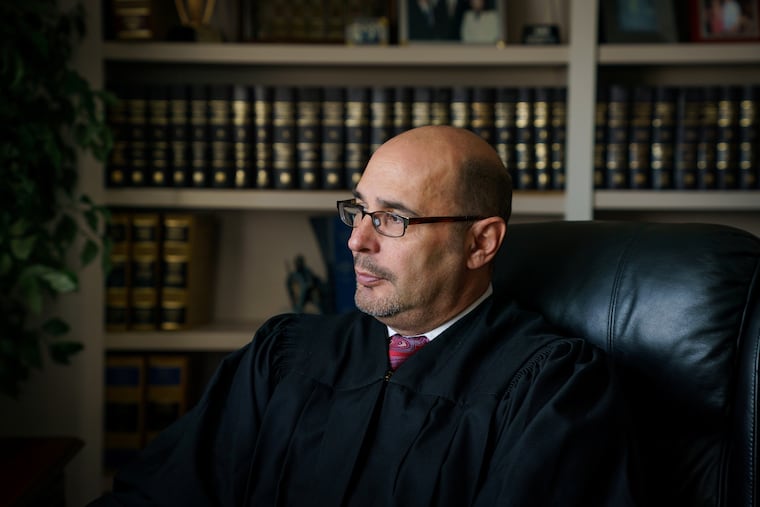
When Common Pleas Court Judge Scott DiClaudio sat before the Court of Judicial Discipline in October and answered questions under oath about whether he sought to influence a colleague’s decision in a case, he denied having summoned the fellow judge to his Philadelphia courtroom.
DiClaudio said he did not ask Judge Zachary Shaffer to come see him that day in June. Shaffer, he said, showed up unannounced.
“I was unaware that day he was going to walk in,” DiClaudio said. “He was unannounced and unexpected.”
But a recording captured by digital audio systems inside DiClaudio’s and Shaffer’s courtrooms and obtained by The Inquirer calls that account into question.
According to the recording, DiClaudio asked his assistant, Gary Silver, to contact Shaffer on the morning of June 12.
“Is Judge Shaffer on the bench right now?” DiClaudio asked his court staff around 11 a.m., according to the recording. “Can you call down there and see if he’s still on the bench, please?”
A few minutes later, according to a recording from the digital system inside Shaffer’s courtroom, Silver visited Shaffer.
“1001 wants to see you,” Silver told the judge, referring to the number of DiClaudio’s courtroom, according to the audio.
The recordings raise questions about DiClaudio’s sworn testimony before the disciplinary panel as he faces charges from the Judicial Conduct Board that he sought to influence Shaffer’s handling of a gun case involving a defendant with ties to Philadelphia rapper Meek Mill.
Elizabeth Hoffheins, deputy counsel for the Judicial Conduct Board, said during the hearing that DiClaudio’s conduct was so egregious that it brought the judiciary into disrepute.
DiClaudio has denied that he sought to influence Shaffer’s decision-making and said his colleague misunderstood his words and intentions on that day. He has been suspended without pay as the disciplinary case proceeds.
DiClaudio’s attorney, Michael van der Veen, declined to comment on the recordings and said the judge had done nothing wrong.
“It would not be appropriate to comment about alleged secondhand partial evidence in an ongoing matter,” van der Veen said in a statement Monday. “It remains very concerning that there are continual leaks of information somewhere in this process. As from the beginning, my client professes his innocence.”
The conversations were captured on a digital audio recording system embedded in dozens of courtrooms across Philadelphia to aid in the transcription of testimony and proceedings. The systems, which have been in city courtrooms since 2003, can be turned on and off between hearings at the discretion of court reporters, who transcribe hearings.
On the morning of June 12, inside courtrooms 1001 and 905, the systems captured the brief side conversations of the judges and their staff.
At the hearing in the Court of Judicial Discipline, Shaffer testified that he was seated in his ninth-floor courtroom when Silver, DiClaudio’s assistant and a former defense attorney, came in and said DiClaudio wanted to see him.
Shaffer said that during that week in June, he and his court clerk, Nicole Vernacchio, had been in touch with DiClaudio about buying T-shirts from DiClaudio’s wife’s cheesesteak shop.
About 45 minutes after Silver came by, he said, they went up to DiClaudio’s 10th-floor room, assuming the shirts were ready to be picked up.
They met in DiClaudio’s robing room and talked for about 10 minutes before DiClaudio asked Vernacchio to leave the room, he said. Vernacchio also testified that the judge asked her to step out.
After she left, Shaffer said, DiClaudio pulled out a piece of lined paper with “Dwayne Jones, courtroom 905, and Monday’s date” written on it.
DiClaudio held it out at his side, he said, then looked at him and said, “OK?”
Shaffer said he was confused, and hesitantly said, “OK.”
Then, he said, DiClaudio ripped up the paper and threw it away.
The judges then spoke casually about unrelated topics for a few minutes, he said. As he started to leave, Shaffer said, DiClaudio told him, “‘You probably would have done the right thing anyway.’”
Shaffer said he was shocked. He believed DiClaudio was suggesting that he should give a favorable sentence to Jones, who was scheduled to appear in front of him in a few days on illegal gun possession charges connected to a fatal shooting.
The next morning, Shaffer said, he reported the conversation to his supervisors, and they referred the matter to the Judicial Conduct Board. He recused himself from Jones’ case.
Court administrators placed DiClaudio on administrative leave amid an investigation into the matter.
In September, the Judicial Conduct Board charged DiClaudio with multiple ethical violations, saying his actions on that day represented “conduct that was so extreme that it brought the judicial office itself into disrepute.”
At the October hearing, held to determine whether DiClaudio should be suspended without pay amid the ongoing inquiry, DiClaudio took the stand and vehemently denied Shaffer’s version of events.
He said he had met Jones at The Roots Picnic on June 1. During a brief conversation, he said, Jones mentioned that he had a gun case in front of Shaffer, and gave DiClaudio his business card.
“I eventually say, ‘Judge Shaffer is a good judge. He does the right thing,’” DiClaudio said he responded. “He gives me his card. I put it in my cell phone case. Then he leaves, never to be seen again.”
He’d forgotten about the conversation, he said, until he saw Shaffer on June 12 and remembered he still had Jones’ business card. He took out the card and relayed the conversation he’d had with Jones before tossing it into the trash, he said.
“I was relating the story to Judge Shaffer to give him a compliment,” DiClaudio said. “I wasn’t trying to influence a case.”
He also denied asking Vernacchio, the clerk, to leave the room.
Van der Veen asked DiClaudio whether he asked Shaffer to come to his courtroom.
“Never,” he said.
Van der Veen told the disciplinary panel that he and DiClaudio had never before heard Shaffer’s contention that his fellow judge had summoned him for a conversation and said it was “shocking.” And he noted that there was no mention of such a request in the summary of Shaffer’s interview with the investigator from the disciplinary board.
(Shaffer, for his part, insisted that he told the investigator DiClaudio had asked him to come to his courtroom. He said he did not review the summary of his conversation with the investigator before it was shared with the board and DiClaudio and his lawyer, and said the report was incomplete and in some ways inaccurate.)
Van der Veen seized on the omission. He suggested that the assertion that DiClaudio had called Shaffer to his courtroom was a “new fact” belatedly raised to support his contention that DiClaudio had sought to influence him.
“Otherwise‚" the lawyer said, “it is completely nonsensical. If you’re going to come to the theory of the prosecutors, that this was … clandestine, premeditated, and designed by Judge DiClaudio, that’s completely false if Judge DiClaudio didn’t call for the meeting.”
Hoffheins, the attorney for the Judicial Conduct Board, told the disciplinary panel DiClaudio orchestrated the meeting with Shaffer to seek a favorable sentence for Jones. The judge did so, she said, because Jones is a friend of Meek Mill. DiClaudio is also a friend of Mill’s, and has worked with him on criminal justice reform issues related to the rapper’s nonprofit.
“The nature of misconduct here is not a technical misstep. It is an abuse of judicial privilege,” she said of DiClaudio’s actions. “It was made behind closed doors, and it was an attempt to tilt the scales of justice for a personal acquaintance.”
The judicial officers on the disciplinary court agreed that the allegations were consequential. In November, they suspended DiClaudio without pay.
The case now awaits a trial before the disciplinary tribunal. If the panel finds that DiClaudio violated judicial ethics or constitutional rules, he could be censored, fined, or removed from office.
DiClaudio was elected to Philadelphia’s Court of Common Pleas in November 2015, and took the bench in January 2016. In recent years, he has mostly heard cases filed by people seeking to have their murder convictions overturned.
He has presided over many high-profile exonerations and wrongful-conviction cases and approved the release or resentencing of dozens of people who had been serving life in prison.
Over the last decade, he has faced multiple inquiries from the Judicial Conduct Board.
In 2020, the Court of Judicial Discipline determined that he violated the code of conduct for judges when he failed to report debts on annual financial disclosure forms and repeatedly defied a judge’s orders to pay thousands of dollars in overdue bills to a Bala Cynwyd fitness club. He was suspended for two weeks, and placed on probation through 2026.
Then, in April of this year, the board filed charges against DiClaudio for allegedly using his position as a judge to promote his wife’s cheesesteak shop. In so doing, the board said, he had eroded public trust in the judiciary and abused the prestige of the office for personal gain. DiClaudio has denied the allegations, and the case is pending before the disciplinary court.
DiClaudio was reelected to another 10-year term last month, though he has publicly discussed retiring after the New Year.