The arts season is about to begin. Will cuts to SEPTA mean a loss of audiences?
Audiences, performers, students, arts and culture workers all take public transit to get to arts venues. SEPTA's cuts pose a 'critical setback' to the city's arts and culture sector.
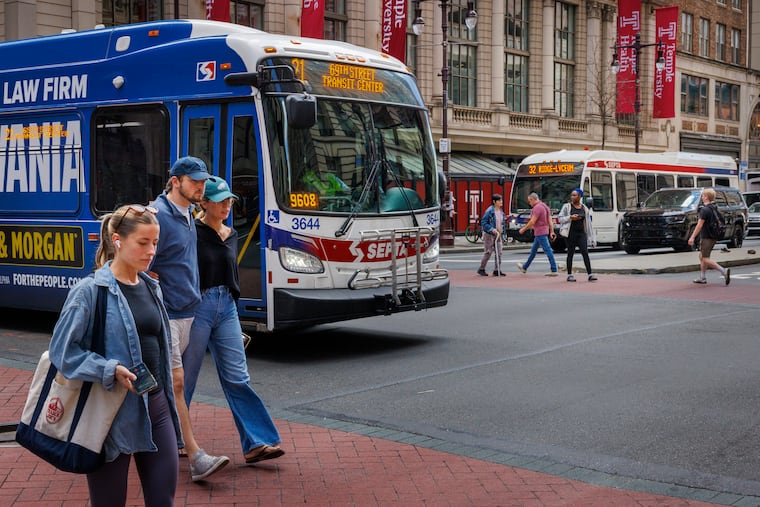
You can see what’s at stake almost any day of the week: Dance students hopping into the subway to and from classes in pointe and pas de deux, ushers and docents on buses to theaters and museums, and Broadway fans taking Regional Rail home after shows.
As cuts to SEPTA service disrupt the livelihoods of healthcare workers and the smooth running of restaurants and other businesses, so do they threaten Philadelphia’s arts and culture sector.
SEPTA, the nation’s sixth-largest public transit system, is facing a $213 million operating deficit for the 2026 fiscal year, which began July 1. State legislators remain at a stalemate over funding. This week, SEPTA enacted a 20% service cut on buses, subways, and trolleys. Next week, the number of midday trains will be slashed across all lines alongside a fare increase that raises the base one-way rate to $2.90.
» READ MORE: SEPTA cuts have gone into effect. Here’s what to know.
Arts leaders fear that longer and more expensive trips to concerts and exhibitions will take a bite out of ticket sales just as the curtain is about to rise on the 2025-26 arts season.
No one knows exactly how much attendance might suffer, but a recent Greater Philadelphia Cultural Alliance survey found that more than a fifth of theatergoers take public transportation. What if that slice of the audience didn’t show up this fall?
“It’s not 60%, but boy, 20% would be a hit,” said Amy L. Murphy, managing director of the Arden Theatre Company.
‘Essential infrastructure’
Even as leaders wait to see what the impact is, one cut is already being felt.
SEPTA’s Mann Loop was eliminated as of Sunday, severing a direct route from Center City to and from the Mann Center in Fairmount Park. The service had been popular enough to add a second bus on some nights, said Mann president and CEO Catherine M. Cahill in a statement.
“We are among many who are negatively impacted by these cuts, and we urge state officials to approve the necessary public transit funding to restore these vital services,” she said.
Some arts patrons may choose to drive instead, but many don’t own a car, which could put arts and culture experiences beyond reach.
SEPTA “makes it possible for everyone to participate in the city’s cultural life — it is an essential infrastructure for the continued vitality of Philadelphia,” said Ryan Fleur, president and CEO of the Philadelphia Orchestra and Ensemble Arts. “You can’t be a great city or a major city without meaningful public transport, and we know when we look at systems around the world, public transport requires a subsidy.”
That subsidy pays dividends, leaders say. A robust public transportation system is “part of the puzzle of putting together a healthy and thriving creative economy,” said Patricia Wilson Aden, GPCA’s president and CEO. “Public transit is essential to ensuring that the region’s $4.1 billion creative economy continues to thrive and grow.”
The prospect of making trips to arts and culture events harder and more expensive compounds challenges already faced by the sector. Some groups not only are still struggling to recoup attendance lost during the pandemic, but are also reeling from the recent cancellation of federal funding from the National Endowment for the Arts, National Endowment for the Humanities, and Institute of Museum and Library Services.
“Live performances in theaters have just started to rebound from COVID, so to have an instance where their audiences can’t have access to theater experiences would disrupt the rebound that we’ve seen,” Aden said. “To have this essential service pulled out from under us would be, I think, a critical, critical setback.”
Impacts on workers and students
Another constituency likely to be challenged by service cuts is arts and culture workers.
Halcyone Schiller, president of Philadelphia cultural workers union AFSCME Local 397, said the cuts would make for a tougher commute for many, including Philadelphia Museum of Art staffers, the majority of whom cannot afford to live in the neighborhoods near the museum.
“It’s going to make a large difference for workers. Most of the [bus] lines around the Art Museum are getting cut or reduced.”
Spending more on getting to work is “definitely on people’s minds,” Schiller said. “At what point is it a losing proposition? It cuts into already-depressed wages.”
The problem may be particularly acute after hours. An estimated 700 Philadelphia nighttime arts and culture workers commute using public transportation, according to a recent Econsult Solutions Inc. analysis.
“When you think about an actor getting out at 10:30 at night, you don’t want to sit waiting for a bus two hours, but I think that’s what we’re looking at,” Murphy said.
SEPTA plans to impose a 9 p.m. curfew on rail service in January as part of a second round of service cuts, if funding from Harrisburg is not secured.
Students, too, will be among those left scrambling for alternatives.
“We know this is going to have a huge impact on our families, either because it’s going to take much more time for them to travel or affect students’ ability to get to our branches independently,” said Helen Eaton, CEO of the Settlement Music School, where the new semester starts Tuesday.
And it’s not just budding young Questloves and Mario Lanzas who will be challenged to get to one of the school’s five sites. About 12% of Settlement’s 5,000 students are adults, “and we have a lot of people in the 65-plus category, and most of them take public transportation,” said Eaton.
Wait-and-see approach
Transportation is a major issue for many arts lovers. More than a third of respondents (37%) to a GPCA survey cited limited transit options or parking as barriers to attending arts events more often. In a survey of patrons at 10 theaters in the five-county region in Southeastern Pennsylvania, 22% of respondents said they used public transportation to get to the performance.
Robin Mitchell-Boyask, a Mount Airy resident who uses public transportation to get to Philadelphia Orchestra performances, is taking a wait-and-see approach before deciding whether to pull back on concerts. The cuts in service, he points out, are falling upon a public transit network whose service was not exactly bountiful to begin with.
“The whole system, because it is so underfunded, has never run as robustly as it should. The arts were probably being hurt by this already without realizing it.”