The Trocadero Theatre’s reopening has been rumored for years. But its future is unclear.
The theater at 10th and Arch that we lovingly call The Troc closed in 2019.
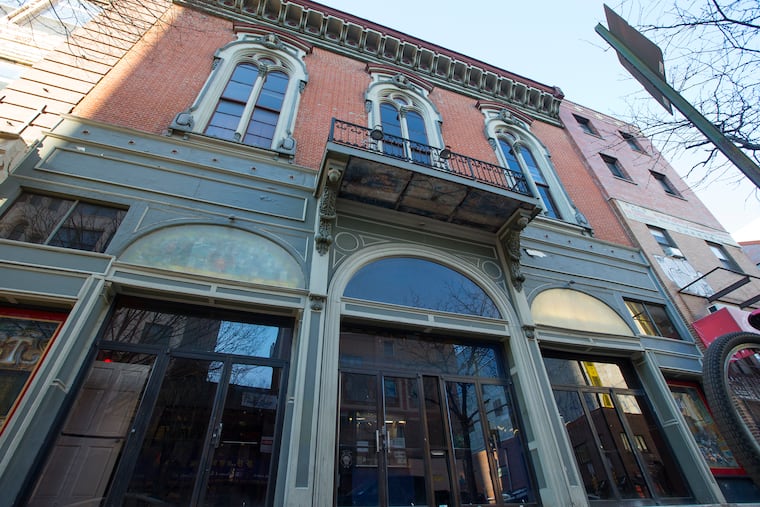
For a certain generation of aging punk rockers, metalheads, and hipsters, there is arguably no more formative a live music venue in Philadelphia than the Trocadero Theatre.
It was, for decades, one of the strongest beating hearts of the city’s alternative music scene, bringing scores of now-legendary artists to Chinatown to sonically assault its 1,200-strong crowds. Sonic Youth, Radiohead, Wilco, Hole, Pearl Jam, Soundgarden, Fugazi — all of them and more graced the venue’s storied stage at one time or another, many of them multiple times. Bob Dylan, too.
Zombie Proms, movie nights, battles of the bands, and countless dance parties called it home over the years. Bam Margera and the late Ryan Dunn dived from its ornate, Victorian balconies into a sea of concertgoers in the early 2000s in what became iconic images for CKY and Jackass fans. And in 2014, comedian Hannibal Buress launched into a bit on its stage that would, astoundingly, lead to Bill Cosby’s imprisonment on a now-vacated sexual assault conviction.
But in 2019, all that came to a halt. One day in late August, the Big Mess Cabaret performed the Trocadero into history, the venue shut its doors, and it appeared one of Philadelphia’s great showplaces was gone for good.
Now, six years and several rumors later, what is happening with the theater at 10th and Arch Streets that we lovingly call the Troc? That’s what one reader asked via Curious Philly, The Inquirer’s forum for questions on all things local.
» ASK US: Have something you’re wondering about the Philly region? Submit your Curious Philly question here.
No developments yet
The Trocadero’s fate remains unclear. Stephen Pang, who bought the building in the late 1970s, declined to be interviewed. His daughter Joanna, who led operations for decades before the venue’s closing, could not be reached for comment.
An expected return of the Troc in some form, however, has been on music lovers’ radars since 2022. Late that year, news broke that Northwest Arch LLC, the legal entity that technically owns the Trocadero, secured a $2.5 million grant through Pennsylvania’s Redevelopment Assistance Capital Program to revamp and potentially revive the venue. But while the Trocadero was awarded the grant, it so far has not used it, according to program documents reviewed by The Inquirer.
“We can confirm that a RACP grant was awarded in 2022, but the subgrantee [Trocadero] has not yet completed the documentation or drawn down any related funds,” said Lawrence McComie, senior vice president and chief credit officer at the Philadelphia Industrial Development Corp., which administers the grant contracts awarded by the state.
The initiative serves as a reimbursement program, so grantees essentially have to front the money for eligible work before seeking funds to cover their incurred costs. And, before doing that, a number of documents must be submitted to the state — a stage that appears not to have been reached here. No agreement has been signed and enacted regarding the Trocadero’s grant, and there is currently no formal timeline for its use, a representative of Gov. Josh Shapiro’s administration said.
As a result, at least as a music venue, the Troc at this point seems to remain in stasis, and Philadelphia continues to await its return. But when that will come exactly is anybody’s guess.

Burlesque hall ‘bumped into oblivion’
As a building, however, the Trocadero has existed a lot longer than it has been closed — 155 years to be exact. Built by architect Edwin F. Durang, a prominent designer of East Coast churches, it opened officially on Aug. 29, 1870, as the Arch Street Opera House.
Contrary to its name, the venue specialized initially in minstrel shows, musical comedies, and vaudeville. By 1896, it would be renamed the Trocadero Theatre, and several years after that, its focus became burlesque shows — and that remained so for about 75 years.
That burlesque incarnation was “bumped into oblivion” in early 1978, as the Daily News put it at the time. That year, it was added to the National Register of Historic Places, and it was already considered a historical gem for the region.
Stephen Pang became the Troc’s owner in 1979, and set about remodeling it and repurposing it into something of a Chinese cultural arts center and martial-arts movie showhouse. That year, he also rented it out to organizations including the Pennsylvania Opera Theater, which likely performed the first actual opera in the building with a rendition of The Barber of Seville, according to a 1991 Inquirer report.

The Troc’s rock era
By 1986, the Troc again transformed. This time, the change was led by Rick Blatstein, then a nightclub impresario known for spots like the Empire Rock Club. He headed up remodeling the building into a rock venue and, alongside a young Stephen Starr, began booking acts.
The first show came that March with a performance by guitarist-singer Nils Lofgren and folk-rocker Steve Forbert. According to The Inquirer, however, the Troc’s remodel was so good — much of the building’s glorious old architecture was left intact — the two performers were “upstaged by their venue.”
Blatstein remained at the helm until 1991, when David and Stephen Simons, of Khyber Pass Pub fame, took over. The pair set their sights on the popular alternative music scene of the day, with an eye toward groups like Fugazi and the Butthole Surfers, as well as hip-hop acts like De La Soul. They also worked out an all-ages main floor and 21-and-up balcony seating, marking Philly’s first all-ages club in which liquor was served, according to an Inquirer report.
That lasted until 1996, when the Troc briefly closed after a Halloween show. Fittingly, that last performance came from legendary New Jersey horror punks the Misfits.
Inquirer reports from the time indicate that David Simons and his partner, booker Jo Nguyen, planned to relocate to the West Coast, and Stephen Pang declined to renew their lease at the Trocadero. Instead, Pang planned to continue operating the venue as a rock room, but with his daughters, Joanna and Julianna, at the helm — now with a wider focus to compete with the day’s larger, more dominant concert promoters.
“This place has been a part of Philadelphia for so many years,” Joanna Pang told The Inquirer at the time. “We want to continue to be a part of that.”
‘This was home to me’
For more than two decades, they did — but it was not without struggle. In 2011, the Troc’s leadership filed for bankruptcy protection, citing “burdensome” contracts with Ticketmaster that ate into profits, and it successfully restructured in 2012.
But in the ensuing years, the Troc had difficulty finding its place in the region’s club scene, which was packed with similarly sized rooms, many with large corporate backers, all competing for similar audiences. In the city alone, there were the Theatre of the Living Arts, World Cafe Live, and Union Transfer, as well as venues out in the burbs like the Keswick Theatre. Buzz around the Troc’s shows, it seemed, continued to fizzle as the years wore on.
And in March 2019, news broke that its closure was impending.
“This was home to me,” Joanna Pang told Variety. “But the landscape of the business has changed in the last five years. It’s harder now to be an independently run venue — it’s a different world.”
The end, at least, was relatively quick. After a few months of lament and remembrance, it was over by June. Now, we are left with the hope that architect George Plowman, who developed the Troc’s site plan in 1896, expressed in an Inquirer interview way back when.
“The Trocadero,” he said, “will be a very handsome place of amusement.”